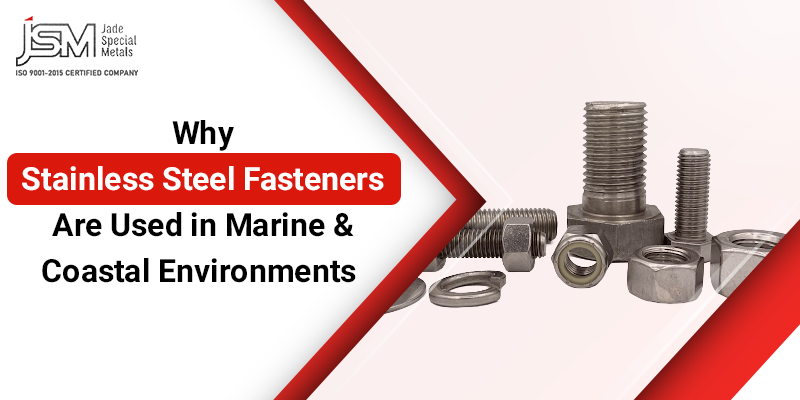
One of the toughest conditions that any construction material can encounter is saltwater and a coastal environment. The regular contact with the salt spray, humidity, and changes in temperatures encourages the corrosion and makes regular carbon steel fasteners rust, weaken, and become useless more quickly than expected. The occurrence of fastener failure is not a matter of maintenance in the boats, jetties, docks, offshore platforms, and coastal buildings; it is a significant structural safety hazard capable of causing both expensive repairs and devastating damage. That explains why the stainless steel fasteners are regarded as a non-negotiable option in the construction of the marine and coastal facilities. Stainless steel fasteners are specially made to resist corrosion, pitting and chemical attack in the marine areas where ordinary steel cannot be used. Then it becomes very important for the marine contractors, boat builders, and coastal infrastructure engineers to choose appropriate stainless steel fasteners that can be used to guarantee lasting durability, safety and long service life in the harsh saltwater conditions.
Why Marine and Coastal Environments Are Extremely Corrosive
Marine and coastal settings are highly corrosive because of the continuous occurrence of chlorides in the seawater, which violently attack metals and dissolves its protective oxide layer. The ions of chloride penetrate the surface of the fasteners and structural elements, making the rust progress faster and causing pitting and crevice corrosion. At the coast, corrosion does not just occur in those regions that have direct contact with the seawater. The salt spray and airborne chloride may travel many miles into the interior, corroding the portions of the surfaces that are exposed to the air. Corrosion is also determined by the conditions of exposure. Completely submerged parts are corroded in a steady manner; however, the most active processes are in the splash zone, where the salt deposits are concentrated, and the most rapid corrosion takes place. Also, saltwater leads to high chances of galvanized corrosion in case dissimilar metals are used in combination, where the less noble metal is easily corroded. All these factors combined can render the marine environment highly destructive to normal steel fasteners.
Why Stainless Steel Fasteners Are Essential for Marine Applications
Marine applications are built with the use of stainless steel fasteners because they are designed to endure extreme conditions like saltwater and coastal environments. Their major benefit is that they develop a chromium oxide passive layer on the surface, which serves as a protective layer against corrosion, and it heals itself in case the surface is scratched or damaged. Stainless steel also has a longer lifecycle compared to carbon or galvanized steel fasteners, because it does not degrade in a short period under salt environments like a smart investment, though the initial cost is higher since the lifecycle cost of stainless steel is much less, since it does not need maintenance and replacement. Aesthetics are also maintained because stainless steel fasteners do not leave undesirable rust stains on boat hulls, decks, and coastal buildings. Moreover, their good strength-to-weight ratio makes them suitable for marine hardware where sound fastening without any extra weight is essential to the safety, performance, and durability.
Understanding Marine-Grade Stainless Fasteners: 316 vs 304
When it comes to choosing the right stainless steel grade for a marine application. Then it’s become an important topic to know before you buy any grade. The most common and popular grades are 304 and 316 Stainless Steel, and the comparison between them and their information is given below.
- 304 Stainless Steel: The 304 Stainless steel is commonly used in the form of nuts and bolts for a general outdoor environment. But when it comes to marine environmet where diect contact with salty spray and coastal humidity makes it less suitable for long-term exposure in the marine environments.
- 316 Stainless Steel: The 316 stainless steel bolts and nuts commonly referred to as the marine-grade stainless steel, include 2-3% molybdenum, which is very effective in improving chloride attack, and pitting corrosion. This renders it appropriate to docks, boats and shore buildings. There are many grades, like A193 B8M Bolts, ASTM F593 Bolts, and ASTM F594 Nuts, which are typically used for marine specifications.
- 304 vs 316 Rule of Thumb: Where your project is within 5 miles of the ocean or in contact with saltwater, then it is always advisable to use 316 stainless fasteners because they are longer lasting in both durability and lifecycle performance.
| Grade | Key Alloy Element | Saltwater Resistance | Best Use Case |
| 304 (18-8) | 18% Cr, 8% Ni | Moderate (Can pit) | Cabin interiors, freshwater boats |
| 316 (Marine) | 16% Cr, 10% Ni, 2% Mo | Excellent (Resists chlorides) | Hull fittings, docks, offshore rigs |
| Carbon Steel | None (Iron/Carbon) | Poor (Rsts rapidly) | Indoor / Painted structures only |
ASTM F593 Bolts and F594 Nuts: Marine Fastener Standards
ASTM F593 Bolts are the standard specification of stainless steel bolts, hex cap screws, and studs that are intended to be used in environments resistant to corrosion, which is very applicable in the marine and coastal settings. Typical examples of stainless grades that are covered by this standard are 304 and 316, which have standard chemical composition, mechanical strength, and dimensional accuracy. The complementary specification is ASTM F594 Nuts that are intended to be used with F593 bolts to ensure that the load distribution and joint integrity in stainless steel bolting assemblies are correct.
Condition A (Annealed) in these standards is fasteners that are supplied in a more ductile condition, and have an excellent corrosion resistance, whereas Condition CW (Cold Worked) is higher tensile strength by strain hardening, most preferred in structural marine applications. The use of ASTM F593 bolts and ASTM F594 nuts is important in marine commercial projects because it complies with engineering standards, enhances integrity during salt exposure and minimizes insurance, inspection, and liability exposure during fastener failure.
A193 B8M Bolts for High-Performance Marine Applications
ASTM A193 B8M is a high-performance stainless steel fastener. It was developed to serve in high-temperature and high-pressure service and is most typically utilized in piping systems and flange connections. A193 B8M bolts are chemically identical to 316 stainless steel and have much more rigorous mechanical testing and quality control than general hardware-grade stainless fasteners, and are therefore suitable in strenuous marine environments. They are also common in marine engine rooms, offshore platforms, and coastal oil and gas installations, where resistance to chloride corrosion and stress cracking is extremely important.
In this, Class 1 A193 B8M bolts are solution-annealed and offer excellent corrosion resistance to typical marine piping applications, whereas Class 2 bolts are strain-hardened to attain much greater strength to important joints subjected to vibration and high loads. The use of A193 B8M bolts in marine constructions guarantees the observance of industrial standards, enhanced reliability during prolonged operation in the environment of sea salt, and decreased probability of failure in case of A193 B8M, comparable to non-certified stainless steel fasteners.
Complete Marine Fastening Systems: Stainless Steel Bolts and Nuts
The whole marine and coastal environment depends on the function of stainless steel fasteners and not on individual bolts and nuts. It is essential that grades should be matched, i.e., 316 stainless steel bolts should be matched by 316 stainless steel nuts and this will offer uniform corrosion resistance and strength in the presence of salt water. Inappropriate mismatched grades that are not used in a prudent manner may cause uneven corrosion and shorten the service life of the joints, particularly in the continuously wet or splash zone environments.
Galling is another important issue, in which the threads of the stainless steel disappear during the tightening process through friction and sticking of the steel. The mitigation of this risk can occur through the use of anti-seize lubricants, controlled speeds, and even in certain instances, it can be achieved by a careful combination of grades like a 316 bolt and a 304 nut. Marine assemblies also need washers: fender washers are used to distribute the load on softer materials, lock washers are used to avoid loosening due to constant vibration. These components should be used together to guarantee long-term marine application safety and performance.
Applications: Where Stainless Fasteners Are Used in Marine Environments
Marine environments have a large usage of stainless steel fasteners to guarantee that they are resistant to corrosion, maintain structural integrity, and are long-lasting when subjected to continuous exposure to saltwater and moisture. So some of the most common places where stainless steel fasteners are use is given below.
| Application | Environment | Recommended Grade |
| Boat Hull Fittings | Submerged / Splash Zone | 316 Stainless |
| Deck Railings (Inland) | Atmospheric Moisture | 304 Stainless |
| Offshore Rig Structure | Extreme Salt / High Load | A193 B8M / Duplex 2205 |
Installation Best Practices for Marine Stainless Steel Fasteners
To install the fasteners in any application or structure, it has become a very crucial part that will determine the longshelf life of that particular structure. So that’s why use the proper procedure to install it that is listed below.
- Isolation between Dissimilar Metals: In mounting stainless steel fasteners on aluminum hulls, decks, or frames, plastic or nylon washers, sleeves or bushings should always be used. This physical distance inhibits galvanic corrosion, which is normal when it occurs in saltwater and dissimilar metals react, leading to an accelerated process of material loss.
- Proper lubrication: Treadding under the load, stainless steel bolts and nuts tend to gall. The use of an anti-seize paste of marine grade, like Tef-Gel or Lanocote, helps to minimize friction and provides ease of tightening and easy future removal without thread damage.
- Correct Torque Application: Excessive tightening of stainless steel fasteners may result in thread damage and disruption of the protective coating of chromium oxide, which gives corrosion resistance. Adhere to recommended joint integrity by using calibrated instruments and following recommended torque values.
- Standard Cleaning and Maintenance: The stainless fasteners, even the corrosion-resistant ones, are good with frequent freshwater sprays. Removal of salt deposits and contaminants aids in preserving surface passivation and increases service life in severe marine service.
Common Mistakes to Avoid with Marine Fasteners
Some of the most common mistakes people make using the stainless steel fasteners can cause significant damage to their componets or structure. So here are the common mistakes given below, so read them and try to avoid them.
- Using 304 Stainless Steel Below the Waterline: Although 304 stainless steel is used in general outdoor applications, it cannot be exposed to a salty environment at all times. Its lower portion is extremely susceptible to chloride pitting, resulting in unexpected and unnoticed breakage of the fastener.
- Assuming “Stainless” Means Rust-Proof: Stainless steel fasteners do not prevent corrosion; they are resistant. Even quality stainless fasteners in the marine environment will stain, pit, or corrode unless they are selected properly, installed properly and maintained properly.
- Mixing Dissimilar Metals Without Isolation: Essentially, the installation of stainless steel bolts in galvanized or aluminum parts that are not insulated forms galvanic corrosion. Electrical isolation of various metals should always be done by the use of nylon washers or sleeves.
- Ignoring Thread Galling Risks: The stainless steel nuts and bolts need proper lubrication during the installation process. Without proper lubrication, stripped threads or any broken bolts can cause expensive damage and downtime.
Conclusion
Although the stainless steel fasteners are a little bit expensive in the short run, they are the only option in the marine and coastal areas. They have higher corrosion resistance, strength, and durability, and have long-term performance where normal steel or coated fasteners break. That’s why Jade Alloys provides high-quality stainless steel fasteners that can be easily used in saltwater. 316 stainless steel is the one that should be used, as it provides a great resistance to the pitting caused by chloride. Further longevity and safety are increased with proper installation, such as isolation between dissimilar metals, anti-seize lubrication, proper torque, and washers. The quality stainless fasteners will be cost-effective in terms of maintenance, structural failures, and will provide great cost savings in the life of the project.
Frequently Asked Questions (FAQ)
1. What are the types of bolts?
There are many types of bolts, and each is made for a specific purpose. Some common ones include hex bolts, carriage bolts, eye bolts, anchor bolts, U-bolts, and flange bolts. The right choice depends on where and how the bolt will be used in construction, automotive work, or machinery.
2. What is a type 8 bolt?
A “type 8 bolt” usually means a Grade 8 bolt in the imperial system. These are high-strength bolts made from hardened steel and are commonly used in heavy-duty applications like trucks and industrial equipment.
3. Are class 8.8 bolts strong?
Yes, Class 8.8 bolts are considered strong. They are high-tensile metric bolts and are widely used in structural and mechanical assemblies where good strength is required.
4. How to identify bolt grade?
You can identify a bolt’s grade by looking at the markings on its head. Imperial bolts use radial lines (for example, six lines usually indicate Grade 8), while metric bolts have numbers like 8.8 or 10.9 stamped on them.
5. What does M10 bolt mean?
An M10 bolt is a metric bolt with a 10 mm diameter. The “M” stands for metric, and “10” tells you the thickness of the bolt’s shank in millimeters.