What Are ASTM A320 Grade L7 Bolts?
ASTM A320 Grade L7 is a standard material specification for alloy steel bolting materials intended for pressure vessels, valves, flanges and fittings operating at low and cryogenic temperatures. Unlike high-temperature bolting specifications, A320 L7 mandates Charpy V-notch (CVN) impact testing at -101°C (-150°F) to verify adequate notch toughness making it the go-to bolting grade for LNG terminals, cryogenic storage and cold-climate petrochemical installations.
L7 vs B7 — the critical difference: Both grades use the same 4140 Cr-Mo alloy steel base with identical tensile requirements. The difference is that the Charpy impact test is required in A320 L7 at -101°C, but not required in A193 B7, which is designed for use in high temperatures.
Grade L7 fasteners are produced from AISI 4140, 4142, 4145, 4140H, 4142H, or 4145H chromium-molybdenum alloy steel, quenched and tempered at a minimum of 593°C (1100°F). Jade Alloys stocks and manufactures Grade L7 stud bolts, hex bolts, heavy hex bolts, double-end studs and threaded rods from ¼ inch to 4 inches in diameter. Every shipment is accompanied by full mill test reports (MTR), Charpy impact test certificates and export grade documentation.
| Base material | AISI 4140 Cr-Mo |
| Tensile (≤65mm) | 860 MPa |
| Application | High temp. (up to ~370°C) |
| Impact test | Not required |
| Nut match | A194 Gr. 2H |
| Base material | AISI 4140 Cr-Mo |
| Tensile (≤65mm) | 860 MPa |
| Application | Low temp. (down to -101°C) |
| Impact test | Mandatory CVN @ -101°C |
| Nut match | A194 Gr. 7 |
Chemical Composition of ASTM A320 Grade L7 Bolts
ASTM A320 L7 is produced from chromium-molybdenum alloy steel corresponding to AISI 4140, 4142, 4145, 4140H, 4142H, or 4145H. The composition below is per ASTM A320 specification.
| Element | Carbon (C) | Manganese (Mn) | Phosphorus (P) max | Sulfur (S) max | Silicon (Si) | Chromium (Cr) | Molybdenum (Mo) |
|---|---|---|---|---|---|---|---|
| Grade L7 (%) | 0.38–0.48 | 0.75–1.00 | 0.035 | 0.040 | 0.15–0.35 | 0.80–1.10 | 0.15–0.25 |
For sour-service (NACE) applications, Grade L7M permits a reduced minimum carbon content of 0.28%, allowing the use of AISI 4130 or 4130H. The intentional addition of bismuth (Bi), selenium (Se), tellurium (Te) or lead (Pb) to any L7 variant is not permitted.
ASTM A320 Grade Comparison – Chemical Composition
| Grade | Steel Type | AISI Equivalent | Carbon (%) | Chromium (%) | Molybdenum (%) | Nickel (%) | Special Note |
|---|---|---|---|---|---|---|---|
| L7 | Cr-Mo alloy steel | 4140 / 4142 / 4145 | 0.38–0.48 | 0.80–1.10 | 0.15–0.25 | — | Standard low-temp grade |
| L7M | Cr-Mo alloy steel | 4130 / 4130H | 0.28 min | 0.80–1.10 | 0.15–0.25 | — | NACE/sour service compliant |
| L43 | Ni-Cr-Mo alloy steel | 4340 | 0.38–0.43 | 0.70–0.90 | 0.20–0.30 | 1.65–2.00 | High hardenability, large diameters |
Mechanical Properties of ASTM A320 Grade L7 Bolts
Mechanical requirements vary by bolt diameter. Values below are per ASTM A320 / ASME SA320 Grade L7 in both metric (SI) and imperial (US Customary) units. Heat treatment: Quenched and Tempered at a minimum tempering temperature of 593°C (1100°F).
Metric (SI) — ASTM A320 Grade L7
| Diameter | Min. Tempering Temp. | Tensile Str. Min (MPa) | Yield Str. Min 0.2% (MPa) | Elongation 4D Min (%) | Reduction of Area Min (%) | Hardness Max |
|---|---|---|---|---|---|---|
| M64 and under | 593°C | 860 | 725 | 16 | 50 | 321 HBW / 35 HRC |
| Over M64 to M100 | 593°C | 795 | 655 | 16 | 50 | 321 HBW / 35 HRC |
| Over M100 to M180 | 593°C | 690 | 515 | 18 | 50 | 321 HBW / 35 HRC |
Imperial (US Customary) — ASTM A320 Grade L7
| Diameter | Min. Tempering Temp. | Tensile Str. Min (ksi) | Yield Str. Min 0.2% (ksi) | Elongation 2in. Min (%) | Reduction of Area Min (%) | Hardness Max |
|---|---|---|---|---|---|---|
| 2½” and under | 1100°F | 125 | 105 | 16 | 50 | 321 HBW / 35 HRC |
| Over 2½” to 4″ | 1100°F | 115 | 95 | 16 | 50 | 321 HBW / 35 HRC |
| Over 4″ to 7″ | 1100°F | 100 | 75 | 18 | 50 | 321 HBW / 35 HRC |
Charpy V-Notch Impact Test Requirements
The mandatory Charpy V-notch impact test is the defining feature of ASTM A320 L7 that separates it from A193 B7. This test verifies that the bolt material retains sufficient fracture toughness at cryogenic temperatures, preventing brittle failure in cold-service flanged joints.
Brittle fracture in bolted connections at low temperature is one of the leading causes of catastrophic flange leaks in cryogenic and LNG applications. The CVN requirement in A320 L7 provides engineered assurance against this failure mode. Jade Alloys provides certified CVN test reports with every L7 shipment.
Full-Size and Sub-Size Specimen Requirements
| Specimen Size (mm) | Test Temperature (°F) | Test Temperature (°C) | Min. Average (3 specimens) ft·lbf [J] | Min. Individual (1 specimen) ft·lbf [J] |
|---|---|---|---|---|
| 10 × 10 (Full size) | -150°F | -101°C | 20 [27] | 15 [20] |
| 10 × 7.5 (Sub-size) | -150°F | -101°C | 16 [22] | 12 [16] |
Note: Specimens are machined longitudinally from the bolt/stud. Testing is performed per ASTM E23. All three specimens in a set must meet the minimum average, and only one specimen of the set may fall below the average to the single-specimen minimum.
ASTM A320 L7 Bolts Specification & Dimensions
Jade Alloys supplies ASTM A320 L7 bolts to the following dimensional standards, certifications, and compliance requirements.
| Parameter | Details |
|---|---|
| Standard | ASTM A320 / ASME SA320 Grade L7 |
| Dimensions | ASME B18.2.1 (inch hex bolts), ASME B18.2.3.3M (metric hex), ASME B18.3 (socket cap) |
| Thread standard | ASME B1.1 — 2A/3A Unified Inch; ASME B1.13M — 6h Metric Coarse |
| Size range (inch) | ¼” to 4″ diameter |
| Size range (metric) | M6 to M100 |
| Length range | Custom lengths; standard 1″ to 36″ |
| Heat treatment | Quenched & Tempered — min. tempering temperature 593°C (1100°F) |
| Hardness | 321 HBW maximum / 35 HRC maximum |
| Dual certification | Dual certified as per ASTM & ASME codes |
| Sour service | NACE MR0103 / MR0175 / ISO 15156 compliance (Grade L7M) |
| PED compliance | PED 97/23/EC; Merkblatt AD 2000 W2 |
| Marking | Manufacturer’s ID mark + “L7” symbol marking |
| Finish / coating | Plain, Hot-Dip Galvanized (HDG), Black Oxide, Xylan, PTFE, Zinc Flake, Cadmium (per request) |
| Melt origin | Korea, Japan, Europe, South America (traceable MTR provided) |
Dimension Charts – ASTM A320 L7 Stud Bolts & Hex Bolts
Standard dimensions for ASTM A320 Grade L7 stud bolts and hex bolts as per ASME B18.2.1 (inch) and ASME B18.2.3.3M (metric). Custom lengths and non-standard configurations available on request.
Stud Bolt Dimensions – ASME B18.31.2 (Inch)
| Nominal Diameter (in.) | Threads per Inch (UNC) | Thread Series | Min. Body Diameter (in.) | Max. Body Diameter (in.) | Std. Thread Length (in.) |
|---|---|---|---|---|---|
| ¼ | 20 | UNC 2A | 0.237 | 0.250 | 0.75 |
| ⅜ | 16 | UNC 2A | 0.360 | 0.375 | 1.00 |
| ½ | 13 | UNC 2A | 0.482 | 0.500 | 1.25 |
| ⅝ | 11 | UNC 2A | 0.605 | 0.625 | 1.50 |
| ¾ | 10 | UNC 2A | 0.729 | 0.750 | 1.75 |
| ⅞ | 9 | UNC 2A | 0.852 | 0.875 | 2.00 |
| 1 | 8 | UN 8 2A | 0.976 | 1.000 | 2.25 |
| 1¼ | 8 | UN 8 2A | 1.223 | 1.250 | 2.75 |
| 1½ | 8 | UN 8 2A | 1.470 | 1.500 | 3.25 |
| 1¾ | 8 | UN 8 2A | 1.716 | 1.750 | 3.75 |
| 2 | 8 | UN 8 2A | 1.963 | 2.000 | 4.25 |
| 2½ | 8 | UN 8 2A | 2.456 | 2.500 | 5.25 |
| 3 | 8 | UN 8 2A | 2.950 | 3.000 | 6.25 |
| 4 | 8 | UN 8 2A | 3.938 | 4.000 | 8.25 |
Metric Hex Bolt Dimensions – ASME B18.2.3.3M (mm)
| Nominal Size | Width Across Flats (max) | Width Across Flats (min) | Head Height (max) | Head Height (min) | Body Diameter (max) | Width Across Corners (max) |
|---|---|---|---|---|---|---|
| M10 | 17.00 | 15.73 | 6.63 | 6.17 | 10.00 | 18.48 |
| M12 | 19.00 | 17.73 | 7.76 | 7.24 | 12.00 | 20.78 |
| M16 | 24.00 | 23.67 | 10.32 | 9.68 | 16.00 | 27.71 |
| M20 | 30.00 | 29.16 | 12.88 | 12.12 | 20.00 | 34.64 |
| M24 | 36.00 | 35.00 | 15.44 | 14.56 | 24.00 | 41.57 |
| M30 | 46.00 | 45.00 | 19.48 | 17.92 | 30.00 | 53.12 |
| M36 | 55.00 | 53.80 | 23.38 | 21.63 | 36.00 | 63.51 |
| M42 | 65.00 | 62.90 | 26.97 | 25.03 | 42.00 | 75.06 |
| M48 | 75.00 | 72.60 | 31.07 | 28.93 | 48.00 | 86.60 |
| M56 | 85.00 | 82.20 | 36.20 | 33.80 | 56.00 | 98.15 |
| M64 | 95.00 | 91.80 | 40.90 | 38.10 | 64.00 | 109.70 |
Available Product Types
ASTM A320 Grades Overview
ASTM A320 covers multiple alloy steel and stainless steel grades for low-temperature bolting. The table below compares the key grades to help you select the right material for your application.
| Grade | Material | Min. Test Temp. | Tensile (ksi / MPa) | Key Application | Nut Grade |
|---|---|---|---|---|---|
| L7 | 4140/4142 Cr-Mo | -150°F (-101°C) | 125 ksi / 860 MPa | General low-temp pressure vessels | A194 Gr. 7 |
| L7M | 4130 Cr-Mo (low C) | -150°F (-101°C) | 125 ksi / 860 MPa | Sour service / NACE applications | A194 Gr. 7M |
| L43 | 4340 Ni-Cr-Mo | -150°F (-101°C) | 125 ksi / 860 MPa | Large diameter, high hardenability | A194 Gr. 7 |
| B8 | 304 Stainless Steel | -320°F (-196°C) | 75–125 ksi | Corrosive / cryogenic service | A194 Gr. 8 |
| B8M | 316 Stainless Steel | -320°F (-196°C) | 75–125 ksi | Highly corrosive cryogenic service | A194 Gr. 8M |
Mating Hardware – Nuts & Washers
Correct pairing of nuts and washers with ASTM A320 L7 bolts is essential for joint integrity and code compliance, particularly in flanged pressure vessel and piping systems.
| Bolt Grade | Recommended Nut Grade | Washer Grade | Application |
|---|---|---|---|
| ASTM A320 L7 | ASTM A194 Grade 7 | ASTM F436 Type 1 | Standard low-temperature bolting |
| ASTM A320M L7 | ASTM A194M Grade 7 | ASTM F436M Type 1 | Metric pressure vessel assemblies |
| ASTM A320 L7M | ASTM A194 Grade 7M | ASTM F436 Type 1 | Sour / NACE service flanges |
International Equivalent Grades
ASTM A320 Grade L7 corresponds to several international specifications. The table below lists direct material equivalents and near-equivalent grades across major standards.
| Standard | Grade / Designation | Country / Region | Notes |
|---|---|---|---|
| ASTM A320 | Grade L7 | USA | Primary specification |
| ASME SA320 | Grade L7 | USA (ASME BPVC) | Technically identical to ASTM A320 L7 |
| AISI / SAE | 4140 / 4142 / 4145 | USA | Base steel equivalent |
| DIN EN 10269 | 42CrMo4 | Germany / EU | Similar Cr-Mo alloy composition |
| BS EN 10269 | 42CrMo4 | UK / EU | Equivalent alloy steel grade |
| ISO 898-1 | Property Class 10.9 | International | Strength class comparable; different test approach |
| JIS G4105 | SCM440 | Japan | 4140-equivalent Cr-Mo steel |
| GB/T 3077 | 42CrMo | China | Near-equivalent alloy composition |
Industries & Applications
Recommended Tightening Torque – ASTM A320 L7 Stud Bolts
The torque values below are indicative for ASTM A320 L7 stud bolts with ASTM A194 Grade 7 heavy hex nuts. Values assume a friction coefficient (K-factor) of 0.20 with no lubrication. For critical flange joints, consult ASME PCC-1 or your flange design engineer for precise torque calculations.
Important: These are reference values only. Actual tightening torque must be calculated based on bolt grade, nut hardness, lubricant type, flange surface condition, and gasket seating stress requirements per ASME PCC-1 guidelines.
| Bolt Size | Threads per Inch | Bolt Root Area (in²) | Bolt Load (Target, lbf) | Torque (Dry, ft·lbf) | Torque (Lubricated, ft·lbf) |
|---|---|---|---|---|---|
| ½”-13 | 13 | 0.1419 | 11,820 | 25–30 | 18–22 |
| ⅝”-11 | 11 | 0.226 | 18,840 | 50–60 | 36–45 |
| ¾”-10 | 10 | 0.334 | 27,840 | 90–110 | 65–80 |
| ⅞”-9 | 9 | 0.462 | 38,520 | 145–175 | 105–130 |
| 1″-8 | 8 | 0.606 | 50,520 | 215–260 | 155–190 |
| 1¼”-8 | 8 | 0.969 | 80,800 | 430–520 | 310–375 |
| 1½”-8 | 8 | 1.405 | 117,100 | 750–900 | 540–650 |
| 2″-8 | 8 | 2.504 | 208,700 | 1,780–2,140 | 1,280–1,545 |
Values based on 60% of minimum proof load. K = 0.20 (dry) / 0.15 (MoS₂ or similar lubricant). Always defer to project-specific bolt-load calculations.
Frequently Asked Questions - ASTM A320 Grade L7 Bolts
What is ASTM A320 Grade L7?
ASTM A320 Grade L7 is a standard material specification for alloy steel bolting materials for pressure vessels, valves, flanges, and fittings intended for low-temperature service. Grade L7 is produced from 4140/4142 chromium-molybdenum (Cr-Mo) alloy steel, quenched and tempered, and must pass Charpy V-notch impact testing at -101°C (-150°F). Minimum tensile strength is 860 MPa (125 ksi) for diameters up to 65 mm (2½ inches).
What is the minimum service temperature for ASTM A320 L7 bolts?
ASTM A320 Grade L7 bolts are qualified for service temperatures as low as -101°C (-150°F), verified by mandatory Charpy V-notch impact testing. A minimum average impact energy of 27 J (20 ft·lbf) on a 10×10 mm specimen is required at this test temperature, with a minimum of 20 J (15 ft·lbf) permitted for one specimen in a set of three.
What is the difference between ASTM A320 L7 and ASTM A193 B7?
Both A320 L7 and A193 B7 use the same 4140 Cr-Mo alloy steel base material with identical tensile requirements. The critical difference is that A320 L7 mandates Charpy V-notch impact testing at -101°C, qualifying it specifically for cryogenic and low-temperature pressure vessel applications. A193 B7 is designed for high-temperature service (up to ~370°C) and does not require impact testing. If your service condition is below ambient — especially below -29°C — A320 L7 is the code-required choice.
What nut grade is used with ASTM A320 L7 bolts?
ASTM A194 Grade 7 heavy hex nuts are the recommended and code-specified mating nut for ASTM A320 L7 bolts. Grade 7 nuts are also made from 4140 Cr-Mo alloy steel and are impact-tested at -101°C to maintain cold-service integrity across the full bolted joint. For metric assemblies, ASTM A194M Grade 7 nuts are specified. ASTM F436 Type 1 hardened washers are also recommended for flanged connections.
What is the difference between A320 L7, L7M, and L43?
All three are low-temperature grades under ASTM A320. Grade L7 uses AISI 4140/4142/4145 Cr-Mo steel with a minimum carbon content of 0.38%. Grade L7M is similar but permits AISI 4130 or 4130H with carbon as low as 0.28%, making it the preferred choice for sour-service (H₂S-containing) environments requiring NACE MR0175/MR0103 compliance. Grade L43 uses a nickel-chromium-molybdenum alloy steel (AISI 4340), offering greater hardenability for larger diameter bolts where through-hardening of 4140 may be insufficient.
Is ASTM A320 L7 the same as ASME SA320 L7?
Yes. ASME SA320 Grade L7 is the ASME Boiler & Pressure Vessel Code equivalent of ASTM A320 Grade L7. The technical requirements are identical. The ASME prefix indicates that the material is certified under ASME pressure vessel code requirements. Jade Alloys supplies dual-certified material to both ASTM A320 and ASME SA320 standards, with appropriate test reports and material identification.
What Charpy impact values are required for ASTM A320 L7 bolts?
ASTM A320 L7 requires Charpy V-notch impact testing at -101°C (-150°F). For a full-size (10×10 mm) specimen, the minimum average impact energy for a set of three specimens is 27 J (20 ft·lbf). A single specimen may not fall below 20 J (15 ft·lbf). Sub-size specimens (10×7.5 mm) have proportionally reduced requirements. All test specimens are machined longitudinally from the finished bolt or stud and tested per ASTM E23.
Can ASTM A320 L7 bolts be used in sour service (H₂S environments)?
Standard A320 L7 (4140 steel, max 35 HRC) can be used in mildly sour environments if hardness is controlled. For strict NACE MR0175 / ISO 15156 compliance, Grade L7M is the preferred variant as it uses a lower-carbon 4130 alloy steel with maximum hardness of 22 HRC in the base metal. Jade Alloys can supply both L7 and L7M with full NACE compliance documentation.
Countries We Export ASTM A320 L7 Bolts To
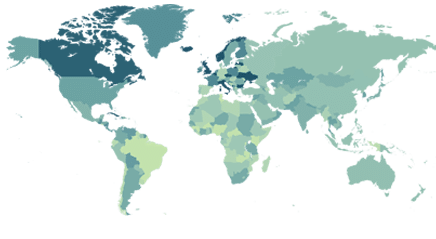
Jade Alloys exports ASTM A320 Grade L7 Bolts to over 40 countries across all major industrial regions. We handle all export documentation including country-of-origin certificates, fumigation certificates, and port-specific packing requirements.
Why Source ASTM A320 L7 Bolts from Jade Alloys?
Ready to Order ASTM A320 L7 Bolts?
Send us your requirements — size, grade (L7 / L7M / L43), quantity, certification, and destination — and receive a competitive quote within 24 hours.