Introduction
In the vast world of industrial fasteners, few components are as specialized yet universally essential as the coupling nut. Often overlooked in favor of standard hex nuts or bolts, these elongated fasteners play a critical role in extending, connecting, and stabilizing threaded rod assemblies across countless industries. From towering construction projects to intricate machinery, the humble coupling nut ensures continuity and structural integrity.
Whether you are a project manager sourcing components for a petrochemical plant or an engineer designing a suspension system, understanding the nuances of these fasteners is vital. This comprehensive guide explores everything you need to know about coupling nuts—from the ubiquitous hex coupling nuts to specialized reducing variants. We will delve into material specifications, provide a detailed coupling nut size chart, and discuss why choosing the right grade, such as ASTM A194 Grade 2H nuts, can make or break your assembly’s performance.
At Jade Alloys, we understand that precision and reliability are non-negotiable. As a leading supplier and exporter of high-quality fasteners, including stainless steel, alloy steel, and carbon steel variants, we bring you this guide to help you navigate the complexities of industrial fastening solutions.
Table of Contents
- Introduction
- What is a Coupling Nut?
- How Coupling Nuts Work
- Types of Coupling Nuts
- Materials Used in Coupling Nuts
- Coupling Nut Sizes and Specifications
- Manufacturing Standards
- Applications and Industries
- Coupling Nut vs. Regular Nut
- How to Choose the Right Coupling Nut
- Installation Tips and Best Practices
- Conclusion
- Frequently Asked Questions
What is a Coupling Nut?
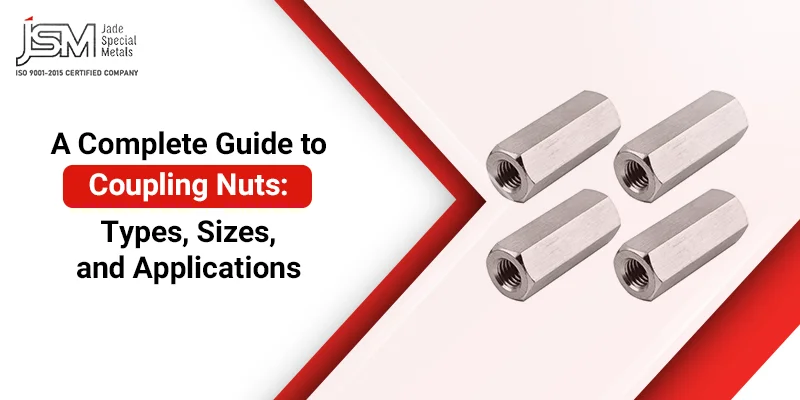
A coupling nut, also known as an extension nut, is a threaded fastener used to join two male threads, most commonly threaded rods. Unlike standard nuts, which are primarily used to secure a bolt or screw in place, the primary function of a coupling nut is to connect two separate pieces of threaded material to create a continuous, extended assembly. Visually, they resemble standard nuts but are significantly longer. This added length allows for sufficient thread engagement on both ends, ensuring that the connection is strong enough to handle the tensile loads applied to the rod assembly. The exterior is typically hexagonal, allowing for easy tightening with a wrench, hence the common term hex coupling nuts.While they are simple in design, their utility is unmatched. They allow for the extension of threaded rods in ceiling suspensions, pipe hanging systems, and leveling applications where a single rod length is insufficient.
How Coupling Nuts Work
The mechanism behind a coupling nut bolt connection is straightforward but relies on precise engineering. The interior of the nut is tapped with a continuous thread. To connect two rods, one rod is screwed into one end of the nut, typically to the halfway point. The second rod is then screwed into the opposite end until it meets the first rod.
Key Mechanism: For maximum strength, it is crucial that both threaded rods are engaged to a depth at least equal to the diameter of the rod. This ensures the load is distributed evenly across the threads, preventing stripping or failure under tension.
Often, these nuts are used in conjunction with jam nuts. A jam nut is tightened against the coupling nut to lock the assembly in place, preventing it from loosening due to vibration or torque. Some coupling nuts also feature a “sight hole”—a small hole drilled through the side—which allows inspectors to visually verify that both rods are fully engaged within the nut.
Types of Coupling Nuts
While the standard hex design is most common, several variations exist to suit specific industrial needs.
Hex Coupling Nuts
This is the industry standard. They have a hexagonal outer shape that allows for easy installation using standard wrenches or socket tools. They are widely used in general construction, plumbing, and maintenance.
Round Coupling Nuts
Instead of a hexagonal exterior, these have a smooth, cylindrical outer surface. They are often used in applications where a wrench is not needed or where a cleaner, more streamlined appearance is desired. They are typically tightened using pipe wrenches or strap wrenches.
Reducing Coupling Nuts
Also known as reducer nuts, these are specialized fasteners with two different thread sizes on either end. They allow for the connection of two rods of different diameters. For example, connecting a 1/2″ rod to a 3/8″ rod. This is particularly useful in retrofitting existing systems or stepping down rod sizes to save weight and cost.
Sight Hole Coupling Nuts
As mentioned previously, these nuts include a small transverse hole. This feature is critical in safety-heavy industries like structural steel erection, where visual verification of thread engagement is mandatory for compliance.
Heavy Hex Coupling Nuts
These are slightly larger and wider across the flats than standard hex coupling nuts. They are designed for high-strength structural applications and are often paired with heavy hex bolts and high-strength threaded rods.
Materials Used in Coupling Nuts
The material of the coupling nut must match or exceed the strength and corrosion resistance of the rods being connected. At Jade Alloys, we supply a vast range of materials to suit every environmental condition.
Stainless Steel (304 & 316)
Stainless steel coupling nuts are essential for environments prone to corrosion, such as marine applications, chemical processing plants, and outdoor construction. Grade 316 offers superior resistance to chlorides and acids compared to Grade 304.
For more on our stainless steel capabilities, visit our stainless steel fasteners page.
Carbon Steel
Standard carbon steel is the most common material for general-purpose coupling nuts. It offers high strength at a lower cost. These are often usually zinc-plated or hot-dip galvanized to provide a basic level of corrosion resistance.
We supply ASTM A563 nuts which cover carbon and alloy steel nuts for general structural and mechanical uses.
Alloy Steel (High Strength)
For high-pressure and high-temperature applications, alloy steel is the material of choice. Grades such as ASTM A194 Grade 2H are heat-treated for superior strength and are commonly used in high-pressure piping and flanges.
Explore our high-strength options: ASTM A194 Grade 2H Nuts.
Exotic Alloys (Inconel, Monel, Hastelloy)
For extreme environments involving high heat or aggressive chemicals, exotic nickel alloys are required. Jade Alloys specializes in these difficult-to-find materials, ensuring your critical infrastructure remains secure under the harshest conditions.
Coupling Nut Sizes and Specifications
Selecting the correct size is paramount. Below is a general coupling nut size chart for standard hex coupling nuts. Note that dimensions can vary slightly based on the manufacturing standard (ASME/ANSI).
Standard Hex Coupling Nut Dimensions (Inch Series)
| Thread Diameter | Width Across Flats (Wrench Size) | Standard Length |
| 1/4″ – 20 | 7/16″ | 7/8″ |
| 3/8″ – 16 | 5/8″ | 1-1/8″ – 1-3/4″ |
| 1/2″ – 13 | 11/16″ – 7/8″ | 1-3/4″ |
| 5/8″ – 11 | 13/16″ – 1-1/16″ | 2-1/8″ |
| 3/4″ – 10 | 1-1/4″ | 2-1/4″ |
| 7/8″ – 9 | 1-7/16″ | 2-1/2″ |
| 1″ – 8 | 1-5/8″ | 2-3/4″ – 3″ |
Note: This chart is for reference. Always consult specific ASTM or IFI standards for precise tolerances and load ratings. Custom lengths are often available upon request from manufacturers like Jade Alloys.
Manufacturing Standards
Industrial fasteners must adhere to strict standards to ensure safety. Coupling nuts are no exception.
- IFI-128: The Industrial Fasteners Institute standard that specifically covers the dimensions and physical properties of hex coupling nuts.
- ASTM A563: Covers the chemical and mechanical requirements for carbon and alloy steel nuts.
- ASTM A194: This standard covers carbon and alloy steel nuts for bolts for high-pressure or high-temperature service. It is critical for industries like oil and gas. See our ASTM A194 Grade 8 Nuts for high-temp stainless options.
- ASME B18.2.2: Covers general purpose dimensions for square and hex nuts, which often informs coupling nut geometry.
Applications and Industries
The versatility of coupling nuts sees them deployed across a wide spectrum of industries:
- Construction & Infrastructure: Joining threaded rods for hanging ceilings, HVAC ductwork suspension, and pipe supports.
- Oil & Gas: Used in flange connections and high-pressure piping assemblies where long studs are required.
- Marine: Stainless steel coupling nuts are used to secure rigging and deck hardware where corrosion resistance is key.
- Automotive: Used in linkage assemblies and custom suspension modifications.
- Manufacturing: Essential for leveling heavy machinery by connecting anchor bolts to machine bases.
Coupling Nut vs. Regular Nut
While they look similar, their functions are distinct. Here is a quick comparison:
| Feature | Regular Hex Nut | Coupling Nut |
| Primary Function | Fastening / Securing | Connecting / Extending |
| Length | Short (typically < diameter) | Long (typically 3x diameter) |
| Application | Tightening bolts against surfaces | Joining two threaded rods together |
| Thread Engagement | Full bolt through | Halfway from each side |
How to Choose the Right Coupling Nut
Choosing the correct coupling nut bolt combination is critical for safety.
- Match the Grade: Ensure the nut grade matches the rod grade. Using a weak nut on a high-strength rod creates a weak link. For example, pair Grade B7 studs with Grade 2H nuts.
- Check the Thread Pitch: Ensure the thread pitch (Coarse UNC or Fine UNF) matches exactly. Mismatched threads will strip and fail.
- Consider the Environment: Use Zinc Plated for indoor/dry use, Hot Dip Galvanized for outdoor use, and Stainless Steel (304/316) for marine or chemical environments.
- Verify Load Requirements: For structural lifting or suspension, calculate the total load and ensure the fastener assembly exceeds the safety factor requirements.
Installation Tips and Best Practices
Proper installation ensures the longevity of the connection.
- Clean Threads: Ensure the threaded rods are clean and free of burrs or debris before threading.
- Mark the Center: If visual verification isn’t possible, mark the rods to ensure they are inserted to the center of the coupling nut.
- Use Locking Mechanisms: In high-vibration areas, use a jam nut or thread-locking compound (like Loctite) to prevent the coupling nut from backing off.
- Avoid Over-Torqueing: While tight is good, over-tightening can strip the threads inside the coupling nut, especially if the material is softer like brass or aluminum.
Conclusion
Coupling nuts are the unsung heroes of industrial assembly. They provide the necessary extension and connection capabilities that allow complex piping, suspension, and structural systems to exist. From standard hex coupling nuts to specialized alloy variants, understanding their properties and applications ensures your projects are built on a secure foundation.
Whether you require standard ASTM A563 carbon steel nuts or high-performance Grade 2H alloy fasteners, quality manufacturing makes the difference. Always prioritize certified suppliers who can provide material test reports and ensure compliance with international standards.
Need High-Quality Industrial Fasteners?
Jade Alloys is a premier manufacturer and exporter of coupling nuts, bolts, and specialized fasteners. From stainless steel to exotic alloys, we have the stock to meet your project's urgent needs.
Frequently Asked Questions
Q: Can I use a regular nut as a coupling nut?
A: No. Regular nuts do not have sufficient length to engage enough threads from two opposing rods to create a safe connection.
Q: How much thread engagement do I need?
A: A general rule of thumb is that the thread engagement for each rod should be at least equal to the diameter of the rod.
Q: Are coupling nuts as strong as the rod?
A: Yes, if selected correctly. The coupling nut should be of a material grade equal to or stronger than the threaded rod to ensure the assembly maintains the rod’s tensile strength.
Q: Does Jade Alloys supply custom-length coupling nuts?
A: Yes, as a specialized manufacturer, we can provide custom dimensions and materials based on your project requirements.