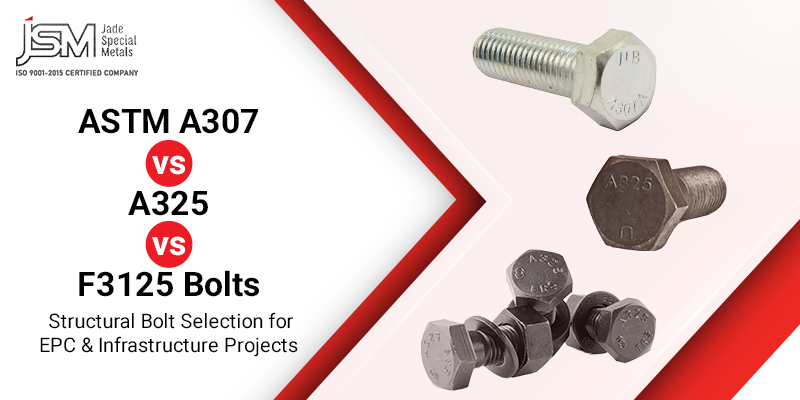
On EPC and infrastructure projects, procurement teams often get BOMs without a grade on high-strength structural bolts, and that left the site engineers to make guesses between ASTM A307 bolts or ASTM A325 bolts and the existing standard of ASTM F3125 bolts. The cost of such an ambiguity is evident: failed QC inspections, non-conformances of specifications, and the rework costs are many times higher than the cost of the fastener. This guide gives you the engineering decision logic, mechanical property comparisons, nut pairing requirements, and procurement verification steps to specify correctly in the first time. This lack of clarity can directly impact the joint’s performance, compliance, and approval during the quality check stages. This guide will help you to understand the difference between A307 vs A325 bolts, their strength, and application requirements, and help to choose the suitable material according to your project and the transition to ASTM F3125 bolts in different industries.
Why Bolt Grade Matters More Than Most Engineers Realize
The choice of bolt grade directly affects the structural safety, compliance, and project schedules. The use of structural connections is regulated by AISC 360-16 and the RCSC 2020 Specification, which specify where high-strength fasteners such as ASTM A325 bolts (which became covered by ASTM F3125 bolts) must be used. The error that is often observed is the replacement of ASTM A307 bolts in the joints where moments are necessary, causing non-compliance. The outcome is failed inspections, replacement of bolts, rework and the possibility of liability. In the majority of present-day specifications, moving to ASTM F3125 bolts, outdated and misapplication of grade may slow down approvals and add project expense.
What Makes a Bolt “Structural” vs General-Purpose?
The difference between the structural and general-purpose bolts is based on the way they are loaded and the way the connection is designed. Structural bolts like ASTM A325 bolts (since specified under ASTM F3125 bolts) are intended to be used in bearing-type and slip-critical connections, where load behavior is predictable and controlled. With a bearing-type connection, the load is borne by the bolt shank in the bearing against the hole and with a slip-critical connection, the load is held by developing friction by the tension of the bolt. Here is where the proof load is significant, it is the most important factor of a bolt, as it is the limit of the maximum load that a bolt can hold before it can be permanently deformed to be used in structural application. However, ASTM A307 bolts are general-purpose fasteners produced without the quench-and-temper heat treatment that gives structural bolts their controlled mechanical properties — no proof load requirement, no pretensioning capability, and no recognition under RCSC 2020 or AISC 360-16 for structural joints.
ASTM A307 Bolts — Specs, Grades, and Where They Belong
ASTM A307 bolts are the low-strength and general purpose bolts that are applied in areas where structural load is not significant. They possess the lowest tensile strength of 60,000 psi (414 MPa) and are produced of low-carbon steel without any heat treatment which restricts their application in high-stakes applications. These bolts have a conventional hex head and exist in two grades. Grade A to be used generally and Grade B to be used predominately to flanged pipe joints. In accordance with the AISC 360-16 and the RCSC 2020 Specification, structural steel connections may not have ASTM A307 bolts. They are most appropriate in non-critical duties such as pipe hangers, sign boards, equipment supports, light framing and temporary fixtures. Modern day projects tend to favor ASTM F1554 Grade 36 with anchor bolts instead of A307.
ASTM A307 Coating and Availability
ASTM A307 bolts come readily with varying coating alternatives depending on the environment in which they are used. The common finishes include plain (as-rolled / mill finish), zinc-coated to ensure that they have some light anti-corrosion protection as well as hot-dip galvanized (HDG) which is suitable when an environment subject to corrosion has to be used. Galvanizing is normally done to meet the standards of ASTM F2329 to assure the right quality of coating. These are commonly available in sizes ranging between 1/4 inch and 4 inches, and hence are readily available to most projects. The EPC viewpoint of ASTM A307 bolts is that they are cheap and are easily found in large quantities, which is why they are perfect in MTO in non-structural and secondary uses.
ASTM A325 Bolt Specifications — Strength, Types, and Structural Use Cases
ASTM A325 bolts are high-strength structural fasteners manufactured from medium carbon steel and quenched and tempered to deliver the mechanical performance required by AISC 360-16 and the RCSC 2020 Specification for Structural Joints. They offer tensile strength of at least 120 ksi (as high as 1 inch) and 105 ksi (as high as 1 inch), yielding 92 ksi and 81 ksi respectively. These bolts are made of medium carbon steel and quenched and tempered which makes them become stronger than general-purpose bolts. Their heavy hex head is also necessary to have structural joints according to the RCSC 2020 Specification. In the real world, ASTM A325 bolts are applied in the beam, columns and other steel connections and can be installed snug-tight or pre-tensioned according to the load and connection types. ASTM A325 bolts are available in two categories, Type 1 being the general structural, and Type 3 being used outside where better corrosion is required. These bolts are never paired with hardware different to them such as F436 washers and A563 heavy hex nuts to make sure they work well.
A325 Type 1 vs Type 3
| Parameter | Type 1 | Type 3 |
| Material | Medium carbon steel | Weathering steel |
| Strength | 120/105 ksi | 120/105 ksi |
| Corrosion Resistance | Depends on coating | Better for outdoor exposure |
| Use Case | General structures | Bridges, exposed structures |
ASTM F3125 Bolts — The Modern Standard That Replaced A325
The new standard of high-strength structural fasteners is ASTM F3125 bolts, which were launched in 2015 by ASTM International. This standard is an integration of older grades such as A325, A490, A354, etc. ASTM A325 bolts are no longer specified on their own now they are offered as F3125 Grade A325, and have the same performance and strength. The other grade under this standard is F3125 Grade A490 which is stronger (approximately 150 ksi tensile strength) and applied in heavy-duty structures such as bridges. To EPC and procurement teams, this should be considered by the fact that most current project specifications are indicating ASTM F3125 bolts as opposed to the old ones. This means procurement teams should confirm whether the project specification cites ‘A325’ or ‘F3125 Grade A325,’ and ensure the supplier’s Mill Test Report (MTR) references the same standard; the two are mechanically identical, but documentation mismatches can trigger QC holds.
Installation Methods for High-Strength Structural Bolts
High-strength structural bolts like ASTM A325 bolts (under ASTM F3125 bolts) must be installed using proper methods to achieve the required tension, as per the RCSC 2020 Specification. There are four main methods. The turn-of-nut method tightens the bolt to snug-tight and then rotates it further to reach the correct tension, making it simple and widely used. The calibrated wrench method uses a torque wrench to apply a set tension. The tension-control (TC) bolt method is faster, where the bolt end breaks off once proper tension is reached — commonly used in bridges and large projects. The direct tension indicator (DTI) method uses special washers to visually confirm tension, making it useful in building construction. In short, TC bolts are preferred for speed, while DTI is better where easy inspection is needed.
A307 vs A325 Bolts – Side-by-Side Comparison for Specification
| Attribute | ASTM A307 (Grade A) | ASTM A325 / F3125 A325 |
| Material | Low carbon steel | Medium carbon steel, Quenched & Tempered (Q&T) |
| Min. Tensile Strength | 60,000 psi (414 MPa) | 120,000 psi (≤1″) / 105,000 psi (>1″) |
| Min. Yield Strength | ~36,000 psi (248 MPa) | 92,000 psi (≤1″) / 81,000 psi (>1″) |
| Head Style | Standard hex | Heavy hex (Mandatory) |
| AISC/RCSC Structural Use | Not permitted | Required for structural joints |
| Installation Method | Standard torque | Snug-tight or pretensioned |
| Companion Hardware | Standard nut / washer | A563 nut + F436 hardened washer |
| Coatings Available | Plain, zinc, HDG | Plain, zinc, HDG (Type 1 only) |
| Typical Applications | Non-structural, light-duty | Structural steel connections |
| Modern Equivalent | Still current (ASTM A307) | Superseded by ASTM F3125 Grade A325 |
| Typical Cost (Relative) | Lower | Higher (due to Q&T process) |
How to Select the Right Bolt Grade — A Decision Framework for EPC Projects
To guarantee that the selected bolt grade in EPC projects will be correct and will not lead to specification errors, delays on site and compliance problems, a step-by-step method should be followed in its selection. so that it provides an effective decision-making model:
Define the connection type:
The initial action is ensuring that the bolts used are structural (beam-to-column, truss, splice) and non-structural (equipment supports, handrails, pipe supports). The structural connections contain high strength bolts i.e. ASTM A325 bolts and ASTM F3125 bolts on the other hand the bolts used in the non structural connections are usually ASTM A307 bolts.
Check code compliance requirements:
When the project is designed according to the standards, such as AISC 360-16, RCSC, and IBC (International Building Code),that is, the use of ASTM A307 bolts cannot be used with the structural joints. In that situation, most of the industries use ASTM F3125 bolts (including A325 grade).
Assess load type:
Identify the load also, by determining whether the load is static or dynamic, and whether the connection is of shear, tension, or slip-critical. Connection types that are slip-critical are those in which pretensioned ASTM A325 bolts / ASTM F3125 bolts have been used, and certain bearing-type connections might permit snug-tight installation.
Assess exposure to the environment:
When exposed or intended to be used outdoors, then corrosion resistant version such as A325 Type 3 or F3125 Type 3 can be used. In conditions that are corrosive or underwater, the choice of coating is crucial. It is also worth mentioning that the F3125 Grade A490 bolts cannot be hot-dip galvanized.
Ensure availability and procurement planning:
ASTM A307 bolts are inexpensive and readily available and thus can be used in bulk non-critical applications. On the contrary, ASTM A325 bolts and ASTM F3125 bolts might have to submit mill test reports (MTRs), certified suppliers, and longer lead times, thus EPC teams need to consider MTO.
Real-World Application Examples by Industry Sector
| Sector | Connection Type | Recommended Grade | Specification Basis |
| Oil & Gas / Petrochemical | Pipe rack structural steel | F3125 A325 | AISC 360 + owner spec |
| Oil & Gas / Petrochemical | Equipment base plate anchor | ASTM F1554 Gr.55 or Gr.105 | AISC / IBC |
| Power Generation | Structural steel frame | F3125 A325 | AISC 360 |
| Power Generation | Cable tray supports | ASTM A307 Grade A | Non-structural |
| Highway Infrastructure | Bridge structural joints | F3125 A325 or A490 | AASHTO + RCSC |
| Highway Infrastructure | Sign support structures | ASTM A307 or F1554 | Non-structural |
| Commercial Buildings | Moment frame connections | F3125 A325 | IBC + AISC 360 |
| Commercial Buildings | Curtain wall anchors | ASTM A307 or stainless | Architectural spec |
| Industrial / Manufacturing | Heavy equipment base | F3125 A325 | Structural |
| Industrial / Manufacturing | Light equipment curbs | ASTM A307 Grade A | Non-structural |
Procurement & Quality Verification Checklist for EPC Teams
Verify Mill Test Report (MTR):
First of all, ensure that the supplier offers an MTR of bolts used ASTM A325 or ASTM F3125 bolts. Then test material heat number and mechanical properties, and satisfy the ASTM requirements.
Markings of check identification:
Confirm that the bolt marking heat is that all bolts labeled with their grade such as A325 be labeled to A325 and others be labeled to other bolts. Bolts without any markings create enormous variance when it comes to inspection.
Confirm lot traceability:
Ensure that the supplier is offering complete lot traceability and Certificate of Conformance (C of C). This becomes essential in EPC projects in which tracking and documentation of materials are needed.
Approve coating specifications:
In case of galvanized bolts, ensure that the bolts are in compliance with ASTM F2329 and verify coating thickness in accordance with ASTM A153 in place of adequate corrosion protection.
Check nut and washer compatibility:
Ensure that you have the right hardware in all structural bolts, be it A563 Grade DH, DH3. Do not use low-grade nuts (A or C) ; they cannot be used in high-strength applications.
Conclusion:
Getting the bolt grade right at the specification stage eliminates one of the most common and avoidable QC failures in structural steel execution. If you’re reviewing a BOQ, cross-referencing an existing spec, or building a procurement checklist for your next EPC project, the guides below cover each grade and its companion hardware in detail. The engineers have to match the grades of bolts with the load requirements, AISC and RCSC standards, and environmental factors. With an ever-changing specification that is moving more towards ASTM F3125 bolts, it is important to keep up. To ensure sourcing reliability and certified quality, Jade Alloys offers tested structural fasteners that are in accordance with modern projects and procurement requirements.
Frequently Asked Questions (FAQ):
1.Can I substitute ASTM A307 bolts for A325 in a structural connection?
No. ASTM A307 bolts are not permitted for structural steel connections governed by AISC 360 or the RCSC specification. A307 has a minimum tensile strength of 60,000 psi versus 120,000 psi for A325 (≤1″). Substitution creates a non-compliant, under-strength connection and will fail structural inspection.
2.Is ASTM A325 still a current standard?
Technically, ASTM A325 was withdrawn as a standalone standard and incorporated into ASTM F3125 as Grade A325 in 2015. Many project specs and codes still reference ‘A325’ by name, but the mechanical requirements are identical. EPC teams should confirm their project specification language and procure to whichever standard is cited.
3.What is the difference between F3125 Grade A325 and Grade A490?
F3125 Grade A325 has a minimum tensile strength of 120,000 psi (≤1″). F3125 Grade A490 increases this to 150,000 psi, making it suitable for extremely high-load structural connections such as long-span bridges. Critical restriction: A490 cannot be hot-dip galvanized due to hydrogen embrittlement risk.
4.Do ASTM A325 bolts require special installation tools?
Yes, for pretensioned connections. Depending on the RCSC-approved method, installation may require a calibrated torque wrench, a TC (tension-control) installation tool, or direct tension indicator (DTI) washers. Snug-tight connections require only an impact wrench to the snug condition. The connection design dictates which method applies.
5.Are ASTM A307 bolts cheaper than A325?
Yes, typically by 40–60% per bolt, because A307 uses low carbon steel without the quench-and-temper heat treatment required for A325. However, using A307 in applications requiring A325 creates a specification non-conformance. The cost saving is not worth the rework, inspection failure, and liability risk.