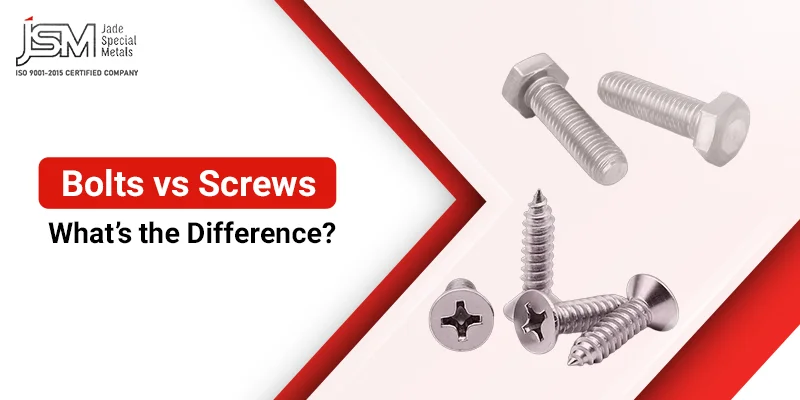
For professionals in the manufacturing and construction sectors, terminology is rarely just about semantics; it is about specification. Although the two terms are commonly used interchangeably during normal conversations, the difference between the two, Bolts and Screws, is an issue of rigid engineering explanation.
At Jade Alloys, we know that it is very important to decide on the right fastener as it is important to decide on the right alloy. Structural integrity may be compromised or the assembly may fail due to a mismatch in specification. To clear up this area of misconception, it is necessary to move beyond the similarity of appearance, and analyze the design purpose, mechanical characteristics, and setting up procedures that isolate these two important elements.
The Regulatory Definition: ANSI and ASME Standards
The most definitive answer to the bolts vs screw debate does not come from the dictionary, but from industrial standards. Specifically, the US Customs and Border Protection (CBP) and the American Society of Mechanical Engineers (ASME B18.2.1) utilize a strict set of criteria to categorize these fasteners.
The primary distinction is functional rather than visual.
The Bolt Criteria By definition, a bolt is an externally threaded fastener designed for insertion through holes in assembled parts. Its defining characteristic is that it is intended to be tightened or released by torquing a nut.
- Assembly: A bolt usually requires access to both sides of the assembly (one for the head, one for the nut).
- Torque Application: In a standard bolt application, the bolt head is held stationary while the nut is turned.
The Screw Criteria A screw is an externally threaded fastener capable of being inserted into holes in assembled parts, of mating with a preformed internal thread, or of forming its own thread.
- Assembly: Screws are often used in “blind” applications where access is available from only one side.
- Torque Application: A screw is tightened by applying torque directly to the head.
Mechanical Design: Strength and Threading
When you examine Bolts and Screws closely, their physical architecture reveals their intended mechanical load.
- The Significance of the Shank: The threading pattern is one of the most visible visual differences.The bolts have a distinctive design of a partial thread, with an unthreaded portion of the shaft referred to as a shank.
This is not a cost-cutting restriction; it is a structural requirement.The unthreaded shank is used as a dowel when the bolt is joining two heavy plates together.It is located in the shear plane (the location where the two plates would be lying side by side).The solid shank has a much higher shear than a threaded section, eliminating the possibility of the fastener snapping when the sideways pressure is applied.
- Tensile Strength and Grip: Contrary to this, screws are often entirely threaded to the head.This type of design gives maximum contact between the material and the fastener.Since screws depend on friction and thread engagement to ensure their retention (instead of the clamping force of a nut), the entire thread is required to give the tensile grip needed to ensure the screw is not pulled out.
Installation Protocols and Tolerances
The confusion in the bolts vs screw discussion often arises because the boundaries can blur. For instance, a “hex cap screw” can technically function as a bolt if secured with a nut. However, the manufacturing tolerances often decide the final classification.
Screws generally require tighter manufacturing tolerances than bolts. Because a screw must mate with a specific internal thread (often a tapped hole in an engine block or precision machine), any deviation in thread concentricity or pitch can cause the fastener to seize or strip the hole.
Bolts, which pass through clearance holes (holes slightly larger than the bolt diameter), have a wider tolerance margin. The nut does the heavy lifting of securing the assembly, meaning the bolt itself does not need to form a perfect seal with the hole wall.
Security and Specialized Applications of Bolts vs Screws
In high-stakes environments, the difference extends to security and tamper resistance.
- Structural Bolts: In irreversible fixings, engineers can use shear bolts. They are engineered in such a way that the head is detachable when the desired amount of torque is attained, and a secure, non-removable fastening is left behind.
- Security Screws: On the other hand, the removable fixings may be based on special screw heads. They need special driver bits (pin-hex or Torx security) to ensure they cannot be removed by an unwarranted user, and are accessible to a service user.
Material Selection: The Jade Alloys Perspective
The geometry of the fastener is just half the story regardless of whether your specification is high shear bolts or precision tapped screws. The lifespan of the component is based on the material composition.
A carbon steel bolt may be sufficient in terms of strength in the case of indoor machinery but is bound to fail once subjected to a marine or a chemical processing setting. In such important applications, alloy is the decisive factor.
At Jade Alloys, we supply a comprehensive range of fasteners in high-performance materials, including:
- Stainless Steel (304/316): For standard corrosion resistance.
- Duplex and Super Duplex: For high-strength requirements in saline environments.
- Nickel Alloys (Inconel, Monel, Hastelloy): For extreme temperature and chemical resistance.
We also offer a complete selection of industry-standard bolt grades such as ASTM A307 Bolts, ASTM A320 L7 Bolts, ASTM A325 Bolts, ASTM A453 Grade 660 Bolts, ASTM F3125 Bolts, ASTM F568M Bolts and ASTM F593 Bolts ensuring compatibility with structural, cryogenic, high-temperature, and corrosion-resistant applications.
Final Thoughts
While the terms are often swapped in conversation, the engineering reality is clear. If it requires a nut and offers high shear strength through a plain shank, you are likely specifying a bolt. If it mates into a tapped hole and requires precise thread engagement, it is a screw.
Understanding this distinction guarantees that your project meets not just the design requirements but also the safety standards necessary for operation.
Looking for specific fastener grades? Browse the Jade Alloys product catalog or contact our technical team to discuss the specific alloy requirements for your next project.