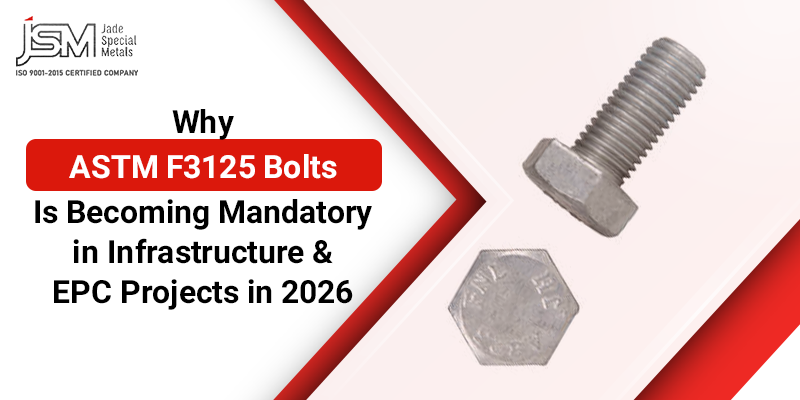
The construction sector is quickly evolving to have a single standard of fastening to enhance safety, uniformity and accountability of projects and the ASTM F3125 requirement is the center stage of this transformation. This requirement is not an option or a guideline, or an optional upgrade; it is a requirement under regulation that standardizes structural bolting regulations so that there is reliable performance and reduced compliance in the projects that occur today in infrastructure. Non-compliant fasteners are becoming a common issue as the government bodies and large contractors audit and approve specifications on F3125. As the 2026 tenders will act with a relentless F3125 compliance, non-observance of this change nowadays may mean disqualification, delays, and increased riskiness, and early knowledge and implementation is a crucial requirement to achieve future-proof construction projects.
What is ASTM F3125 and Why It Superseded A325/A490
ASTM F3125 is a consolidated structural bolting standard that incorporates six older specifications, A325, A325M, A490, A490M, F1852 and F2280. This simplification lowers the confusion, decreases the errors during ordering, and streamlines the quality control of the engineers, fabricators, and suppliers of high-strength structural bolts. The old A325 and A490 specifications have been placed within the standard under Grade 3125, with A325 bolts designated Grade A and B, and A490 bolts designated Grade C and D, so that all types of applications use the same mechanical properties, chemical composition, and performance. ASTM F3125 enhances the verification of compliance, simplifies the procurement process, and supports the current design and construction methods by offering a single standard of this type. That standard also includes all mechanical and chemical requirements of its predecessors, and it is easier to specify bolts to use in structural work without referring to a variety of overlapping standards. The F3125 is the umbrella standard of high-strength structural bolting that modernizes previous specifications but puts strong performance requirements and reliability assurance on structural projects.
Why F3125 Bolts Are Now Required
New construction projects now use ASTM F3125 bolts due to the inclusion of F3125 in building codes such as the IBC and AISC that refer to the standard of high strength structural fasteners, all bolts are now of high standard in regard to both mechanical and chemical specifications. This is of particular concern to the 2026 date since most state DOTs, federal infrastructure projects, and large-scale construction bids will only accept bolts with the F3125 standard and some non-compliant fasteners might be turned away. In addition to complying with regulations, F3125 bolts enhance safety and minimize liability, as structural bolts are of great concern to the integrity of the bridges, buildings and other infrastructure: failure of structural bolts may lead to accidents, financial loss and even legal problems. Projects that have been standardized on F3125 are guaranteed of uniform quality, durability in the long term, and performance that is guaranteed. Major learning point: The adherence to ASTM F3125 is critical to the fulfillment of the present-day codes, obtaining significant contracts, and ensuring the safety and stability of infrastructure.
Key Differences Between ASTM F3125 and Legacy Structural Bolts
The major differences between ASTM F3125 and the Legacy Structural Bolts include that the bolts of F3125 have uniform strength, better manufacturing and testing, and new head markings that increase compliance conspicuously.
| Feature | Legacy A325 / A490 | New ASTM F3125 Standard |
| Tensile Strength (A325) | Varied by diameter (drops above 1″) | Unified 120 ksi for all diameters |
| Specification Type | Separate standards | Single consolidated standard |
| Traceability | Standard | Enhanced (Annex A1 requirements) |
Types of F3125 Bolts: Grade A325, A490, and F1852 Under One Standard
ASTM F3125 is a consolidation of several standards of bolts, yet it is necessary to state the right grade in order to be able to achieve strength, durability, and correct installation.
- Grade A325: The most prevalent and the workhorse of general heavy construction are A325 bolts. They are good tensile strength and durable materials that can be used in regular construction works.
- Grade A490: A490 bolts are super-strong alloy steel bolts that are utilized in heavy-load connections. They are not usually galvanized and are best suited to critical joints that have to be as strong in tensile strength as possible.
- Grade F1852 / F2280: They are A325 (F1852) and A490 (F2280) bolts that are torque-controlled. They also guarantee accurate installation and stability in vital links of the building.
Why EPC Projects Are Transitioning to F3125 Structural Fasteners for Infrastructure
EPC contractors are gradually accepting ASTM F3125 structural fasteners. The reason for this embrace is quite simple. It makes their chain of supply streamlined. This means that by adopting F3125 as their standard for infrastructure fasteners, they can easily reduce their inventory management for structural fasteners and minimize their list of accepted suppliers, as well as ensure fewer ordering errors. A single source for all high-strength structural bolts ensures smooth ordering as well as quality consistency.
Moreover, F3125 is compatible with international metric standards (F3125M), an essential aspect for EPCs dealing with international suppliers or contracts. Adhering to the latest standards also reduces possible legal issues in the event of structural audits, inspections, or government approvals. Adopting an F3125 EPC projects fastener in the industry reduces liabilities and maintains confidence in the safety and integrity of essential infrastructure components.
Critical Applications: Bridge Bolts, Steel Structures, and Heavy Engineering
F3125 structural fasteners have the strength, durability, and safety that challenging infrastructure and heavy engineering tasks demand.
- Bridges: Bridge fasteners and long-span overpasses require Grade A490 of F3125 or F2280 bolts for such high-stress joints. The tensile strength they provide resists massive traffic, dynamic forces, and environmental pressures.
- High-rise buildings: The skyscrapers stand firmly without any problem because of the help of structural bolts, particularly in parts of the world that experience earthquakes. F3125 bolts give the required lateral resistance and vibration forces in skyscrapers to achieve integrity and safety.
- Energy infrastructure: Applications like wind turbines and the transmission lines from the power plants rely on well-toughened and durable fasteners. F3125 bolts ensure reliable connections amid ongoing environmental and mechanical stress, lowering maintenance needs and failure risk.
- Heavy Engineering Projects: F3125 bolts are widely used in heavy-load applications, from industrial frames and cranes to fabrication facilities, where structural integrity is required. The combination of high strength with corrosion resistance makes them suitable for use in the harshest engineering environments
Material Traceability and Quality Compliance in ASTM Fastener Standards
F3125 fasteners are made through stringent QA/QC processes in order to ensure their reliability, strength, and safety.
- Mill Test Reports (MTR): Each production lot of F3125 fasteners must have a Material Test Report (MTR), which documents their chemical composition, mechanical requirements, and heat treatment processes. An MTR enables “full traceability of materials under ASTM specification requirements.”
- Rotational Capacity Testing (RoCap): The properties of a bolt in terms of flexibility and resistance to torque are determined with the help of RoCap during the installation. It counters the possibility that it is not tensioned properly or that it will fail, which is important in applications where stress is an issue of great concern.
Prohibition on Reuse of Galvanized A325 Bolts: F3125 grade A325 bolts and, more so, zinc-coated ones, should not be reused under some high-stress conditions. The usage of such bolts should be reused, which will lead to the deterioration of their mechanical strength. - QA/QC Benefits: Strict testing procedures, traceability, and compliance can minimize the chances of structural failures in buildings and other heavy engineering structures such as bridges and high-rise buildings.
Procurement Guide: Specifying ASTM F3125 Bolts for Infrastructure Projects
There are many steps to choose the perfect fasteners according to your application needs, and the steps that help you to choose the best fasteners for you are given below.
- Check the Grade and Type: Be sure you choose the right grade ( A325, A490, or F1852/F2280 ) and type ( Type 1 -standard, Type 3 -weathering ) for your project. This makes the bolts work out as perthe requirements.
- Pick the Right Style: Choose between Heavy Hex and Tension Control (TC) bolts, depending on the type of design and installation. Selecting an unsuitable style will lead to unjustified delays in assembly.
- Coating or Surface Treatment: In case you need your project galvanized or otherwise treated on its exterior, specify it in your order so as to avoid corrosion and other extreme environments.
- Avoid Generic “A325” Orders: Just asking to have an A325 without any reference to ASTM F3125 will get you old stock or bolt out of compliance- later that may cause compliance and safety problems.
- Oppose Early Update Approved Vendor Lists (AVL): Begin to countercheck certified suppliers. Being prepared with your AVL means that you have compliant bolts in the shortest time, particularly during the 2026 transition.
- Assure Adherence and Quality: The steps will keep the safety level high, ensure the decrease of inspection problems, and ensure that all bolts are in accordance with ASTM F3125 recommendations.
Conclusion
The shift to ASTM F3125 is inevitable in the context of infrastructure projects today, and for a reason. It eases the specifications of bolts, minimizes the errors in ordering, and ensures the uniformity of quality of all the structural fasteners. F3125 improves safety and strengthens critical joints and harmonizes the industry under one, dependable standard by standardizing grades, types, and testing requirements. To the engineers and procurement teams working with a trusted company like Jade Alloys, it is obvious to update your specifications and approved vendor lists immediately. Doing things today makes sure it is completed and eliminates delays and bottlenecks in 2026, which will keep the projects on schedule and within the code.