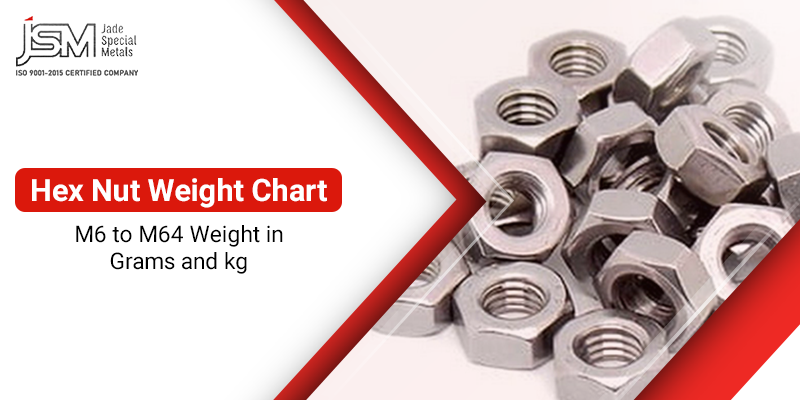
Jade Alloys is a top supplier and exporter of high-quality fasteners. When it comes to industrial procurement, it’s all about having the correct data. For engineers and other buyers, the key to making a successful purchase, estimation of freight costs and planning materials is the knowledge of the hex nut weight chart. When ordering a few dozen or thousands of nuts, it’s important to know the weight in kg or per 100 or 1000 pieces of each nut to prevent expensive over-ordering or shortages. This guide covers standard hex nut dimensions according to DIN 934 / ISO 4032, a full weight table (M6 to M64), heavy hex nut weights, material density comparisons and a step-by-step calculation method.
Hex Nut Dimensions Standard: DIN 934 / ISO 4032
The global benchmark for hex nut dimensions is DIN 934, which is technically equivalent to ISO 4032. This standard specifies the width across flats (WAF), width across corners and height (bearing face to top face) of each metric thread size. The tolerances specified in DIN 934 are very limited for the width across flats and the nut height, such that fasteners of different manufacturers can still be used in the same fastener assembly. An M20 hex nut would have a width across flats of 30 mm, and a nominal height of 18 mm. The standardised hex nut dimensions are the basis for the weight figures in the table below. We produce all of our hex nuts to DIN 934 / ISO 4032 tolerances.
Hex Nut Weight Chart: M6 to M64
The following hex nut weight chart is based on carbon steel hex nuts per DIN 934 / ISO 4032. Weights are calculated at a density of 7.85 g/cm³. The ‘per 1000 pcs’ column is especially useful for bulk buyers and procurement teams managing large project inventories. For a downloadable reference, visit our nuts weight chart page.
| Size | Width Across Flats (mm) | Height (mm) | Weight per Piece (g) | Weight per 100 pcs (kg) | Weight per 1000 pcs (kg) |
| M6 | 10 | 5.2 | 2.0 | 0.20 | 2.00 |
| M8 | 13 | 6.8 | 5.0 | 0.50 | 5.00 |
| M10 | 17 | 8.4 | 9.5 | 0.95 | 9.50 |
| M12 | 19 | 10.8 | 15.0 | 1.50 | 15.00 |
| M16 | 24 | 14.8 | 36.0 | 3.60 | 36.00 |
| M20 | 30 | 18.0 | 70.0 | 7.00 | 70.00 |
| M24 | 36 | 21.5 | 120.0 | 12.00 | 120.00 |
| M30 | 46 | 25.6 | 240.0 | 24.00 | 240.00 |
| M36 | 55 | 31.0 | 430.0 | 43.00 | 430.00 |
| M48 | 75 | 38.0 | 980.0 | 98.00 | 980.00 |
| M64 | 95 | 51.0 | 2300.0 | 230.00 | 2300.00 |
Note: Weights shown are for standard hex nuts in carbon steel. For other materials, apply the density correction factor from the material table in Section 4 below. Actual weights may vary slightly based on thread engagement depth and manufacturing tolerances.
Heavy Hex Nut Weight Chart: M16 to M64
The heavy hex nut weight is notably higher than standard hex nuts because heavy hex nuts have a wider width across flats and greater height. These are governed by ASTM A194 and are widely used in structural bolting, pressure vessel assemblies, and high-pressure piping. Our heavy hex nuts are available in multiple grades for demanding applications.
| Size | Width Across Flats (mm) | Height (mm) | Weight per Piece (g) |
| M16 | 27 | 17.0 | 48.0 |
| M20 | 34 | 20.0 | 95.0 |
| M24 | 41 | 23.5 | 158.0 |
| M30 | 50 | 28.6 | 310.0 |
| M36 | 60 | 33.0 | 550.0 |
| M48 | 82 | 43.0 | 1250.0 |
| M64 | 105 | 56.0 | 2900.0 |
The increased heavy hex nut weight compared to a standard hex nut of the same thread size directly reflects the larger bearing area these nuts provide, making them the preferred choice for high-load flange and structural connections. When specifying material, refer to our carbon steel nuts and heavy hex nuts product pages for full grade availability.
| Need Hex Nuts or Heavy Hex Nuts in Bulk?Jade Alloys supplies ASTM A194 grade hex nuts and heavy hex nuts in carbon steel, stainless steel, Inconel, Hastelloy, and more. Fast quotes, mill certifications, and global shipping.Request a Quote from Jade Alloys |
Nut Weight by Material: Density Comparison
The nut weight chart above is based on carbon steel. When you order nuts in stainless steel, alloy steel, Inconel, Hastelloy, or titanium, the actual weight per piece in kg will differ because each material has a different density. Use the table below to apply a correction factor to the carbon steel baseline weight.
| Material | Density (g/cm³) | Weight Factor vs Carbon Steel |
| Carbon Steel | 7.85 | 1.00 (baseline) |
| Stainless Steel 304 | 7.93 | 1.01 |
| Stainless Steel 316 | 7.98 | 1.02 |
| Alloy Steel | 7.85 | 1.00 |
| Inconel 625 | 8.44 | 1.08 |
| Hastelloy C276 | 8.89 | 1.13 |
| Titanium Gr. 2 | 4.51 | 0.57 |
Example: An M20 carbon steel hex nut weighs approximately 70 g. The same nut in Hastelloy C276 would weigh approximately 70 x 1.13 = 79.1 g per piece. In Titanium Grade 2, the same nut would weigh only 70 x 0.57 = 39.9 g, a significant weight saving for aerospace and marine applications.
How to Calculate Hex Nut Weight
You can calculate hex nut weight manually using the hexagonal cross-section geometry. The formula is:
Weight (g) = ( Area of Hexagon – Area of Bore ) x Height x Density
Where:
- Area of Hexagon = (3 x sqrt(3) / 2) x s² where s = distance across flats / 2
- Simplified: A_hex = 0.866 x (WAF)²
- Area of Bore = pi x (d/2)² where d = nominal thread diameter
Worked Example: M20 Carbon Steel Hex Nut
Width across flats (WAF): 30 mm | Height (H): 18 mm | Thread bore: 20 mm | Density: 7.85 g/cm³
A_hex = 0.866 x 30² = 0.866 x 900 = 779.4 mm²
A_bore = 3.1416 x (10)² = 314.2 mm²
Net area = 779.4 – 314.2 = 465.2 mm²
Volume = 465.2 x 18 = 8,373.6 mm³ = 8.37 cm³
Weight = 8.37 x 7.85 = 65.7 g (approx. 70 g including fillet/chamfer volumes)
The slight difference from the table value accounts for the chamfered bearing face, the countersunk top face, and thread root volumes not captured in the simplified polygon model. For procurement purposes, always use the tabulated values from the nuts weight chart which incorporate these correction factors.
ASTM A194 Nut Grades and Their Applications
The ASTM A194 specification covers nuts for high-pressure and high-temperature service. Understanding which grade to specify is critical to ensuring safe, compliant fastener assemblies. The following table summarizes the most commonly used grades. Click the grade links to view product pages with full specifications and availability from Jade Alloys.
| Grade | Material | Tensile / Proof Strength | Typical Application |
| 2H | Medium Carbon Steel (quenched & tempered) | 175,000 psi proof load | High-pressure piping, structural bolting with A193 B7 |
| 4 | Low Alloy Steel | 144,000 psi proof load | General industrial service, moderate temps |
| 7 | Alloy Steel (chromium-molybdenum) | 175,000 psi proof load | Cryogenic and low-temperature service with A320 L7 |
| 8 | Stainless Steel 304 | 100,000 psi proof load | Corrosive environments, chemical processing |
| 8M | Stainless Steel 316 | 100,000 psi proof load | Marine, pharmaceutical, high-chloride environments |
For high-pressure and high-temperature bolting, ASTM A194 Grade 2H is the most widely specified nut in the industry, paired with ASTM A193 B7 studs. For corrosive environments requiring molybdenum-bearing stainless steel, ASTM A194 Grade 8M (SS 316) is the standard choice in chemical processing and offshore applications.
How Much Does a Hex Nut Weigh?
The answer to how much does a nut weigh depends on the thread size, the standard (hex vs heavy hex), and the material. To summarize the key data points from this guide:
- An M6 hex nut weighs approximately 2 grams per piece (2 kg per 1000 pcs) in carbon steel.
- An M20 hex nut weighs approximately 70 grams per piece (70 kg per 1000 pcs) in carbon steel.
- An M64 hex nut weighs approximately 2.3 kg per piece (2,300 kg per 1000 pcs) in carbon steel.
Heavy hex nuts in ASTM A194 grades weigh 20 to 30 percent more than standard hex nuts of the same thread size. For exotic materials such as Inconel or Hastelloy, apply the density correction factor from Section 4. For a complete reference covering additional sizes and standards, our nuts weight chart page provides a comprehensive listing.rrection factor from Section 4. For a complete reference covering additional sizes and standards, our nuts weight chart page provides a comprehensive listing.
| Need Hex Nuts in ASTM A194 Grades, SS 316, Inconel or Hastelloy? Jade Alloys is a leading manufacturer and exporter of hex nuts, heavy hex nuts, and all ASTM A194 nut grades. We supply M6 to M64 in carbon steel, stainless steel 304/316, alloy steel, Inconel, Hastelloy, and Titanium with full mill certifications, NABL test reports, and fast global shipping. Get a Quote from Jade Alloys Today |