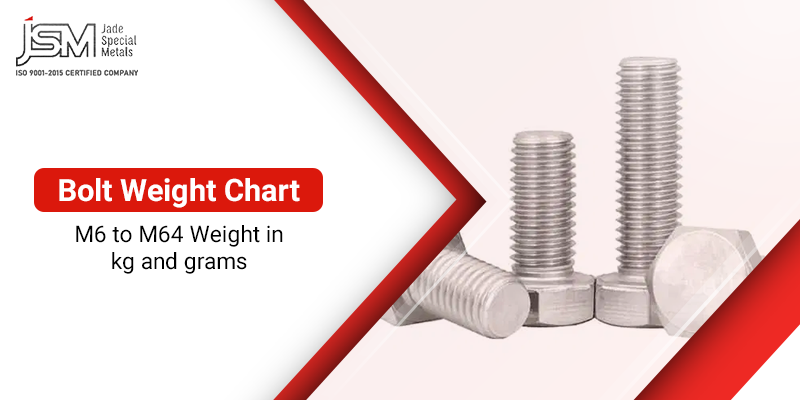
Accurate bolt weight data starts with a reliable supply source. Jade Alloys is a leading bolt suppliers and exporters, and provides a variety of Hex Bolts and Stud Bolts in all important grades and material from M6 to M64. All of our fasteners are made to ISO and ASME standards, and are fully traceable and supported with documentation.
Why Bolt Weight Matters in Industrial Procurement
Knowing the exact weight of a bolt is not a minor detail in industrial procurement. Whether you’re buying a few grams at a time for oil and gas pipelines, pressure vessels, structural steelwork or heat exchanger, the extra freight and shipping cost of just a few grams per piece can add up. Large Bill of Materials (BOM) preparation is a key part of procurement teams’ jobs, and accurate per-piece weight information is essential for finalizing logistics budgets, calculating container loads and planning cost-effective delivery schedules. If the goods are not estimated accurately at BOM, then there are likely to be unexpected overcharges when the goods are finally shipped, especially when they are shipped by air freight or express goods.
In addition to logistics, bolt weight is also directly related to the structural load calculations. Typical instances where the fasteners’ dead load must be considered by the engineer designing the assembly are for rotating equipment, elevated platforms, or offshore structures. A flanged piping system would be one area that would require a reliable bolt weight chart to be a reference for mechanical designers and for the QA team to prepare inspection records, where many fasteners are required to be used.Whether you are working with standard hex bolts or custom stud bolts, this guide covers accurate weight data from M6 to M64 across all common material grades.
Hex Bolt Weight Chart (M6 to M64)
The table below presents the hex bolt weight chart for standard metric sizes from M6 through M64. Weight values are calculated for carbon steel (density 7.85 g/cm³) at typical standard lengths. Refer to our detailed bolts weight chart page for extended size ranges and additional length variants.
| Size | Diameter (mm) | Thread Pitch | Length (mm) | Weight/Piece (grams) | Weight/100 Pcs (kg) |
| M6 | 6 | 1.0 | 30 | 5.2 | 0.52 |
| M8 | 8 | 1.25 | 40 | 10.8 | 1.08 |
| M10 | 10 | 1.5 | 50 | 19.4 | 1.94 |
| M12 | 12 | 1.75 | 60 | 34.2 | 3.42 |
| M16 | 16 | 2.0 | 80 | 82.6 | 8.26 |
| M20 | 20 | 2.5 | 100 | 159.0 | 15.90 |
| M24 | 24 | 3.0 | 120 | 282.0 | 28.20 |
| M30 | 30 | 3.5 | 150 | 608.0 | 60.80 |
| M36 | 36 | 4.0 | 180 | 1085.0 | 108.50 |
| M48 | 48 | 5.0 | 240 | 2630.0 | 263.00 |
| M64 | 64 | 6.0 | 320 | 7250.0 | 725.00 |
Note: Weight values above are indicative for carbon steel bolts at standard lengths. Actual bolt weight per piece (kg) will vary based on exact thread length, head geometry, and material grade. For material-specific weights, refer to the density correction table further in this page. You can also explore our full range of carbon steel bolts for grade-specific details.
Stud Bolt Weight Chart (M10 to M36)
The stud bolt weight chart below covers common size and length combinations used in pressure vessel flanges and pipeline connections. Since stud bolts are fully threaded without a head, their weight per piece changes directly with length. The values below apply to carbon steel (density 7.85 g/cm³). Nuts are not included in the stud bolt weight.
| Size | Length (mm) | Weight per Piece (grams) |
| M10 | 100 | 15.0 |
| M10 | 200 | 28.6 |
| M12 | 150 | 33.8 |
| M16 | 200 | 80.2 |
| M20 | 250 | 178.4 |
| M24 | 300 | 354.6 |
| M30 | 400 | 892.0 |
| M36 | 500 | 2050.0 |
For large flange assemblies requiring ASME B16.5 or B16.47 compliant stud bolt specifications, weight per piece should be calculated at the exact ordered length. Pair your stud bolt selection with our nuts weight chart for complete fastener assembly weight estimates.
Need a Complete Bolt Weight Chart PDF for your Project?
Download our full catalogue or request custom specifications for your exact bolt size, grade, and material. Download the catalogue Now
How to Calculate Bolt Weight Manually
When a bolt weight calculator is not available and you need a quick manual estimate, the simplified cylindrical volume formula gives reliable results for procurement planning purposes.
The Formula
Weight (kg) = 0.00617 x d² x L
Where:
d = Nominal diameter in mm
L = Total length of bolt in mm (shank length + approximate head height)
0.00617 = Derived constant for carbon steel density (7.85 g/cm³) with unit conversion
This formula approximates the bolt as a solid cylinder and accounts for carbon steel density. It is suitable for hex bolts, stud bolts, and similar threaded fasteners where thread volume loss is negligible for estimation purposes.
Worked Example: M16 x 100mm Hex Bolt
d = 16 mm, L = 100 mm
W = 0.00617 x 16² x 100
W = 0.00617 x 256 x 100
W = 157.95 grams ≈ 158 grams per piece
This result aligns closely with the tabulated value in the hex bolt weight chart above (82.6 grams at 80mm standard length; weight increases proportionally with length). For 500 pieces, total weight would be approximately 79 kg before packaging, which is a useful figure for freight planning.
For stainless steel or exotic alloy bolts, multiply the carbon steel result by the ratio of the material density to 7.85. For example, an Inconel 625 bolt weighs approximately 8.44 / 7.85 = 1.075 times the carbon steel bolt of the same dimensions.
How Material Affects Bolt Weight
The material grade of a bolt directly determines its density and therefore its weight per piece. This is particularly important when sourcing stainless steel bolts or high-performance alloys for offshore, chemical processing, or high-temperature service, as the weight difference affects both structural load assumptions and logistics cost per kilogram of fastener material.
| Material | Density (g/cm³) |
| Stainless Steel 304 | 7.93 |
| Stainless Steel 316 | 7.98 |
| Carbon Steel | 7.85 |
| Alloy Steel | 7.87 |
| Inconel 625 | 8.44 |
| Hastelloy C276 | 8.89 |
| Titanium Grade 2 | 4.51 |
The most significant weight advantage belongs to Titanium Grade 2 bolts, which at a density of only 4.51 g/cm³ are approximately 45 percent lighter than stainless steel equivalents of the same dimensions. For weight-sensitive applications such as aerospace assemblies, marine superstructures, and lightweight pressure systems, specifying Titanium bolts can deliver substantial weight savings without compromising corrosion resistance or mechanical performance. On the heavier end, Hastelloy C276 bolts (8.89 g/cm³) and Inconel 625 bolts (8.44 g/cm³) are notably denser than carbon steel, which must be accounted for in load calculations for elevated or suspended assemblies.
When finalizing material selection, cross-reference weight data with corrosion and temperature requirements. Use the per-piece weight from our bolts weight chart page alongside the density factor in the table above to calculate exact weights for any material. Do not forget to factor in the weight contribution of mating hardware by checking our nuts weight chart for the corresponding nut grades.
Download the Full Bolt Weight Chart PDF or Request Custom Specifications
Jade Alloys supplies hex bolts, stud bolts, and specialty fasteners in stainless steel, carbon steel, alloy steel, Inconel, Hastelloy, and Titanium from M6 to M64 and beyond. Our technical team can provide weight-certified material test reports for any grade.
Download our Catalogue or Contact Us for Custom Bolt Weight Specifications and get accurate bolt weight data for your next project.