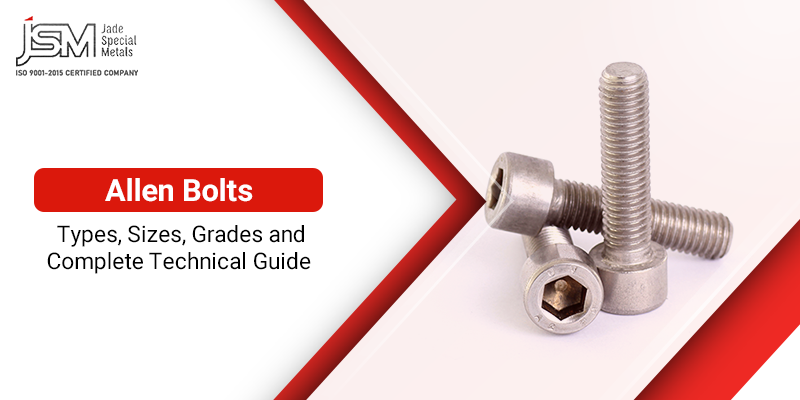
Jade Alloys is a leading Allen Bolts supplier and exporter that provides high quality Allen bolts in varying sizes, standards, materials, and grades for various industrial and construction needs. Our Allen bolts are precision-made to deliver strength, durability and performance.
Allen bolts have a hexagonal recess in the head of the bolt that is driven by an Allen wrench. An allen bolt is also known as a socket head cap screw (SHCS), and is driven with an L-shaped hexagonal key, typically referred to as an allen key, allen wrench or alley screw. As an allan bolt or even an allen boly, the product is among the most common types of fasteners used in precision engineering, automotive and industrial manufacturing.
The mechanical benefit of the internal drive design is the main benefit. The tool is engaged from the inside and not from the outside making torque applied directly along the bolt axis and minimizing the chance for the tool to slip or round. That is why allen bolts are recommended for use in small or recessed areas where it is not possible to use a spanner to turn them. An allen bolt can be driven with just a straight inline allen key in such positions even in an extremely tight assembly envelope, and a standard hex bolt cannot be driven in such positions.
It’s important to note that the allen bolt is not the same as the allen key. The bolt is the thread that is inserted into the hole, the key is the tool for driving the bolt. The problem is that the term Allen, the brand name for Apex Tool Group, was used in the industry in this sense, thus creating a sense of confusion.
Allen Bolt vs Hex Bolt Key Differences
The table below summarises the principal technical differences between the two most common bolt types found in industrial and commercial applications.
| Feature | Allen Bolt | Hex Bolt |
| Drive Type | Internal hex socket (allen key) | External hex head (spanner/wrench) |
| Head Profile | Low, cylindrical or countersunk | Prominent hexagonal head |
| Torque Capacity | High; cam-out resistant | Moderate to high |
| Common Use | Machine assemblies, electronics, precision equipment | Structural, general construction |
| Access Required | Straight inline access with allen key | Open side access with wrench |
From a practical standpoint, the choice between an allen bolt and a hex bolt is governed by three factors: the depth of access available to the tool, the aesthetic requirement of the assembly, and the torque loading involved. Allen bolts sit flush or below the surface of the parent material, which is critical in sliding or rotating assemblies where a protruding head would cause interference. Socket head bolts are also more resistant to cam-out (the tendency of a driver to slip under high torque) because the hex key engages over six full faces inside the socket cavity.
Hex bolts, on the other hand, are faster to install with power tools in open access situations, and their larger bearing surface makes them the standard for structural steelwork. For precision, high-cycle, or space-constrained assemblies, the allen bolt is almost always the better engineering solution.
Allen Bolt Types
Allen bolts are manufactured in several head configurations to address different assembly requirements. Each variant retains the defining internal hex socket drive while offering a different head geometry.
- Socket Head Cap Screw (SHCS): The standard and most widely used form. Features a cylindrical head with a full-depth hex socket. Offers the highest torque capacity of all allen bolt variants and is produced to ISO 4762 / DIN 912.
- Button Head Socket Bolt: A low-profile dome-shaped head that spreads the clamping load over a wider area. Preferred in sheet metal assemblies and applications where a rounded external finish is required.
- Flat / Countersunk Socket Bolt: Designed to sit completely flush with the parent material surface after installation in a countersunk hole. The 90-degree chamfer matches standard countersink profiles.
- Low Head Socket Bolt: A reduced-height cylindrical head for applications with even tighter axial clearance than a standard SHCS allows. Produced to DIN 6912.
- Set Screw (Grub Screw): Headless; the entire length is threaded. Used to lock collars, pulleys, and gears to shafts. Driven entirely by the hex socket in the end face.
- Hollow Allen Bolts: A specialist variant with a full-length axial bore through the shank. Used in hydraulic, lubrication, and instrumentation circuits where fluid or a cable must pass through the fastener itself while maintaining the clamping force.
Allen Bolt Grades and Materials
Grade identification for allen bolts follows the ISO metric property class system. The grade number encodes the tensile strength and yield ratio of the material. For example, grade 12.9 means a minimum tensile strength of 1,220 MPa and a yield ratio of 0.9, giving a proof load of 1,098 MPa. Stainless steel grades use a letter-number code (A2-70, A4-80) where the letter denotes the alloy group and the number the minimum tensile strength in units of 10 MPa.
| Grade | Tensile Strength (MPa) | Common Material | Application |
| 8.8 | 800 | Medium carbon steel | General engineering, machinery |
| 10.9 | 1000 | Alloy steel (quenched) | Automotive, heavy equipment |
| 12.9 | 1220 | Alloy steel (quenched & tempered) | High-stress precision assemblies |
| SS A2-70 | 700 | Stainless steel 304 | Food, medical, mild corrosive environments |
| SS A4-80 | 800 | Stainless steel 316 | Marine, chemical, offshore applications |
| Inconel | Varies by grade | Nickel-chromium alloy | High-temperature and high-pressure |
| Hastelloy | Varies by grade | Nickel-molybdenum alloy | Extreme corrosion and acid environments |
For applications in aggressive chemical or high-temperature environments, exotic alloy fasteners outperform all standard grades. ASTM A193 B8 specification bolts are manufactured from austenitic stainless steel (Grade 304) and are widely used in pressure vessels and piping systems. Stainless steel bolts in grades A2 and A4 are the go-to choice for marine, food processing, and pharmaceutical equipment where corrosion resistance is non-negotiable.
| Need allen bolts in grades 8.8, 10.9, 12.9 or exotic alloys?ASTM A193 B8 Bolts Request a Quote from Jade Alloys |
Allen Bolt Sizes and Dimensions Chart (Metric, ISO 4762)
The dimensions below conform to ISO 4762 for socket head cap screws. Engineers specifying allen bolt sizes should verify these values against the applicable drawing or standard, as manufacturing tolerances apply. Thread pitch values are coarse-pitch series unless otherwise stated.
| Size | Head Dia. (mm) | Head Height (mm) | Socket Size (mm) | Thread Pitch (mm) |
| M4 | 7.0 | 4.0 | 3 | 0.70 |
| M5 | 8.5 | 5.0 | 4 | 0.80 |
| M6 | 10.0 | 6.0 | 5 | 1.00 |
| M8 | 13.0 | 8.0 | 6 | 1.25 |
| M10 | 16.0 | 10.0 | 8 | 1.50 |
| M12 | 18.0 | 12.0 | 10 | 1.75 |
| M16 | 24.0 | 16.0 | 14 | 2.00 |
| M20 | 30.0 | 20.0 | 17 | 2.50 |
| M24 | 36.0 | 24.0 | 19 | 3.00 |
| M30 | 45.0 | 30.0 | 22 | 3.50 |
Lengths for each diameter range from very short (typically 5 mm for M4) to 300 mm or longer for larger diameters. Custom lengths are available from specialist suppliers for non-standard assembly depths. When specifying, always state diameter, length, thread pitch, material, and grade.
DIN and ISO Standards for Allen Bolts
DIN 912 / ISO 4762: Socket Head Cap Screw
DIN 912 is the German standard for socket head cap screws and is functionally equivalent to the international ISO 4762. It governs the head diameter, head height, socket depth, thread specification, and surface finish of standard cylindrical-head allen bolts. DIN 912 is one of the most widely referenced fastener standards in European and global industrial supply chains and remains the default dimensional reference for metric allen bolts used in machinery and equipment manufacture.
ISO 4762: International Equivalent
ISO 4762 was published to align DIN 912 with the international standards framework. For most practical dimensions, DIN 912 and ISO 4762 produce interchangeable parts. Buyers sourcing from multiple countries should reference ISO 4762 to ensure cross-border dimensional compatibility. The standard specifies property classes 8.8, 10.9, and 12.9, and provides tolerances for socket size, socket depth, and thread engagement.
DIN 6912: Low Head Socket Cap Screw
DIN 6912 defines the low-head variant of the socket head cap screw. The head height is approximately 60 percent of the DIN 912 equivalent for the same diameter, while the socket depth is reduced proportionally. This makes DIN 6912 fasteners the correct specification when assembly clearance rules out a standard SHCS but the application still demands the clean inline drive of an allen bolt. The reduced head height also lowers stress concentration in thin-section assemblies.
How to Choose the Right Allen Bolt for Your Application
Selecting the correct allen bolt requires evaluating four primary decision criteria:
- Load Type and Magnitude: For high-tensile or cyclically loaded joints, specify grade 10.9 or 12.9 allen bolts made from alloy steel. For lighter static loads, grade 8.8 in medium carbon steel offers a cost-effective balance of strength and machinability. Always calculate the required proof load before selecting a property class.
- Access and Assembly Envelope: The internal hex socket allows the allen key to be driven in a straight line into confined recesses. If the bolt head must sit flush with or below the material surface, select a countersunk socket bolt; if axial clearance is the constraint, specify DIN 6912 low-head. For assemblies requiring fluid to pass through the fastener, hollow allen bolts are the correct choice.
- Material Environment (Corrosion and Temperature): Standard carbon steel allen bolts corrode rapidly in wet, marine, or chemical environments. Specify stainless steel bolts in grade A2 (304) for general corrosion resistance or A4 (316) for chloride-rich environments. For elevated temperatures or highly acidic media, ASTM A193 B8 stainless or exotic alloys such as Inconel and Hastelloy are the appropriate specification. Socket head bolts are available across all major corrosion-resistant materials.
- Torque Requirement and Tool Access: The torque capacity of an allen bolt is limited by the socket size, which scales with the bolt diameter. Ensure the specified grade and diameter can develop the required clamp force at the tool torque available. In automated assembly, verify that the socket depth is sufficient for the chosen driver bit. For the highest torque transmission, standard cylindrical-head socket head bolts to DIN 912 outperform button-head and low-head variants for the same diameter.
| Jade Alloys supplies allen bolts in grades 8.8 to 12.9 and exotic alloys including Inconel and Hastelloy.Request a Quote Today |
Frequently Asked Questions
What is an allen bolt used for?
Allen bolts fasten precision machine assemblies, electronics, automotive components, and confined spaces where a standard hex bolt and spanner cannot fit. Driven by an internal hex (allen) key.
Is an allen bolt the same as a socket head cap screw?
Yes. An allen bolt and a socket head cap screw (SHCS) are the same fastener. Both feature an internal hexagonal socket drive and conform to ISO 4762 / DIN 912.3
What is the difference between allen bolts and hex bolts?
Allen bolts use an internal hex socket for tight-space access and flush fitting. Hex bolts use an external hex head for open-access, structural, and high-speed power-tool applications.
Which grade is best for allen bolts: 8.8, 10.9, or 12.9?
Grade 12.9 offers the highest strength (1220 MPa). Use 12.9 for high-stress assemblies, 10.9 for automotive and heavy equipment, and 8.8 for general-purpose engineering applications.
Are stainless steel allen bolts available in A2 and A4 grades?
Yes. A2 (Grade 304) suits general and food-grade environments; A4 (Grade 316) is recommended for marine, offshore, and chloride-rich or chemical exposure applications.