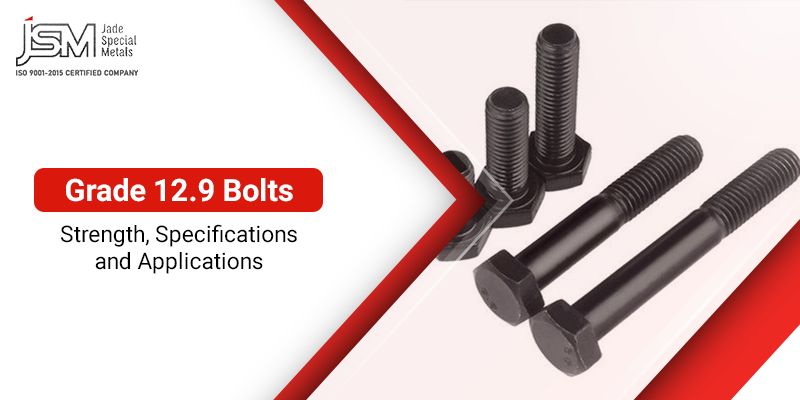
Jade Alloys is a leading Grade 12.9 Bolts supplier and exporter, delivering precision-grade fasteners that meet the most demanding industrial and engineering standards. When it comes to precision critical engineering, it’s not a detail that’s taken lightly. It is a choice that comes on the structure. The grade 12.9 bolts are the highest grade of metric bolts that are available under the ISO 898-1 standard. These bolts have the highest tensile and yield strength that can be used in critical applications such as automotive powertrain assemblies to heavy hydraulic systems. This guide explains all of the specifications, mechanical properties, comparisons with lower grades, acceptable materials and industry applications of class 12.9 bolts.
What Does Grade 12.9 Mean?
Metric bolt grades have a two-part numbering system which is logically based on the mechanics of the bolt itself in terms of ISO 898-1. The tensile strength in the designation 12.9 is specified by the number in front of the decimal multiplied by 100. For grade 12.9, that is 12 x 100 = 1,200 MPa. The number following the decimal indicates yield ratio and is multiplied by 10% of the tensile strength. So 9 x 10% of 1,200 = 1,080 MPa minimum yield strength.
That is, high tensile bolt grade 12.9 must be able to withstand at least 1200 MPa of force before it fails and only start to deform permanently after that. These numbers are why grade 12.9 bolts are only used for joints where the failure of the bolts will be a disaster. This is an unequalled standard for the metric grade.
Grade 12.9 Bolt Mechanical Properties
The following table lists the verified mechanical properties for grade 12.9 bolts per ISO 898-1:
| Property | Value (ISO 898-1) |
| Tensile Strength (min) | 1,200 MPa |
| Proof Load Stress | 970 MPa |
| Yield Strength (min) 0.2% offset | 1,080 MPa |
| Hardness (Rockwell C) | 39 – 44 HRC |
| Elongation at Break (min) | 8% |
| Reduction of Area (min) | 44% |
The high 12.9 bolt tensile strength of 1,200 MPa combined with a proof load stress of 970 MPa makes this grade ideal for joints subjected to dynamic loads, vibration, or extreme clamping force requirements. The 39 to 44 HRC hardness range also indicates significant resistance to wear and surface fatigue under repeated loading cycles.
Grade 12.9 vs 10.9 vs 8.8 Comparison
Understanding where 12.9 bolt vs 10.9 differences matter most helps engineers make correct selections. Below is a direct property comparison across the three most commonly used metric bolt grades:
| Property | Grade 8.8 | Grade 10.9 | Grade 12.9 |
| Tensile Strength (MPa) | 800 | 1,040 | 1,220 |
| Yield Strength (MPa) | 640 | 940 | 1,100 |
| Hardness (HRC) | 22 – 32 | 32 – 39 | 39 – 44 |
| Typical Material | Med. carbon steel | Alloy steel (Cr-Mo) | Alloy steel (Cr-Mo, Cr-Ni-Mo) |
| Fatigue Resistance | Moderate | High | Very High |
| Relative Cost | Low | Medium | High |
Grade 8.8 bolts are the general-purpose workhorse of structural assemblies. They are cost-effective and suitable for most static load applications in construction, machinery framing, and general fabrication. When loads increase or dynamic conditions are introduced, grade 10.9 bolts offer substantially higher tensile and yield values and are widely used in agricultural equipment, automotive chassis, and structural connections.
Grade 12.9 bolts occupy a distinct class. Their use is justified when joint design cannot tolerate any bolt elongation under load, when pre-tension requirements are extremely high, or when the bolt diameter must be minimized without sacrificing strength. Automotive engine blocks, hydraulic cylinder heads, and injection mould clamping systems are typical environments where class 12.9 bolt specifications are specified by design engineers. The cost premium over grade 8.8 is significant, but the consequence of using an understrength fastener in these applications is far greater.
As a bolts manufacturer India, Jade Alloys stocks a full range of high-tensile bolt grades including grade 12.9 in metric sizes for industrial and engineering applications.
Material and Heat Treatment of Grade 12.9 Bolts
Achieving the mechanical targets of grade 12.9 bolts requires a specific material and processing approach. The standard material is alloy steel with compositions based on chromium-molybdenum (Cr-Mo) or chromium-nickel-molybdenum (Cr-Ni-Mo) systems. These alloys provide the hardenability and ductility combination required to meet both the high tensile values and the minimum 8% elongation.
The manufacturing process for alloy steel bolts of this grade involves quenching and tempering. Blanks are heated above the austenizing temperature, rapidly quenched in oil or polymer to achieve a martensitic microstructure, and then tempered at a controlled temperature to reduce brittleness while retaining strength. Without proper tempering, the bolt would be too brittle despite having adequate hardness.
Browse Jade Alloys’ full range of alloy steel bolts for high-performance industrial and structural applications.
| Critical Note for EngineersGrade 12.9 bolts cannot be manufactured in stainless steel. Stainless steel, particularly austenitic grades, cannot be heat treated to reach the 1,200 MPa tensile strength required by the grade. More importantly, high-strength alloy steel bolts electroplated with zinc or cadmium coatings are at serious risk of hydrogen embrittlement. During electroplating, atomic hydrogen can be absorbed into the steel lattice. In a grade 12.9 bolt, the high residual stress from hardening makes the material extremely susceptible to delayed fracture when hydrogen is present. This is why the standard recommends against electroplating for grade 12.9 and instead endorses mechanical plating, hot-dip galvanizing where applicable, or phosphating with oil. |
| Need grade 12.9 alloy steel bolts for your project? Contact Jade Alloys for bulk pricing and specifications. |
Common Grade 12.9 Bolt Sizes and Thread Specifications
Grade 12.9 is a metric-only designation. There is no SAE (Society of Automotive Engineers) equivalent for this grade. The closest SAE class would be Grade 8, but its mechanical properties fall well short of 12.9. The following table provides standard sizes, thread pitch, and load values for class 12.9 bolt specifications per ISO 898-1:
| Size | Pitch (mm) | Proof Load (kN) | Tensile Load (kN) |
| M6 | 1.0 | 11.1 | 14.2 |
| M8 | 1.25 | 20.8 | 26.2 |
| M10 | 1.5 | 33.2 | 41.6 |
| M12 | 1.75 | 49.3 | 61.7 |
| M16 | 2.0 | 93.1 | 116 |
| M20 | 2.5 | 148 | 185 |
| M24 | 3.0 | 214 | 268 |
| M30 | 3.5 | 337 | 422 |
| M36 | 4.0 | 504 | 630 |
These values apply to coarse thread series. Fine thread variants carry slightly higher proof and tensile load values. When specifying grade 12.9 bolts, always confirm thread pitch alongside diameter, as both affect clamping force and installation torque values.
Jade Alloys supplies hex bolts across a wide range of grades and sizes. For applications demanding recessed drive systems, our socket head bolts and allen bolts are available in high-tensile configurations suitable for confined-space installations where a hex wrench is preferred over a spanner.
Applications of Grade 12.9 Bolts
Due to their exceptional 12.9 bolt tensile strength and high clamping capability, these bolts are used across a narrow but critical range of industrial environments:
- Automotive Engine Blocks: Cylinder head bolts, connecting rod bolts, and crankshaft main bearing caps in high-performance and commercial engines frequently specify grade 12.9 due to the extreme combustion pressures and thermal cycling involved.
- Hydraulic Systems: Cylinder end caps and manifold assemblies where fluid pressure creates high separating forces require fasteners that maintain pre-tension without yielding.
- Industrial Machinery: Presses, machine tool spindles, and gearbox housings require high-torque fasteners that resist loosening under vibration.
- Mould Clamping: Injection moulding and die casting equipment use grade 12.9 socket head cap screws for platens and die assemblies where clamping force uniformity is critical to dimensional consistency.
- Structural Joints Under Dynamic Load: Bridges, heavy cranes, and offshore equipment exposed to cyclic loading benefit from the superior fatigue resistance that grade 12.9 offers over lower-rated fasteners.
Standards ISO 898-1 and DIN 912 Class 12.9
The primary international standard governing grade 12.9 bolts is ISO 898-1, which specifies mechanical and physical properties for carbon steel and alloy steel bolts and screws. This standard covers everything from tensile testing methodology to hardness limits and surface finish requirements.
In practice, the most common product form for grade 12.9 is the socket head cap screw manufactured to DIN 912 Class 12.9. DIN 912 defines the dimensional standards for cylindrical head screws with hexagon socket drives. The combination of DIN 912 geometry and 12.9 mechanical grade makes this one of the most widely specified fasteners in mechanical engineering. Other product forms such as hex bolts and alloy steel bolts are also produced to grade 12.9 where application geometry demands external drive.
On the subject of surface treatment, engineers must note that the standard explicitly warns against electroplating of grade 12.9 fasteners. Hydrogen embrittlement induced by electroplating has caused in-service fractures in grade 12.9 bolts even at loads below their rated proof load. Approved alternatives include mechanical zinc plating (cold plating), phosphate and oil treatment, and in lower-strength environments, dacromet or geomet coatings. Any deviation from approved coating methods should be reviewed against ISO 4042 and the bolt manufacturer’s technical guidance.
For applications governed by ASTM specifications, Jade Alloys also supplies fasteners meeting ASTM A193 B7 bolts and related grades for high-temperature and pressure vessel service, as well as socket head bolts and allen bolts for precision machine assembly.
Source High-Qulaity Grade 12.9 Bolts from Jade Alloys
Grade 12.9 bolts are the highest-rated standard metric fasteners available and represent a specific engineering choice, not an upgrade made casually. Their 1,200 MPa tensile strength and 1,080 MPa yield strength, achieved through alloy steel quench-and-temper processing, make them essential in automotive, hydraulic, tooling, and dynamic structural applications. Engineers specifying these bolts must account for hydrogen embrittlement risk in coating selection and ensure that mating threads and joint materials are compatible with the clamping forces generated.
Jade Alloys supplies grade 12.9 bolts and the full range of high-tensile metric fasteners. Whether your requirement is for hex bolts, allen bolts, socket head bolts, or alloy steel bolts, our technical team can assist with grade selection, dimensional verification, and bulk procurement. As a leading bolts manufacturer India, we serve clients across the Middle East, Europe, Southeast Asia, and beyond.
| Need grade 12.9 alloy steel bolts in bulk? Contact Jade Alloys for specifications and pricing. |