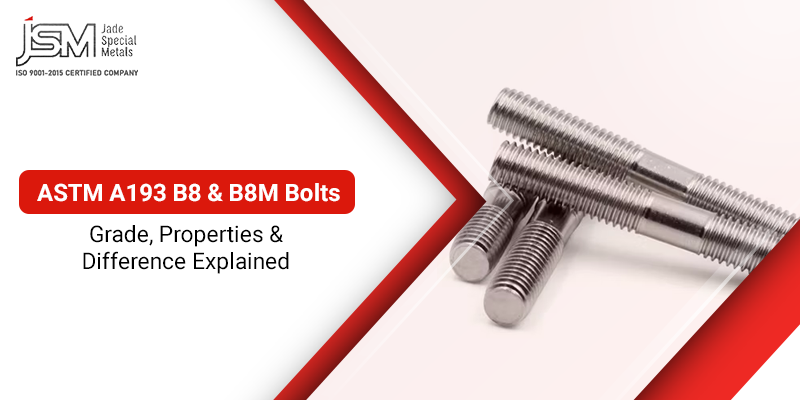
ASTM A193 covers specifications for alloy and stainless steel bolts for high temperature and/or high pressure service and for other special applications. It is referenced in pressure vessel codes (ASME Sec. VIII), piping codes (ASME B31.3), and valve codes throughout the oil and gas, chemical, and power generation industries, and is published by ASTM International. See the ASTM A193 overview guide for a complete overview of all the grades within this specification. This article will concentrate on the two most common grades of stainless steel bolt used by engineers for process plant applications, B8 and B8M.
ASTM A193 B8 Grade Specifications
These ASTM A1993 B8 bolts are mostly made up of 304 Stainless steel (UNS S30400). This grade is mostly used in two classes, the first one is class 1 and class 2, and they both have different fundamentals and processes, and mechanical properties
Comparison table of B8 Class 1 vs B8 Class 2
| Property | B8 Class 1 (Annealed) | B8 Class 2 (Strain-Hardened) |
| Base Material | SS 304 / UNS S30400 | SS 304 / UNS S30400 |
| Condition / Processing | Solution annealed | Strain-hardened (cold-worked) |
| Tensile Strength (min) | 515 MPa (75 ksi) | 690–862 MPa (100–125 ksi)* |
| Yield Strength 0.2% offset (min) | 205 MPa (30 ksi) | 450–690 MPa (65–100 ksi)* |
| Elongation in 50 mm (min) | 30% | 12–20%* |
| Hardness (max) | 192 HBW / B92 HRB | 321 HBW / 35 HRC |
| Cryogenic Service Suitability | Yes — preferred | Not recommended |
ASTM A193 B8M Grade Specifications
ASTM A193 B8M bolts are made of stainless steel 316 (UNS S31600). The major difference between B8 and the alloy is the presence of 2-3% of molybdenum in the alloy. Molybdenum stabilises the passive layer that is essential for the resistance against corrosion of stainless steel and significantly enhances the resistance to pitting and crevice corrosion, particularly in chloride environments. This is B8M’s reason for being the default choice for any application where a seawater, brine, or acidic process stream is nearby. Get the detailed overview of ASTM A193 grade Fastener on our website.
Comparison table of B8M Class 1 vs B8M Class 2
| Property | B8M Class 1 (Annealed) | B8M Class 2 (Strain-Hardened) |
| Base Material | SS 316 / UNS S31600 | SS 316 / UNS S31600 |
| Condition / Processing | Solution annealed | Strain-hardened (cold-worked) |
| Tensile Strength (min) | 515 MPa (75 ksi) | 690–862 MPa (100–125 ksi)* |
| Yield Strength 0.2% offset (min) | 205 MPa (30 ksi) | 450–690 MPa (65–100 ksi)* |
| Elongation in 50 mm (min) | 30% | 12–20%* |
| Hardness (max) | 192 HBW / B92 HRB | 321 HBW / 35 HRC |
| Molybdenum (Mo) Content | 2.0–3.0% | 2.0–3.0% |
| Cryogenic Service Suitability | Yes — preferred | Not recommended |
B8 vs B8M: Which Grade Should You Specify?
The B8 vs B8M decision is almost always driven by the corrosion environment, not by mechanical requirements (since Class 1 properties are identical). The following table captures the key differentiators:
| Factor | B8 (SS 304) | B8M (SS 316) |
| Base Material | Type 304 / UNS S30400 | Type 316 / UNS S31600 |
| Molybdenum (Mo) Content | None | 2.0–3.0% |
| Chloride / Pitting Resistance | Moderate — suitable for fresh water, mild atmospheres | Significantly better — resists seawater, brine, halides |
| General Corrosion Resistance | Good | Excellent |
| Tensile / Yield Strength | Same as B8M (Class 1 = Class 1) | Same as B8 (Class 1 = Class 1) |
| Cost | Lower | Higher (Molybdenum premium) |
| Typical Service Environments | Freshwater systems, food processing (non-saline), general chemical plant (non-halide) | Offshore / marine flanges, desalination, pulp & paper, acidic process streams, seawater cooling |
| Weldability | Good | Good |
| Availability | Wide stock availability | Good availability; larger sizes may need lead time |
Other Grades in the B8 Series
ASTM A193 specifies other grades in the B8 family for further corrosion resistance, stability at high temperature or high sensitisation resistance. Although the majority of specifications are likely to be covered by B8 and B8M, engineers should be mindful of these choices:
| Grade | SS Type | UNS Number | Key Feature / Typical Use Case |
| B8 | 304 | S30400 | General corrosion resistance; the standard baseline grade. |
| B8M | 316 | S31600 | Molybdenum addition; optimized for chloride and pitting resistance. |
| B8A | 304L | S30403 | Low-carbon 304; highly resists sensitization near weld zones. |
| B8C | 347 | S34700 | Niobium-stabilized; provides excellent elevated-temperature oxidation resistance. |
| B8T | 321 | S32100 | Titanium-stabilized; serves a similar high-temperature role to B8C. |
| B8S | Nitronic 50 | S20910 | High strength matched with excellent seawater resistance; ideal for subsea and deepwater setups. |
| B8MN | 316N | S31651 | Nitrogen-strengthened 316; provides a higher minimum yield strength than standard B8M Class 1. |
ASTM A194 Matching Nuts
Correct nut selection is as important as bolt grade selection. ASTM A194 specifies the grades for nuts to be used with high-pressure and high-temperature bolting and provides the matching grades for A193 bolts. It is possible to get galling, strip threads, or fail to meet code specifications if an A193 bolt is used with a mismatched nut.
| Bolt Grade | Matching Nut Grade (A194) | Nut Material | Notes |
| A193 B8 (Class 1 or 2) | ASTM A194 Grade 8 | SS 304 / UNS S30400 | Standard industry pairing; commonly available in standard hex and heavy-hex styles. |
| A193 B8M (Class 1 or 2) | ASTM A194 Grade 8M | SS 316 / UNS S31600 | Molybdenum-bearing nut designed to match the B8M bolt; essential for preventing galvanic and pitting corrosion in chloride/marine environments. |
Applications of A193 B8 and B8M Bolts
These two grades are widely used in process industries. The selection of applications is mostly determined by environment and temperatures:
Chemical plant flanges B8 or B8M:
Pressure vessel and heat exchanger nozzle flanges use with ASME Sec. VIII or B31.3 piping codes. B8M is specified wherever the process stream contains chloride compounds or acids.
Offshore and marine platforms (B8M):
Exposed structural bolting to sea water spray, exposed subsea wellhead assemblies, exposed topside piping to sea water spray. For the most critical joints, B8S can be specified and B8M is the minimum requirement.
Desalination and seawater cooling systems (B8M):
Brine and chlorinated seawater are highly corrosive so B8M Class 1 or 2 Grade 8M nuts are used.
Cryogenic service (B8 or B8M Class 1):
Low temperature properties such as LNG, ethylene and other low-temperature services demand ductility of the annealed condition. Class 1 is required for sub 0 impact.
Food and beverage and pharmaceutical industries (B8 or B8M):
Where there is a need for both hygienic surfaces and corrosion resistance. In environments where CIP (clean-in-place) or salted are involved, B8M preferred.
Pulp and paper mills (B8M):
Bleaching and chemical recovery areas will be high in chloride and acid, B8M is the standard.
Power generation (B8 or B8M):
Condenser and feedwater heater flanges and turbine valve stems. The selection of the grade is based on the characteristics of the cooling water.
These bolts come in a variety of shapes and forms, including standard hex bolts, stud bolts and double-end stud bolts. The most prevalent form in pressure flanges is the stud bolt, which is used for achieving both ends to be torqued, and also for better alignment control.
Ready to source A193 B8 or B8M fasteners?
Jade Alloys supplies ASTM A193 B8 and B8M bolts with full mill test certificates, chemical analysis, and mechanical test reports. We stock standard sizes and manufacture to order for large-diameter or non-standard requirements.