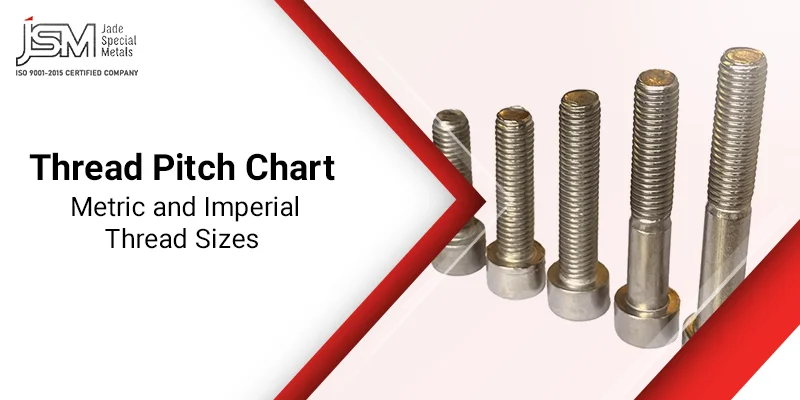
Jade Alloys is a leading manufacturer and exporter of industrial fasteners, serving engineers, procurement teams, and fabricators across construction, piping, and process industries worldwide. Getting the thread callout right before you order is critical, and this guide brings together a complete thread pitch chart covering UNC, UNF, 8UN, ISO metric coarse and metric fine threads, along with tap drill sizes, a metric-to-imperial conversion table, and a short explanation of how to measure pitch on the shop floor.
What Is Thread Pitch?
Thread pitch is the distance from one thread crest to the next crest beside it. On imperial fasteners, we count how many of those crests fit into one inch and call it threads per inch, or TPI. On metric fasteners, we measure the gap itself in millimetres. Both describe the same thing, just counted from opposite directions, which is why a thread pitch chart is the fastest way to move between the two systems without guessing.
Imperial threads are called out as nominal major diameter followed by threads per inch. A 1/2-13 bolt has a half-inch nominal major diameter with thirteen threads counted across one inch of its length. A 3/4-10 has ten. The larger the second number, the finer the thread.
Metric threads are called out as the letter M, then the nominal diameter in millimetres, then the pitch. M10 x 1.5 has a ten millimetre nominal diameter with 1.5 millimetres between each crest. Here the logic flips. A smaller second number means a finer thread.
Pitch versus lead. Pitch is the space between adjacent threads. Lead is how far the fastener travels along its axis in one full turn. On single-start threads, which cover almost every standard bolt, nut, and stud bolt you will handle, pitch and lead are identical. On multi-start threads, they are not, so check before you assume.
Converting pitch to TPI:
TPI = 25.4 divided by pitch in millimetres
An M10 x 1.5 thread works out at 25.4 divided by 1.5, which is 16.93 TPI. Run it the other way and a 1/2-13 thread has a pitch of 25.4 divided by 13, or 1.95 millimetres. That sits close to M12 x 1.75 without matching it, which is exactly why the two never thread together.
Thread Series Explained
Four series cover the overwhelming majority of industrial work.
Coarse thread series: UNC and UNRC. Coarse is the default for general assembly. The threads are deeper and more widely spaced, which makes them forgiving of nicks, rust, site dirt, and the added thickness from hot dip galvanising. They resist cross-threading, they assemble faster because fewer turns take you home, and in softer or more brittle base materials they hold better because the deeper thread form spreads load across more material. If nobody has specified otherwise, coarse is usually the right answer.
Fine thread series: UNF and UNRF. Fine threads have a larger tensile stress area at the same nominal diameter, which means more load capacity from the same bolt size. They also allow finer control over torque and better resistance to loosening under vibration because of the shallower helix angle. The trade-off is tolerance. Fine threads need longer engagement to avoid stripping; they cross-thread more easily, and they perform worse in dirty or corroded conditions. Use them where the assembly is clean and controlled.
8 thread series, 8UN. This series holds a constant eight threads per inch for every diameter of one inch and above. Instead of the pitch getting coarser as diameter grows, it stays fixed, which keeps assembly behaviour predictable across a whole range of sizes. This is the series specified for ASTM A193 B7 stud bolts, A193 B8 and B8M, and ASTM A320 L7 bolts. If you are bolting flanged pressure joints in oil and gas, power, or process work, this is the chart you will read most often. Jade Alloys manufactures stud bolts in 8UN thread to order in carbon, alloy, stainless and nickel grades.
ISO metric coarse and fine, M and MF. Metric threads use the same sixty-degree profile as unified threads, defined in ISO 68- 1, with sizes set out in ISO 261 and ISO 262. DIN 13 covers the same ground in the German system. Every metric diameter has one standard coarse pitch and may also have two or three recognised fine pitches, which is why a metric fine callout must always state the pitch in full. M12 on its own is ambiguous the moment fine threads enter the picture.
Thread Pitch Chart: UNC Coarse (Metric and Imperial)
The table below lists the UNC coarse thread pitch chart with threads per inch, pitch diameter, tensile stress area, and drill sizes, following ASME B1.1.
| Size and TPI | Pitch Dia. (in) | Minor Area (sq in) | Tensile Area (sq in) | Tap Drill | Clearance Drill |
|---|---|---|---|---|---|
| #6 32 | 0.1177 | 0.0074 | 0.0091 | #36 | 9/64 |
| #8 32 | 0.1437 | 0.0120 | 0.0140 | #29 | 11/64 |
| #10 24 | 0.1629 | 0.0145 | 0.0175 | #25 | 3/16 |
| 1/4 20 | 0.2175 | 0.0269 | 0.0318 | #7 | 9/32 |
| 5/16 18 | 0.2764 | 0.0454 | 0.0524 | F | 11/32 |
| 3/8 16 | 0.3344 | 0.0678 | 0.0775 | 5/16 | 13/32 |
| 7/16 14 | 0.3911 | 0.0933 | 0.1063 | U | 15/32 |
| 1/2 13 | 0.4500 | 0.1257 | 0.1419 | 27/64 | 9/16 |
| 5/8 11 | 0.5660 | 0.2020 | 0.2260 | 17/32 | 11/16 |
| 3/4 10 | 0.6850 | 0.3020 | 0.3340 | 21/32 | 13/16 |
| 7/8 9 | 0.8028 | 0.4190 | 0.4620 | 49/64 | 15/16 |
| 1 8 | 0.9188 | 0.5510 | 0.6060 | 7/8 | 1 1/16 |
| 1 1/4 7 | 1.1572 | 0.8900 | 0.9690 | 1 7/64 | 1 5/16 |
| 1 1/2 6 | 1.3917 | 1.2940 | 1.4050 | 1 11/32 | 1 9/16 |
| 2 4 1/2 | 1.8557 | 2.3000 | 2.5000 | 1 25/32 | 2 1/16 |
Thread Pitch Chart: UNF Fine
The UNF fine thread pitch chart also follows ASME B1.1. The UNF range stops at 1 1/2 inch because above that diameter the 8 thread series takes over as the practical choice for heavy work.
| Size and TPI | Pitch Dia. (in) | Minor Area (sq in) | Tensile Area (sq in) | Tap Drill | Clearance Drill |
|---|---|---|---|---|---|
| #6 40 | 0.1218 | 0.0087 | 0.0102 | #33 | 9/64 |
| #8 36 | 0.1460 | 0.0128 | 0.0147 | #29 | 11/64 |
| #10 32 | 0.1697 | 0.0175 | 0.0200 | #21 | 3/16 |
| 1/4 28 | 0.2268 | 0.0326 | 0.0364 | #3 | 9/32 |
| 5/16 24 | 0.2854 | 0.0524 | 0.0580 | I | 11/32 |
| 3/8 24 | 0.3479 | 0.0809 | 0.0878 | Q | 13/32 |
| 7/16 20 | 0.4050 | 0.1090 | 0.1187 | 25/64 | 15/32 |
| 1/2 20 | 0.4675 | 0.1486 | 0.1599 | 29/64 | 9/16 |
| 5/8 18 | 0.5889 | 0.2400 | 0.2560 | 37/64 | 11/16 |
| 3/4 16 | 0.7094 | 0.3510 | 0.3730 | 11/16 | 13/16 |
| 7/8 14 | 0.8286 | 0.4800 | 0.5090 | 13/16 | 15/16 |
| 1 12 | 0.9459 | 0.6250 | 0.6630 | 59/64 | 1 1/16 |
| 1 1/4 12 | 1.1959 | 1.0240 | 1.0730 | 1 11/64 | 1 5/16 |
| 1 1/2 12 | 1.4459 | 1.5210 | 1.5810 | 1 27/64 | 1 9/16 |
Thread Pitch Chart: 8UN Series
Constant eight threads per inch from one inch upward. This is the series used for stud bolts on flanged pressure joints.
| Size and TPI | Pitch Dia. (in) | Minor Area (sq in) | Tensile Area (sq in) | Tap Drill | Clearance Drill |
|---|---|---|---|---|---|
| 1 8 | 0.9188 | 0.5510 | 0.6060 | 7/8 | 1 1/16 |
| 1 1/4 8 | 1.1688 | 0.9290 | 1.0000 | 1 1/8 | 1 5/16 |
| 1 1/2 8 | 1.4188 | 1.4050 | 1.4920 | 1 3/8 | 1 9/16 |
| 1 3/4 8 | 1.6688 | 1.9800 | 2.0800 | 1 5/8 | 1 13/16 |
| 2 8 | 1.9188 | 2.6500 | 2.7700 | 1 7/8 | 2 1/16 |
| 2 1/2 8 | 2.4188 | 4.2900 | 4.4400 | 2 3/8 | 2 9/16 |
| 3 8 | 2.9188 | 6.3200 | 6.5100 | 2 7/8 | 3 1/16 |
| 3 1/2 8 | 3.4188 | 8.7500 | 8.9600 | 3 3/8 | 3 9/16 |
| 4 8 | 3.9188 | 11.5700 | 11.8100 | 3 7/8 | 4 1/16 |
Jade Alloys manufactures A193 B7 and A320 L7 stud bolts in 8UN thread to order.
Thread Pitch Chart: Metric Coarse (ISO)
Metric coarse pitch, equivalent TPI, pitch diameter, and drill sizes, following ISO 261, ISO 262, and DIN 13.
| Size | Pitch (mm) | Equivalent TPI | Pitch Dia. (mm) | Tap Drill (mm) | Clearance Drill (mm) |
|---|---|---|---|---|---|
| M1.6 | 0.35 | 72.6 | 1.373 | 1.25 | 1.80 |
| M2 | 0.40 | 63.5 | 1.740 | 1.60 | 2.40 |
| M3 | 0.50 | 50.8 | 2.675 | 2.50 | 3.40 |
| M4 | 0.70 | 36.3 | 3.545 | 3.30 | 4.50 |
| M5 | 0.80 | 31.8 | 4.480 | 4.20 | 5.50 |
| M6 | 1.00 | 25.4 | 5.350 | 5.00 | 6.60 |
| M8 | 1.25 | 20.3 | 7.188 | 6.80 | 9.00 |
| M10 | 1.50 | 16.9 | 9.026 | 8.50 | 11.00 |
| M12 | 1.75 | 14.5 | 10.863 | 10.20 | 13.50 |
| M16 | 2.00 | 12.7 | 14.701 | 14.00 | 17.50 |
| M20 | 2.50 | 10.2 | 18.376 | 17.50 | 22.00 |
| M24 | 3.00 | 8.5 | 22.051 | 21.00 | 26.00 |
| M30 | 3.50 | 7.3 | 27.727 | 26.50 | 33.00 |
| M36 | 4.00 | 6.4 | 33.402 | 32.00 | 39.00 |
| M48 | 5.00 | 5.1 | 44.752 | 43.00 | 52.00 |
| M64 | 6.00 | 4.2 | 60.103 | 58.00 | 70.00 |
Thread Pitch Chart: Metric Fine (ISO)
Several diameters carry more than one recognised fine pitch. Always write the pitch out in full on a drawing or purchase order.
| Designation | Pitch (mm) | Equivalent TPI | Tap Drill (mm) | Clearance Drill (mm) |
|---|---|---|---|---|
| M8 x 1.0 | 1.00 | 25.4 | 7.00 | 9.00 |
| M10 x 1.25 | 1.25 | 20.3 | 8.80 | 11.00 |
| M10 x 1.0 | 1.00 | 25.4 | 9.00 | 11.00 |
| M12 x 1.5 | 1.50 | 16.9 | 10.50 | 13.50 |
| M12 x 1.25 | 1.25 | 20.3 | 10.80 | 13.50 |
| M16 x 1.5 | 1.50 | 16.9 | 14.50 | 17.50 |
| M20 x 1.5 | 1.50 | 16.9 | 18.50 | 22.00 |
| M24 x 2.0 | 2.00 | 12.7 | 22.00 | 26.00 |
| M36 x 3.0 | 3.00 | 8.5 | 33.00 | 39.00 |
Need Fasteners in a Specific Thread Series?
Jade Alloys manufactures fasteners to drawing in stainless steel, duplex steel, Inconel, and alloy steel across UNC, UNF, 8UN, and full metric ranges. Contact our team for a fast quote.
Get in Touch TodayMetric to Imperial Thread Conversion Chart
These are near equivalents only. They are not interchangeable and must never be mixed inside the same joint. The pitches differ by fractions of a millimetre, which is enough to gall the threads, strip the nut, or leave you with a joint that feels tight and carries almost nothing. Use this table to find the closest substitute when sourcing, never to justify a mixed assembly.
| Metric Size | Nearest Imperial | Metric Pitch (mm) | Imperial TPI (mm equivalent) | Difference |
|---|---|---|---|---|
| M6 x 1.0 | 1/4-20 | 1.00 | 20 (1.27 mm) | Imperial coarser |
| M8 x 1.25 | 5/16-18 | 1.25 | 18 (1.41 mm) | Imperial coarser |
| M10 x 1.5 | 3/8-16 | 1.50 | 16 (1.59 mm) | Imperial coarser |
| M12 x 1.75 | 1/2-13 | 1.75 | 13 (1.95 mm) | Imperial coarser |
| M16 x 2.0 | 5/8-11 | 2.00 | 11 (2.31 mm) | Imperial coarser |
| M20 x 2.5 | 3/4-10 | 2.50 | 10 (2.54 mm) | Very close, still not equal |
| M24 x 3.0 | 1-8 | 3.00 | 8 (3.18 mm) | Imperial coarser |
Coarse Thread or Fine Thread: Which Should You Use?
| Application | Choose | Why |
|---|---|---|
| High vibration | Fine | A shallower helix angle resists loosening |
| Frequent disassembly | Coarse | Fewer turns, far less risk of cross-threading |
| Soft or brittle base material | Coarse | A deeper form spreads load over more material |
| Hot dip galvanised parts | Coarse | Zinc build-up chokes a fine thread |
| Thin walled components | Fine | More threads engaged in limited wall thickness |
| High tension joints | Fine | Larger tensile stress area at the same diameter |
| Dirty or corrosive site conditions | Coarse | Tolerates rust, grit and minor damage |
| Stainless fasteners prone to galling | Coarse | Less surface contact, lower galling risk |
| Flanged pressure joints above one inch | 8UN | Consistent pitch across every diameter |
| Precision adjustment | Fine | Finer torque and position control per turn |
Whenever a fine thread is specified, check the available engagement length before you commit. Fine threads only deliver their strength advantage when there is enough engaged material behind them. Short engagement turns a fine thread from an advantage into a stripped hole. Pair the bolt with matching hex nuts in the same series and grade, never with a near equivalent.
How to Measure Thread Pitch
Three methods, in order of reliability.
Thread pitch gauge. The right tool and the fastest. Press the leaves against the thread until one seats with no light showing at any crest, then read the marking. Metric gauges are marked in millimetres, imperial gauges in TPI, and most sets include both, so confirm which one you picked up before you read it.
Caliper across the crests. Best for metric. Measure the distance across several crests, say ten, then divide by ten. Measuring one gap alone magnifies any small error. Take the major diameter at the same time, and you have the complete callout.
Count across one inch. Best for imperial. Lay a steel rule along the thread, line the zero mark up with one crest, and count how many crests reach the one-inch mark. That count is your TPI. Count crests, not the valleys between them, which is the most common source of an answer that is off by one.
A few cautions. Worn, painted or galvanised threads read badly, so measure a clean, undamaged section wherever you can. Be careful separating a metric fine thread from a similar imperial size. M20 x 2.5 and 3/4-10 sit about four hundredths of a millimetre apart, which no gauge will resolve for you. Measure the major diameter as well and let that settle it.
Thread Standards Reference
| Standard | Covers |
|---|---|
| ASME B1.1 | Unified inch screw threads, UNC, UNF, UNEF and 8UN |
| ISO 68 1 | Basic sixty-degree metric thread profile |
| ISO 261 | ISO general purpose metric threads, general plan |
| ISO 262 | Selected sizes for bolts, screws and nuts |
| DIN 13 | Metric ISO threads in the German system |
| BS 3643 | ISO metric threads, British Standard |
| ASTM A193 | Alloy and stainless bolting for high temperature service |
| ASTM A194 | Nuts for high pressure and high temperature service |
| ASTM A320 | Alloy steel bolting for low temperature service |
The Bottom Line
This guide has covered the full thread pitch chart across UNC, UNF, 8UN, ISO metric coarse and metric fine, along with tap drill sizes, a metric-to-imperial conversion table and a short method for measuring pitch by hand. Whether you are sourcing a general assembly bolt in coarse thread or specifying stud bolts in 8UN for a flanged pressure joint, the data above gives you the reference needed to call out the thread correctly the first time.
Need Fasteners in a Specific Thread Series?
Jade Alloys supplies bolts, nuts and stud bolts in UNC, UNF, 8UN and full metric ranges, cut and rolled to ASTM, ASME, DIN, BS and ISO standards. Contact us for cut-to-length and full range options.
Contact Us NowFrequently Asked Questions
1. What is thread pitch and how is it measured?
2. What is the difference between thread pitch and TPI?
3. How do I convert metric thread pitch to threads per inch?
4. Is coarse or fine thread stronger?
5. When should I use 8UN thread instead of UNC?
6. What thread pitch does an M10 bolt have?
7. What is the standard thread pitch for a 1/2 inch bolt?
8. Are UNC and metric coarse threads interchangeable?
9. Which thread series do ASTM A193 B7 stud bolts use?