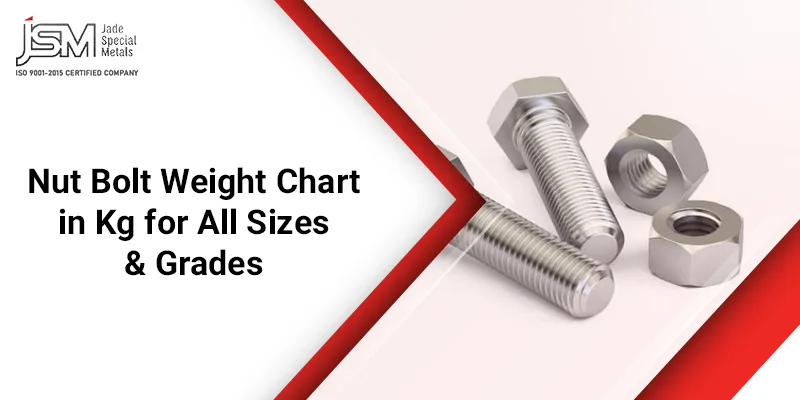
This nut bolt weight chart is provided in different metric sizes ranging from M6 to M64. The weight of each M12 × 60 mm carbon steel bolt and the corresponding nut is around 82g, 100 sets of bolts weigh about 8.2kg, and 1kg of bolts contain around 12 sets. Refer to this nut bolt weight chart (kg) for order weight, freight and bills of materials estimates. Bolt weight chart mm references, individual and combined fastener weights and material correction factors are provided. For additional information, check out our hex bolt weight chart and hex nut weight chart. A nut bolt calculator can also be used to calculate weight based on other dimensions and materials to serve as a reference for additional calculations. If you are looking for an MS bolt weight chart, stud bolt weight chart, bolt weight chart pdf or nut bolt weight chart kg pdf download, refer to the corresponding chart and/or calculator resources on the website.
Nut Bolt Weight Chart in Kg
| Fastener Size & Length | Bolt Only Weight (g) | Nut Only Weight (g) | Assembly Set Weight (g) | Weight per 100 Sets (kg) | Pieces per Kg (Sets/kg) |
| M6 × 30 mm | 8.2 | 2.5 | 10.7 | 1.07 | 93.5 |
| M8 × 40 mm | 19.8 | 5.2 | 25.0 | 2.50 | 40.0 |
| M10 × 50 mm | 40.5 | 11.6 | 52.1 | 5.21 | 19.2 |
| M12 × 60 mm | 64.9 | 17.3 | 82.2 | 8.22 | 12.2 |
| M16 × 80 mm | 153.9 | 33.3 | 187.2 | 18.72 | 5.3 |
| M20 × 100 mm | 301.2 | 64.4 | 365.6 | 36.56 | 2.7 |
| M24 × 120 mm | 531.9 | 110.0 | 641.9 | 64.19 | 1.6 |
How to Read This Chart
To estimate fastener weights for structural, piping and machinery applications, keep the following assumptions in mind.
Weight Units: Values are shown in grams per piece or set and in kilograms per 100 sets.
Measurement Basis: Bolt length L is measured under the head to the end of the shank. Bolt diameter d is the nominal thread major diameter.
Bolt and Nut Assembly: Unless stated otherwise, one assembly set consists of one hex head bolt and one matching standard hex nut. Flat washers and spring washers are excluded unless specified.
Material Baseline: The chart uses a carbon steel density of 7.85 g/cm³. For stainless steel and high-nickel alloys, apply the appropriate material correction factor.
Thread Type: Bolt weights assume partly threaded hex bolts to ISO 4014. Fully threaded bolts to ISO 4017 weigh slightly less because the thread is smaller than the nominal diameter.
Manufacturing Tolerances: The chart provides calculated nominal weights. Actual batch weights can vary by a few percent due to dimensional tolerances, thread geometry, material grade and surface coatings.
Weight per 100 Bolt and Full Hex Bolt and Nut Weight Chart (M6–M64)
| Size | M6 | M8 | M10 | M12 | M16 | M20 | M24 | M30 | M36 | M42 | M48 | M56 | M64 |
| Nut weight per piece (g) | 2.5 | 5.2 | 11.6 | 17.3 | 33.3 | 64.4 | 110.0 | 229.0 | 392.0 | 646.0 | 966.0 | 1,424.0 | 1,964.0 |
| 20 mm | 0.85 | 1.70 | – | – | – | – | – | – | – | – | – | – | – |
| 30 mm | 1.07 | 2.09 | 3.96 | – | – | – | – | – | – | – | – | – | – |
| 40 mm | 1.29 | 2.50 | 4.58 | 6.84 | – | – | – | – | – | – | – | – | – |
| 50 mm | 1.51 | 2.90 | 5.21 | 7.53 | 14.90 | – | – | – | – | – | – | – | – |
| 60 mm | – | 3.31 | 5.83 | 8.23 | 16.15 | 28.50 | – | – | – | – | – | – | – |
| 80 mm | – | – | 7.08 | 9.61 | 18.72 | 32.40 | 54.10 | – | – | – | – | – | – |
| 100 mm | – | – | – | 11.00 | 21.28 | 36.56 | 59.15 | 108.50 | – | – | – | – | – |
| 120 mm | – | – | – | – | 23.85 | 40.70 | 64.19 | 117.40 | 166.70 | – | – | – | – |
| 140 mm | – | – | – | – | – | 44.85 | 69.24 | 126.30 | 208.60 | 267.80 | – | – | – |
| 160 mm | – | – | – | – | – | 49.00 | 74.28 | 135.20 | 221.90 | 333.60 | 404.10 | – | – |
| 180 mm | – | – | – | – | – | – | 79.33 | 144.10 | 235.20 | 352.00 | 502.50 | – | – |
| 200 mm | – | – | – | – | – | – | 84.37 | 153.00 | 248.50 | 370.40 | 527.00 | 650.30 | – |
| 250 mm | – | – | – | – | – | – | – | 175.25 | 281.75 | 416.40 | 588.25 | 742.50 | 996.40 |
| 300 mm | – | – | – | – | – | – | – | – | 315.00 | 462.40 | 649.50 | 839.20 | 1,122.60 |
ISO 4032 and DIN 934 Hex Nut Weight Compared
Standard hex nuts vary slightly depending on whether they follow ISO 4032 (modern metric standard, slightly higher nut thickness m on specific sizes) or DIN 934 (legacy standard).
| Size | Across flats s (mm) | ISO 4032 height m (mm) | DIN 934 height m (mm) | ISO 4032 (kg) | DIN 934 (kg) |
| M6 | 10 | 5.2 | 5.0 | 0.26 | 0.25 |
| M8 | 13 | 6.8 | 6.5 | 0.56 | 0.52 |
| M10 | 16 ISO, 17 DIN | 8.4 | 8.0 | 1.03 | 1.16 |
| M12 | 18 ISO, 19 DIN | 10.8 | 10.0 | 1.60 | 1.73 |
| M16 | 24 | 14.8 | 13.0 | 3.81 | 3.33 |
| M20 | 30 | 18.0 | 16.0 | 7.23 | 6.44 |
| M24 | 36 | 21.5 | 19.0 | 12.4 | 11.0 |
| M30 | 46 | 25.6 | 24.0 | 24.4 | 22.9 |
Bolt, Nut, and Washer Assembly Weight Chart
| Size | Bolt + nut (g) | Single washer (g) | Two washers (g) | Set total (g) | Per 100 sets (kg) |
| M8 x 40 mm | 25.0 | 2.14 / 1.83 | 4.28 / 3.66 | 29.28 / 28.66 | 2.93 / 2.87 |
| M10 x 50 mm | 52.1 | 4.08 / 3.57 | 8.16 / 7.14 | 60.26 / 59.24 | 6.03 / 5.92 |
| M12 x 60 mm | 82.3 | 6.27 | 12.54 | 94.84 | 9.48 |
| M16 x 80 mm | 187.2 | 14.60 / 11.30 | 29.20 / 22.60 | 216.40 / 209.80 | 21.64 / 20.98 |
| M20 x 100 mm | 365.6 | 28.30 / 17.20 | 56.60 / 34.40 | 422.20 / 400.00 | 42.22 / 40.00 |
| M24 x 120 mm | 641.9 | 52.30 / 32.30 | 104.60 / 64.60 | 746.50 / 706.50 | 74.65 / 70.65 |
Weight per 1000 Pieces and Pieces per Kg
When conducting store inventory counts by scale weight or ordering small packaged units, converting between total mass and quantity is critical.
Mathematical Conversion Formulas
- Calculate Weight per 1,000 Pieces (kg):
Weight per 1,000 pieces (kg) = weight per 100 pieces (kg) x 10
- Calculate Pieces per Kilogram (pcs/kg):
Pieces per Kg = 100 / Weight per 100 pcs (kg)
Pieces per Kg = 1000 / Assembly Set Weight in Grams
- Convert Kilograms to Pounds (lbs):
Weight in lb = weight in kg x 2.2046
Worked Conversion Example
If an M16 × 80 mm bolt + nut set weighs 18.72 kg per 100 sets:
- Weight per 1,000 sets: 18.72 × 10 = 187.2 kg
- Pieces per Kilogram: 100 / 18.72 = 5.34 sets/kg
- Weight per 100 sets in lbs: 18.72 × 2.20462 = 41.27 lbs
Inch (UNC) Nut and Bolt Weight in Lbs per 100
| Size and length | Bolt only (lb per 100) | Nut only (lb per 100) | Set (lb per 100) | Set (kg per 100) | Sets per kg |
| 1/4 in x 1-1/2 in | 2.4 | 0.74 | 3.2 | 1.43 | 69.8 |
| 3/8 in x 2 in | 7.1 | 1.58 | 8.6 | 3.92 | 25.5 |
| 1/2 in x 2-1/2 in | 16.1 | 3.75 | 19.8 | 9.00 | 11.1 |
| 5/8 in x 3 in | 30.7 | 7.30 | 38.0 | 17.23 | 5.81 |
| 3/4 in x 4 in | 58.6 | 11.90 | 70.5 | 31.99 | 3.13 |
| 7/8 in x 4-1/2 in | 90.8 | 19.00 | 109.8 | 49.81 | 2.01 |
| 1 in x 5 in | 135.2 | 28.30 | 163.5 | 74.15 | 1.35 |
| 1-1/4 in x 6 in | 257.9 | 53.20 | 311.1 | 141.11 | 0.71 |
| 1-1/2 in x 7 in | 433.0 | 88.50 | 521.5 | 236.55 | 0.42 |
How Material Changes Nut Bolt Weight
The baseline tables in this guide use standard carbon steel ( 7.85 g/cm 3 ). If your project specifies stainless steel, corrosion-resistant nickel alloys, or lightweight titanium, multiply the baseline carbon steel weight by the appropriate material factor shown below.
Material Density & Multiplier Table
| Material Grade | Density (g per cubic cm) | Weight Multiplier vs Carbon Steel |
| Carbon / Alloy Steel (Grade 8.8, 10.9, B7) | 7.85 | 1.000 |
| Stainless Steel 304 / 304L | 7.93 | 1.010 |
| Stainless Steel 316 / 316L | 7.98 | 1.016 |
| Duplex 2205 | 7.80 | 0.994 |
| Inconel 625 | 8.44 | 1.075 |
| Inconel 718 | 8.19 | 1.043 |
| Hastelloy C276 | 8.89 | 1.132 |
| Monel 400 | 8.80 | 1.121 |
| Titanium Grade 2 | 4.51 | 0.574 |
Material Calculation Worked Example
Problem: Calculate the weight of 500 sets of M20 × 100 mm hex bolts and nuts made from Hastelloy C276.
- Find baseline carbon steel weight:
From the chart, 100 sets of carbon steel M20 × 100 mm weigh 36.56 kg.
- Apply material multiplier:
The Hastelloy C276 factor is 1.132.
Weight per 100 sets (Hastelloy) = 36.56 kg × 1.132 = 41.39 kg
- Calculate for 500 sets:
Total Weight = 41.39 kg × 5 = 206.95 kg
How to Calculate Nut Bolt Weight
Calculate the weight of a bolt and nut set by estimating three components: the bolt head, the shank and threaded section, and the nut. Use millimetres for all dimensions and a density of 0.00785 g/mm³ for carbon steel.
1. Bolt Head Weight Formula
Head weight (g) = 0.866 × s² × k × 0.95 × 0.00785
Here, s is the width across the flats in mm, and k is the head height in mm. The factor 0.95 accounts for the material removed by the head chamfer.
2. Bolt Shank and Thread Weight Formula
Shank weight (g) = 0.00617 × d² × L
Here, d is the nominal shank diameter in mm, and L is the length in mm. This formula estimates the weight of a plain cylindrical shank. A threaded section weighs slightly less because its thread-root diameter is smaller than the nominal diameter.
3. Hex Nut Weight Formula
Nut weight (g) = (0.866 × s² − 0.7854 × d₁²) × m × 0.00785 × 0.94
Here, s is the nut width across flats in mm, d₁ is the thread minor diameter in mm, and m is the nut height in mm. Estimate the minor diameter using:
d₁ = d − 1.0825 × pitch
The factor 0.94 accounts approximately for chamfers and other material removed from the nut.
4. Worked Example: M12 × 60 mm Bolt and Nut
For an M12 bolt with an 18 mm head width, a 7.5 mm head height, and a 60 mm length, the estimated component weights are:
- Bolt head: 0.866 × 18² × 7.5 = 2,104 mm³ before the chamfer allowance. After applying the 0.95 factor, the estimated weight is approximately 15.7 g.
- Plain shank: 0.00617 × 12² × 60 = 53.3 g. This assumes the full length is a plain cylinder, so it provides an upper-bound estimate for the shank.
- Bolt total: The head and full plain shank weigh approximately 69.0 g.
- M12 DIN 934 nut: The reference chart lists a weight of approximately 17.3 g.
The combined bolt-and-nut set weighs approximately 82.2 g according to the chart. Using the full plain-shank estimate gives an upper bound of approximately 86.3 g for the complete set.
For a detailed nut calculation, see the DIN 934 nut weight chart. For other fastener sizes and materials, use the metal weights calculator.
Frequently Asked Questions
What is the weight of an M10 bolt and nut?
An M10 × 50 mm carbon steel bolt with a matching nut weighs about 52.1 g per set, which is 5.21 kg per 100 sets.
How many nuts and bolts are in 1 kg?
An M12 × 60 mm bolt and nut set weighs about 82.3 g, so 1 kg holds approximately 12 complete sets. Smaller sets give more: an M8 × 40 mm set weighs about 25 g, which equals 40 sets per kg.
How do you calculate nut bolt weight?
Add the head volume, the shank and thread volume, and the nut volume, then multiply by the material density. For carbon steel, the density is 7.85 g/cm³. A bolt shank of diameter d and length L weighs approximately 0.00617 × d² × L grams, with d and L measured in millimetres.
Does a bolt weight chart include the nut?
Not always. Check the column headings. This chart lists bolt-only, nut-only and combined set weights separately, with the full chart also providing kilograms per 100 bolt-and-nut sets.
Does stainless steel weigh more than carbon steel?
Yes, slightly. Stainless steel 304 is approximately 1% denser than carbon steel, while grade 316 is about 1.6% denser. Multiply the carbon steel weight by 1.01 for grade 304 or 1.016 for grade 316 to estimate the weight.
Can I use this chart for stainless steel or alloy bolts?
Yes. Multiply the carbon steel weight by the relevant material factor from the density table. For Inconel 625, use a factor of 1.075; for Monel 400, use 1.121.
What is the weight of 100 M12 nuts and bolts?
One hundred M12 × 60 mm carbon steel bolt-and-nut sets weigh approximately 8.23 kg.
How accurate are nut bolt weight charts?
Weight charts provide calculated nominal weights. Actual weights vary with manufacturing tolerances, thread length, material grade and surface coatings. Weigh a sample when an exact figure is required.