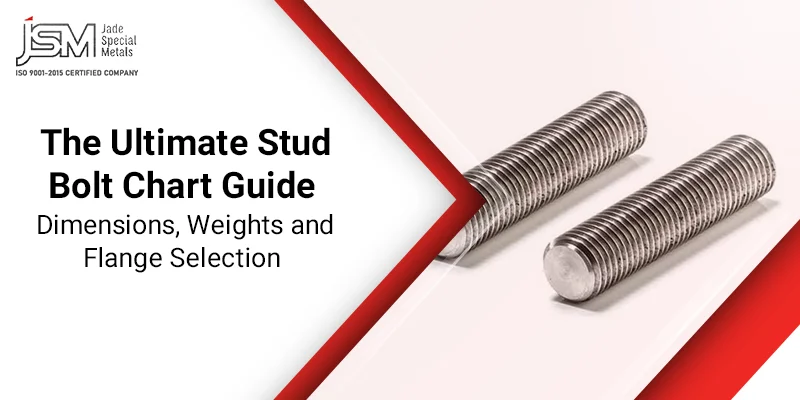
Jade Alloys is a leading manufacturer and exporter of industrial fasteners, serving piping designers, procurement teams and field inspectors across refineries, offshore platforms and process plants worldwide. Getting stud bolt sizing right on flanged joints, valves and pressure piping comes down to two things. Keeping the plant safe and not paying for a leak later. A stud that sits two threads short, or a thread pitch forced into a tapped flange it was never meant for, will find you out the moment the system heats up and starts cycling. Usually as a weeping gasket. Sometimes as something worse.
This stud bolt chart pulls together the data that piping designers, buyers, and field inspectors actually reach for. Metric and imperial weights, ASME B16.5 flange bolting tables, heavy hex nut dimensions, torque values, and the length formula you can run on the back of a drawing while standing at the joint.
One thing worth settling before the tables. Three forms of stud turn up on site, and people order the wrong one more often than you would expect. Fully threaded studs carry thread the whole way along and cover the overwhelming majority of flange work. Double end studs have a plain unthreaded waist between two threaded ends, used where the stud passes through a bore and only the ends need to grip. Tap end studs have a shorter threaded end that screws permanently into a tapped hole, leaving a longer nut end exposed for repeated assembly. Weld studs and single-end studs exist too, but those belong to fabrication rather than flange bolting.
Understanding Stud Bolt Standards and Thread Pitch Profiles
Unlike a hex cap screw, the common stud bolt is a continuous threaded rod with a nut on each end. That is the whole point of it. You pull tension from both sides of the joint instead of one, and the load lands evenly across the gasket face. Matching thread pitch to the specification is step one, every time, and it is the step people skip when they are in a hurry.
Four thread profiles cover almost everything you will handle.
Unified Coarse, or UNC. The standard pitch for general mechanical connections below 1 inch diameter. Deeper, more widely spaced threads that shrug off site dirt, minor damage, and plating buildup.
Unified Fine, or UNF, is found in specialised machinery and compact valve assemblies that need tight tension control and extra resistance to vibration. You will rarely see it on flange bolting.
8 Thread Series, or 8UN. The specified series for pressure piping and ASME flange bolting at 1 inch diameter and above. The reasoning is mechanical, not arbitrary. As diameter grows, a coarse thread keeps cutting deeper into the core of the rod, and eventually you are throwing away the strength you paid for. Fixing the pitch at eight threads per inch stops that. Core tensile strength stays high, and torque wrenching stays manageable whether you are on a 1-inch stud or a 4-inch one.
ISO metric and DIN. Metric projects work to DIN 976 for full thread studding, DIN 939 for tap end studs, and ASME B18.31.2 for metric patterns. DIN 2510 covers double end studs with a reduced shank.
Full pitch, stress area, and tap drill data for all four series sit on our thread pitch chart.
Imperial Stud Bolt Weight and Dimension Chart
Imperial studs are still the workhorse across oil refineries, gas processing units, and chemical plants running to ASME and ANSI codes. Use this stud bolt weight chart to check dimensions or to estimate weight in kilograms per 100 pieces across standard cut lengths.
| Nominal Diameter | Threads Per Inch | Minor Dia. (in) | Weight per 100 pcs at 100 mm (kg) | Weight per 100 pcs at 200 mm (kg) |
|---|---|---|---|---|
| 3/8 inch | 16 UNC | 0.2938 | 4.8 | 9.5 |
| 1/2 inch | 13 UNC | 0.4030 | 8.6 | 17.1 |
| 5/8 inch | 11 UNC | 0.5135 | 13.5 | 27.0 |
| 3/4 inch | 10 UNC | 0.6273 | 19.6 | 39.3 |
| 7/8 inch | 9 UNC | 0.7387 | 26.9 | 53.9 |
| 1 inch | 8 UNC and 8UN | 0.8466 | 35.2 | 70.5 |
| 1 1/8 inch | 8 UN | 0.9716 | 45.2 | 90.4 |
| 1 1/4 inch | 8 UN | 1.0966 | 56.4 | 112.8 |
| 1 3/8 inch | 8 UN | 1.2216 | 68.8 | 137.6 |
| 1 1/2 inch | 8 UN | 1.3466 | 82.5 | 165.1 |
| 1 3/4 inch | 8 UN | 1.5966 | 113.6 | 227.2 |
| 2 inch | 8 UN | 1.8466 | 149.7 | 299.4 |
| 2 1/4 inch | 8 UN | 2.0966 | 190.8 | 381.7 |
| 2 1/2 inch | 8 UN | 2.3466 | 236.7 | 473.5 |
| 3 inch | 8 UN | 2.8466 | 343.8 | 687.7 |
| 3 1/2 inch | 8 UN | 3.3466 | 470.5 | 941.0 |
| 4 inch | 8 UN | 3.8466 | 617.3 | 1234.5 |
These weights are worked out for carbon and alloy steel at 7.85 grams per cubic centimetre, using the mean of nominal and stress area so that the metal removed by the thread is properly accounted for. Stainless, duplex, and nickel grades come in within about three percent either side.
Need Fasteners in a Specific Thread Series?
Need Crate Weights for a Shipment? Download the stud bolt chart PDF for desk and field use, or drop your bill of materials into the Jade Alloys metal weights calculator to estimate freight loads.
Get in Touch TodayMetric Stud Bolt Size and Weight Chart
Metric studding to DIN 976 and ISO standards is the norm across European, Middle Eastern and Asian projects. Pitch, minor diameter, stress area and mass per metre below are calculated on exactly the same basis as the imperial chart above so the two agree with each other rather than contradicting.
| Nominal Size | Pitch (mm) | Minor Dia. (mm) | Stress Area (sq mm) | Mass per Metre (kg) |
|---|---|---|---|---|
| M6 | 1.00 | 4.773 | 20.1 | 0.190 |
| M8 | 1.25 | 6.466 | 36.6 | 0.341 |
| M10 | 1.50 | 8.160 | 58.0 | 0.536 |
| M12 | 1.75 | 9.853 | 84.3 | 0.775 |
| M16 | 2.00 | 13.546 | 157.0 | 1.405 |
| M20 | 2.50 | 16.933 | 245.0 | 2.195 |
| M24 | 3.00 | 20.319 | 353.0 | 3.161 |
| M27 | 3.00 | 23.319 | 459.0 | 4.049 |
| M30 | 3.50 | 25.706 | 561.0 | 4.976 |
| M36 | 4.00 | 31.093 | 817.0 | 7.202 |
| M42 | 4.50 | 36.479 | 1121.0 | 9.838 |
| M48 | 5.00 | 41.866 | 1473.0 | 12.884 |
| M56 | 5.50 | 49.252 | 2030.0 | 17.635 |
| M64 | 6.00 | 56.639 | 2676.0 | 23.130 |
| M80 | 6.00 | 72.639 | 4344.0 | 36.779 |
| M100 | 6.00 | 92.639 | 6940.0 | 58.066 |
How Stud Bolt Weights Are Calculated
If the size you want is not in either table above, the sum takes about ten seconds.
A fully threaded stud weighs less than a solid round bar of the same nominal diameter, because the thread cuts metal away. It weighs more than the stress area on its own would suggest, because the crests are still sitting there. Split the difference between the two and you land within roughly two percent, which is comfortably good enough for freight estimating or stock valuation.
Effective area equals nominal area plus stress area, divided by 2
Weight in kg equals effective area in sq mm, times length in mm, times density in grams per cubic cm, divided by 1,000,000
Worked example, M24 stud, 500 mm long, carbon steel:
Nominal area 452.4 sq mm, stress area 353.0 sq mm. Effective area works out to 402.7 sq mm. Weight equals 402.7 times 500 times 7.85, divided by 1,000,000, which gives 1.58 kg per piece.
Densities to use are 7.85 for carbon and alloy steel, 8.00 for 316 stainless, 7.80 for duplex, and 8.44 for Inconel 625, all in grams per cubic centimetre.
ASME B16.5 Flange Stud Bolt Chart
Full thread engagement through the nut, without excessive stick-out on the other side, is what site sign-off comes down to. The tables below give bolt quantity and diameter for every flange size in ASME B16.5, from 1/2 inch through to 24 inch.
Bolt quantity and diameter, Class 150 to Class 600
| Pipe Size (NPS) | Class 150 | Class 300 | Class 600 |
|---|---|---|---|
| 1/2 inch | 4 x 1/2 inch | 4 x 1/2 inch | 4 x 1/2 inch |
| 3/4 inch | 4 x 1/2 inch | 4 x 5/8 inch | 4 x 5/8 inch |
| 1 inch | 4 x 1/2 inch | 4 x 5/8 inch | 4 x 5/8 inch |
| 1 1/2 inch | 4 x 1/2 inch | 4 x 3/4 inch | 4 x 3/4 inch |
| 2 inch | 4 x 5/8 inch | 8 x 5/8 inch | 8 x 5/8 inch |
| 3 inch | 4 x 5/8 inch | 8 x 3/4 inch | 8 x 3/4 inch |
| 4 inch | 8 x 5/8 inch | 8 x 3/4 inch | 8 x 7/8 inch |
| 6 inch | 8 x 3/4 inch | 12 x 3/4 inch | 12 x 1 inch |
| 8 inch | 8 x 3/4 inch | 12 x 7/8 inch | 12 x 1 1/8 inch |
| 10 inch | 12 x 7/8 inch | 16 x 1 inch | 16 x 1 1/4 inch |
| 12 inch | 12 x 7/8 inch | 16 x 1 1/8 inch | 20 x 1 1/4 inch |
| 14 inch | 12 x 1 inch | 20 x 1 1/8 inch | 20 x 1 3/8 inch |
| 16 inch | 16 x 1 inch | 20 x 1 1/4 inch | 20 x 1 1/2 inch |
| 18 inch | 16 x 1 1/8 inch | 24 x 1 1/4 inch | 20 x 1 5/8 inch |
| 20 inch | 20 x 1 1/8 inch | 24 x 1 1/4 inch | 24 x 1 5/8 inch |
| 24 inch | 20 x 1 1/4 inch | 24 x 1 1/2 inch | 24 x 1 7/8 inch |
Bolt quantity and diameter, Class 900 to Class 2500
| Pipe Size (NPS) | Class 900 | Class 1500 | Class 2500 |
|---|---|---|---|
| 1/2 inch | 4 x 3/4 inch | 4 x 3/4 inch | 4 x 3/4 inch |
| 1 inch | 4 x 7/8 inch | 4 x 7/8 inch | 4 x 7/8 inch |
| 2 inch | 8 x 7/8 inch | 8 x 7/8 inch | 8 x 1 inch |
| 3 inch | 8 x 7/8 inch | 8 x 1 1/8 inch | 8 x 1 1/4 inch |
| 4 inch | 8 x 1 1/8 inch | 8 x 1 1/4 inch | 8 x 1 1/2 inch |
| 6 inch | 12 x 1 1/8 inch | 12 x 1 3/8 inch | 8 x 2 inch |
| 8 inch | 12 x 1 3/8 inch | 12 x 1 5/8 inch | 12 x 2 inch |
| 10 inch | 16 x 1 3/8 inch | 12 x 1 7/8 inch | 12 x 2 1/2 inch |
| 12 inch | 20 x 1 3/8 inch | 16 x 2 inch | 12 x 2 3/4 inch |
| 14 inch | 20 x 1 1/2 inch | 16 x 2 1/4 inch | not covered |
| 16 inch | 20 x 1 5/8 inch | 16 x 2 1/2 inch | not covered |
| 18 inch | 20 x 1 7/8 inch | 16 x 2 3/4 inch | not covered |
| 20 inch | 20 x 2 inch | 16 x 3 inch | not covered |
| 24 inch | 20 x 2 1/2 inch | 16 x 3 1/2 inch | not covered |
Stud lengths, Class 150 and Class 300
| Pipe Size | Class | Stud Diameter | RF Length (in) | RTJ Length (in) |
|---|---|---|---|---|
| 1/2 inch | 150 | 1/2 inch | 2.25 | 2.75 |
| 1 inch | 150 | 1/2 inch | 2.50 | 3.00 |
| 2 inch | 150 | 5/8 inch | 3.25 | 3.75 |
| 4 inch | 150 | 5/8 inch | 3.50 | 4.00 |
| 6 inch | 150 | 3/4 inch | 4.00 | 4.50 |
| 8 inch | 150 | 3/4 inch | 4.25 | 4.75 |
| 10 inch | 150 | 7/8 inch | 4.75 | 5.25 |
| 12 inch | 150 | 7/8 inch | 5.25 | 5.75 |
| 1/2 inch | 300 | 1/2 inch | 2.50 | 3.00 |
| 1 inch | 300 | 5/8 inch | 3.00 | 3.50 |
| 2 inch | 300 | 5/8 inch | 3.50 | 4.00 |
| 4 inch | 300 | 3/4 inch | 4.25 | 4.75 |
| 6 inch | 300 | 3/4 inch | 4.75 | 5.25 |
| 8 inch | 300 | 7/8 inch | 5.25 | 5.75 |
| 10 inch | 300 | 1 inch | 6.25 | 6.75 |
| 12 inch | 300 | 1 1/8 inch | 6.75 | 7.25 |
At Class 600 and above, you will normally find RF and RTJ stud lengths come out the same, because the flange is already thick enough at those classes to swallow the ring groove. The difference shows up at Class 150 and Class 300, where flanges are thinner. For any size or class not listed here, run the formula further down rather than interpolating between rows. Interpolation on flange bolting is how people end up with a pallet of studs that are a quarter inch short.
Heavy Hex Nut Dimensions for Stud Bolts
Pressure piping codes call for heavy hex nuts rather than standard finished hex nuts, and there is a good reason for it. The extra width across the flats gives impact wrenches and torque tools something proper to grip, and it spreads the clamping load across more of the flange face, so threads are far less likely to strip or gall during makeup.
| Stud Diameter | Thread Pitch | Across Flats (in) | Across Flats (mm) | Nut Height (in) | Washer OD (mm) |
|---|---|---|---|---|---|
| 1/2 inch | 13 UNC | 7/8 inch | 22.22 | 31/64 inch | 27.0 |
| 5/8 inch | 11 UNC | 1 1/16 inch | 26.98 | 39/64 inch | 34.0 |
| 3/4 inch | 10 UNC | 1 1/4 inch | 31.75 | 47/64 inch | 42.0 |
| 7/8 inch | 9 UNC | 1 7/16 inch | 36.51 | 55/64 inch | 50.0 |
| 1 inch | 8 UN | 1 5/8 inch | 41.27 | 63/64 inch | 56.0 |
| 1 1/8 inch | 8 UN | 1 13/16 inch | 46.03 | 1 7/64 inch | 62.0 |
| 1 1/4 inch | 8 UN | 2 inch | 50.80 | 1 7/32 inch | 68.0 |
| 1 1/2 inch | 8 UN | 2 3/8 inch | 60.32 | 1 15/32 inch | 82.0 |
Which nut grade pairs with which stud? Dimensions are only half the decision, and the half people remember. Grade pairing is the other half, and it is where flanged joints actually fail.
Pair A193 B7 with A194 2H, B8 with A194 8, B8M with A194 8M, and A320 L7 with A194 4 or 7. The nut is deliberately made softer than the stud. If something is going to gall or strip during makeup, you want the damage on the nut you can cut off in ten minutes, not on the stud buried inside the flange. Full range in our heavy hex nuts section.
How to Calculate Stud Bolt Length for Flanges
Working the length out before you order saves genuine trouble later. Order short, and the threads will never bite fully through the nut. Order long, and they foul the pipe run next door, or the insulation jacket, or a valve body nobody drew in.
Stud bolt length formula for raised face flanges. Stud length is measured end to end, excluding the chamfered points.
Length equals 2 times flange thickness, plus gasket thickness, plus 2 times nut height, plus 2 times thread overhang.
Flange thickness is taken from the applicable ASME B16.5 dimension table. Compressed gasket thickness runs roughly 1/8 inch or 3.2 mm for a spiral wound gasket. Heavy hex nut height is nearly equal to the bolt diameter. Thread overhang past each nut face is normally 1.5 to 3 thread pitches.
Worked example, a 4 inch Class 300 raised face flange joint:
Flange thickness, 2 times 1.25 inch, gives 2.50 inch. Compressed gasket adds 0.125 inch. Nut heights, 2 times 0.75 inch, give 1.50 inch. Thread overhang, 2 times 0.125 inch, gives 0.25 inch. Total comes to 2.50 plus 0.125 plus 1.50 plus 0.25, which gives 4.375 inches. Order size rounds up to 4.50 inches, the standard quarter-inch increment.
Always round up, never down. Standard length tolerance is plus or minus 1.3 mm up to 12 inches, plus or minus 3.2 mm from 12 to 18 inches, and plus or minus 6.4 mm above 18 inches.
Stud Bolt Torque Specification Chart
Use these figures to seat flange gaskets properly without stretching studs past their elastic limit.
| Stud Diameter | A193 B7 (ft lb) | A193 B7 (Nm) | A193 B8 Class 2 (ft lb) | A193 B8 Class 2 (Nm) | Duplex S31803 (ft lb) | Duplex S31803 (Nm) |
|---|---|---|---|---|---|---|
| 1/2 inch | 60 | 81 | 45 | 61 | 55 | 75 |
| 5/8 inch | 120 | 163 | 90 | 122 | 110 | 149 |
| 3/4 inch | 210 | 285 | 155 | 210 | 190 | 258 |
| 7/8 inch | 340 | 461 | 250 | 339 | 310 | 420 |
| 1 inch | 510 | 691 | 375 | 508 | 460 | 624 |
| 1 1/8 inch | 740 | 1003 | 545 | 739 | 670 | 908 |
| 1 1/4 inch | 1040 | 1410 | 765 | 1037 | 940 | 1274 |
| 1 1/2 inch | 1820 | 2468 | 1340 | 1817 | 1640 | 2223 |
These values assume a K factor of 0.15 on clean, lubricated threads at ambient temperature. Dry threads need roughly thirty percent more torque to reach the same preload, and the scatter around that figure is much wider, which is the real problem with dry makeup. On critical joints, bolt tensioning gives far more consistent results than torque and should be specified wherever the code allows it.
Material Grade Selection Guide
Operating temperature, pressure rating and process chemistry drive the grade decision. Checking the grade against the service before you order is what stops stress corrosion cracking and brittle failure from turning up eighteen months later.
| Grade | Specification | Temperature Range | Typical Applications |
|---|---|---|---|
| Alloy B7 | ASTM A193 B7 | minus 29 C to 425 C | General refinery piping, steam lines, standard pressure vessels |
| Alloy L7 | ASTM A320 L7 | minus 101 C to 340 C | Low temperature piping, LNG storage, cold climate offshore |
| Alloy B16 | ASTM A193 B16 | 425 C to 593 C | Power generation, high-temperature boilers, turbine casings |
| Stainless B8 | ASTM A193 B8, type 304 | minus 196 C to 538 C | Chemical processing, food service piping, mild organic acids |
| Stainless B8M | ASTM A193 B8M, type 316 | minus 196 C to 538 C | Marine environments, offshore platforms, harsh chemical service |
| Duplex | UNS S31803 and S32750 | minus 50 C to 300 C | Desalination plant, sour gas lines, seawater cooling systems |
| Nickel alloys | Inconel 625 and Hastelloy C276 | minus 196 C to 980 C | Severe acid handling, high-temperature chemical reactors |
Jade Alloys manufactures stud bolts in every grade listed above, cut to length to drawing. Need certified material for critical service? See our stock of ASTM A193 B7 stud bolts and duplex and super duplex fasteners, or request a quote.
Stud Bolt Coatings and Surface Finishes
Coating affects two things: how long the stud lasts and how the joint makes up.
PTFE and Xylan give the best corrosion resistance and, just as usefully, a consistent friction coefficient, which matters a great deal when torque values are specified. They also handle repeated disassembly well. Hot dip galvanising suits structural and outdoor work, though the zinc buildup means the nut has to be tapped oversize to suit, and that catches people out. Zinc plating is light indoor protection only. Black phosphate is a cheap, mild protectant for dry indoor service. Plain finish is normal where the joint is insulated, or the process fluid is doing the protecting.
A practical note on stainless steel fasteners. Stainless galls against stainless under load, and once it seizes, you are cutting the stud out. A coating or an anti-seize compound is not optional on B8 or B8M studs that will ever need to come apart again.
Need Custom Stud Lengths or High Alloy Specifications? Jade Alloys manufactures stud bolts in carbon steel, duplex, super duplex, and nickel alloys, cut to length and certified to your specification. Contact our team for a fast quote.
Get in Touch TodayThe Bottom Line
This guide has covered stud bolt weights in metric and imperial, the ASME B16.5 flange bolting matrix across every pressure class, heavy hex nut dimensions and grade pairing, the stud length formula with a worked example, torque values, material grade selection and coating options. Whether you are ordering off-the-shelf B7 studs, metric DIN 976 threaded bar, or custom machined super duplex fasteners for critical service, the data above gives you the reference needed to specify the joint correctly the first time.
Source Stud Bolts from Jade Alloys. Jade Alloys supplies stud bolts in carbon steel, alloy steel, stainless, duplex, and nickel alloys. Contact us for cut-to-length and full range options.
Contact Us NowFrequently Asked Questions
1. How many threads should stick out past the nut face?
2. Why do large studs use 8UN threads instead of standard UNC coarse threads?
3. Why are studs longer for RTJ flanges than raised face flanges?
4. How do I calculate stud bolt length for a flange?
5. How many stud bolts does a Class 150 flange need?
6. Which nut grade pairs with an A193 B7 stud?
7. How do I calculate the weight of a stud bolt?
8. What is the standard stud bolt length tolerance?
9. Are metric and imperial stud bolts interchangeable?
9. What grade of stud bolt is used for high-temperature service?