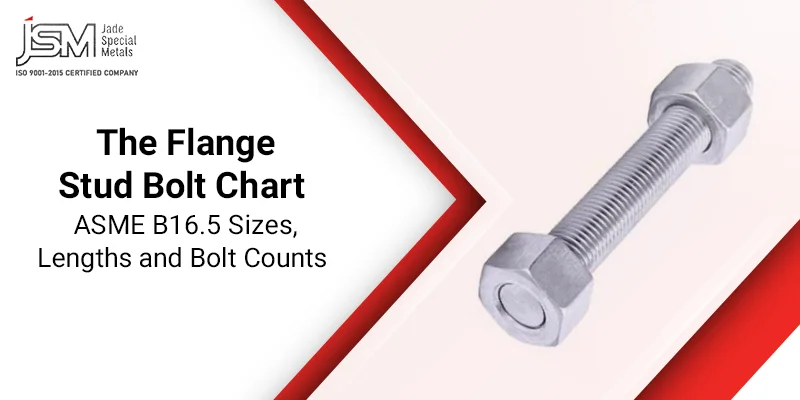
Jade Alloys is a leading manufacturer and exporter of industrial fasteners, serving piping engineers and procurement teams sourcing flange bolting for refineries, offshore platforms and process plant worldwide. Most flange stud bolt questions come down to the same three things. How many studs, what diameter, and how long. Get any of them wrong and you find out during a hydrostatic test, which is the most expensive place to find out.
This flange stud bolt chart answers all three from one table. Bolt count, stud diameter, raised face and ring type joint lengths, and bolt circle diameter are laid out by pressure class from Class 150 through Class 900, so you can compare classes side by side instead of opening a separate page for each one.
If what you actually need is the underlying stud data, thread series, weights, torque figures or grade selection, that lives on our stud bolt chart guide. This page stays on the flange.
What Is a Flange Stud Bolt
A flange stud bolt is a headless, fully threaded rod with a chamfered point at each end, tightened with a heavy hex nut on both sides. There is no head, and that is deliberate. You can pull tension from either side, you can get a wrench on it in a crowded pipe rack, and when a nut seizes after ten years in service, you cut off the nut rather than the stud.
Three details matter when you order.
- Chamfered points. Both ends carry a 45 degree point so the nut starts square and does not gall on the first turn. This matters more than it sounds, because a galled first thread on a 2 inch stud is a scrapped stud.
- Thread series. Below 1 inch diameter, coarse UNC. At 1 inch and above, the 8 thread series, which fixes the pitch at eight threads per inch so the thread stops eating into the core of the rod as diameter grows. Metric follows coarse or fine pitch to ISO 261.
- Dimensional standards. ASME B18.31.2 for continuous thread studs, ASME B16.5 for the flanges themselves, DIN 976 for metric threaded rod, and BS 4882 for bolting in pressure applications.
- Stock sizes and custom lengths are in our fastener catalogue.
Which Gasket Goes With Which Flange Facing
Facing drives both the gasket and the stud length, so it is worth settling before you read the chart.
- Raised face. Takes a spiral wound or compressed fibre gasket. The default for Class 150 and Class 300 service, and where you see the biggest gap between RF and RTJ stud lengths.
- Ring type joint. Takes a solid metal ring seated in a machined groove. Normal at Class 600 and above, and on sour or high temperature duty where a soft gasket will not survive. The ring holds the faces further apart, so the stud has further to reach.
- Flat face. Takes a full face gasket. Turns up mainly on cast iron equipment, where a raised face would concentrate load and crack the flange.
- Get the facing wrong and the stud length is wrong with it, which is the single most common reason a pallet of studs comes back.
Flange Stud Bolt Chart, Class 150 and Class 300
Bolt count, stud diameter, stud length and bolt circle diameter. Lengths are measured point to point, which includes both chamfered ends. Class 150 raised face flanges are shown without a ring type joint column because that facing is not offered at Class 150 in ASME B16.5.
| Pipe Size | 150 Dia | 150 Qty | 150 BCD | 150 RF Length | 300 Dia | 300 Qty | 300 BCD | 300 RF Length | 300 RTJ Length |
|---|---|---|---|---|---|---|---|---|---|
| 1/2 inch | 1/2 inch | 4 | 2.38 inch | 2.25 inch | 1/2 inch | 4 | 2.62 inch | 2.50 inch | 3.00 inch |
| 3/4 inch | 1/2 inch | 4 | 2.75 inch | 2.50 inch | 5/8 inch | 4 | 3.25 inch | 3.00 inch | 3.50 inch |
| 1 inch | 1/2 inch | 4 | 3.12 inch | 2.50 inch | 5/8 inch | 4 | 3.50 inch | 3.00 inch | 3.50 inch |
| 1 1/2 inch | 1/2 inch | 4 | 3.88 inch | 2.75 inch | 3/4 inch | 4 | 4.50 inch | 3.50 inch | 4.00 inch |
| 2 inch | 5/8 inch | 4 | 4.75 inch | 3.25 inch | 5/8 inch | 8 | 5.00 inch | 3.50 inch | 4.00 inch |
| 3 inch | 5/8 inch | 4 | 6.00 inch | 3.50 inch | 3/4 inch | 8 | 6.62 inch | 4.25 inch | 4.75 inch |
| 4 inch | 5/8 inch | 8 | 7.50 inch | 3.50 inch | 3/4 inch | 8 | 7.88 inch | 4.50 inch | 5.00 inch |
| 6 inch | 3/4 inch | 8 | 9.50 inch | 4.00 inch | 3/4 inch | 12 | 10.62 inch | 4.75 inch | 5.50 inch |
| 8 inch | 3/4 inch | 8 | 11.75 inch | 4.25 inch | 7/8 inch | 12 | 13.00 inch | 5.50 inch | 6.00 inch |
| 10 inch | 7/8 inch | 12 | 14.25 inch | 4.50 inch | 1 inch | 16 | 15.25 inch | 6.25 inch | 6.75 inch |
| 12 inch | 7/8 inch | 12 | 17.00 inch | 4.75 inch | 1 1/8 inch | 16 | 17.75 inch | 6.75 inch | 7.25 inch |
BCD in the table above stands for bolt circle diameter.
Need These Studs Cut to Length? Need these studs cut to length in B7, B8M or duplex? Request a quote and we will come back within twenty four hours with pricing and lead time.
Get in touch todayFlange Stud Bolt Chart, Class 600 and Class 900
| Pipe Size | 600 Dia | 600 Qty | 600 RF Length | 600 RTJ Length | 900 Dia | 900 Qty | 900 RF Length | 900 RTJ Length |
|---|---|---|---|---|---|---|---|---|
| 2 inch | 5/8 inch | 8 | 4.25 inch | 4.25 inch | 7/8 inch | 8 | 5.75 inch | 5.75 inch |
| 3 inch | 3/4 inch | 8 | 5.00 inch | 5.00 inch | 7/8 inch | 8 | 5.75 inch | 5.75 inch |
| 4 inch | 7/8 inch | 8 | 5.75 inch | 5.75 inch | 1 1/8 inch | 8 | 6.75 inch | 6.75 inch |
| 6 inch | 1 inch | 12 | 6.75 inch | 6.75 inch | 1 1/8 inch | 12 | 7.75 inch | 7.75 inch |
| 8 inch | 1 1/8 inch | 12 | 7.75 inch | 7.75 inch | 1 3/8 inch | 12 | 8.75 inch | 8.75 inch |
| 10 inch | 1 1/4 inch | 16 | 8.50 inch | 8.50 inch | 1 3/8 inch | 16 | 9.25 inch | 9.25 inch |
| 12 inch | 1 1/4 inch | 20 | 8.75 inch | 8.75 inch | 1 3/8 inch | 20 | 10.00 inch | 10.00 inch |
At Class 600 and above, RF and RTJ lengths come out the same. The flange is already thick enough at those classes to swallow the ring groove, so the extra depth does not translate into extra stud length. The difference only really shows up at Class 300, where flanges are thinner.
To pair studs with the matching flange, see our ASME B16.5 flange range.
Flange Bolt Tightening Sequence
Getting the number and the length right counts for nothing if the joint is pulled down unevenly. A flange tightened straight round the circle in order will cock on one side and leak on the other, and no amount of extra torque fixes it afterwards.
- Number the positions. Mark every stud position clockwise around the flange before you start. On anything above eight studs, you will lose track otherwise.
- Lubricate. Apply anti seize to the stud threads and to the nut bearing faces. The bearing face matters as much as the thread, because that is where a large share of the friction sits.
- Bring up hand tight, then check the gap. Pull every nut up finger tight and check the flange gap is even all the way round before any torque goes on. If it is not even now, it will not be even later.
- Run three torque passes in a cross pattern. Thirty percent of the target, then sixty percent, then one hundred percent. Cross the flange each time, working opposite pairs rather than neighbours.
- Finish with a full check pass. One full pass clockwise at one hundred percent. Nuts will move on this pass, which is normal, because tightening one stud relaxes its neighbours slightly. Keep going round until nothing moves.
Target torque figures for B7, B8 Class 2 and duplex, with the assumed friction coefficient stated, are on our stud bolt chart guide. Torque values are meaningless without a stated friction assumption, so always check which one a chart is using before you dial in a wrench.
Length, Weight, Torque and Grade Data
Rather than repeat data that already lives elsewhere on the site, here is where to find it.
- Stud length calculation. Two flange thicknesses, plus gasket, plus two nut heights, plus thread overhang, rounded up. Use it for any size or class not listed in the charts above rather than interpolating between rows. The full formula and a worked example are on the stud bolt chart guide.
- Stud weight. Imperial and metric weight charts, plus the formula for sizes not listed, on the same page. For mixed shipments across several alloys, the metal weights calculator handles the density differences.
- Torque values. Charts for B7, B8 Class 2 and duplex in both units, on the stud bolt chart guide.
- Material grades. Temperature ranges and service applications for B7, B16, A320 L7, B8, B8M, duplex and nickel alloys are on the same page. For high-temperature refinery service, our ASTM A193 B7 stud bolts are the usual starting point.
- Thread data. Pitch, stress area and tap drill sizes for UNC, UNF, 8UN and metric on our thread pitch chart.
Ready to Source Flange Stud Bolts? Whether you are fitting out a high pressure refinery line or a cryogenic piping project, send us the flange schedule and we will quote the full bolting package
Contact Us Now
Frequently Asked Questions
1. What is the difference between stud length measured point to point and thread to thread?
2. What is the bolt circle diameter for a 6 inch Class 300 flange?
3. Do Class 600 flanges need longer studs than Class 300 at the same pipe size?
4. Can I reuse flange stud bolts after a shutdown?
5. Why do Class 150 flanges have no ring type joint option?
6. How many studs does a 10 inch Class 300 flange take?