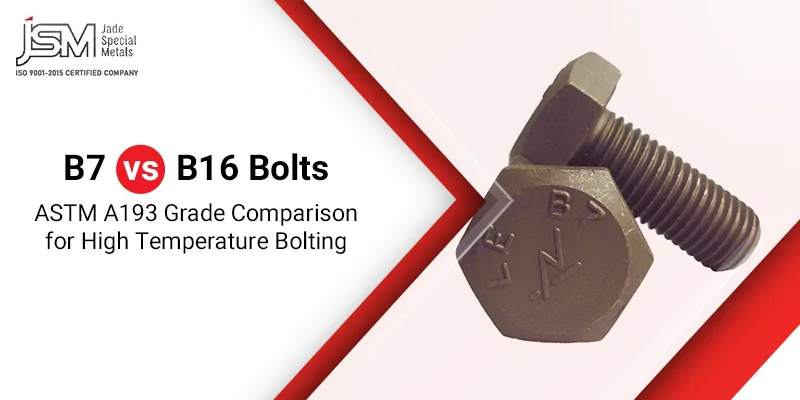
Jade Alloys manufactures both ASTM A193 B7 bolts and ASTM A193 B16 bolts, and the question we hear most often from buyers choosing between the two is not about strength, since the two grades are extremely close on paper, but about temperature. The real difference between B7 and B16 shows up only once a joint is running hot for a long period of time, which is why getting this choice right matters more the higher the operating temperature climbs. This guide sets out the composition, mechanical properties, temperature limits and matching nut grades for both, and links through to our full B7 and B16 product pages for ordering.
Both grades sit within ASTM A193, the specification covering alloy and stainless steel bolting for high-temperature and high pressure service.
What Is ASTM A193?
ASTM A193 covers alloy steel and stainless steel bolting material intended for high temperature or high pressure service, most commonly stud bolts used on flanged piping connections, valves and pressure vessels. The specification includes a range of grades built for different services, from general purpose carbon and alloy steel grades through to stainless steel grades for corrosive environments. B7 and B16 are both alloy steel grades within A193, and both are quenched and tempered chromium molybdenum steels, which is why they are so close in composition and in room temperature strength. For the complete standard overview and the full grade range, see our guide to what ASTM A193 covers.
B7 vs B16 at a Glance
| Property | ASTM A193 B7 | ASTM A193 B16 |
| Material Type | Chromium molybdenum alloy steel | Chromium molybdenum vanadium alloy steel |
| Standard | ASTM A193 | ASTM A193 |
| Main Alloying Difference | No specified vanadium addition | 0.25 to 0.35% vanadium |
| Heat Treatment | Quenched and tempered | Quenched and tempered |
| Minimum Tensile Strength | 860 MPa / 125 ksi | 860 MPa / 125 ksi |
| Minimum Yield Strength | 725 MPa / 105 ksi | 725 MPa / 105 ksi |
| Maximum Hardness | 321 HBW | 321 HBW |
| High Temperature Stability | Good | Better |
| Stress Relaxation Resistance | Moderate | Higher |
| Typical Selection | General high temperature piping | Higher temperature piping |
| Relative Cost | Lower | Higher |
B7 vs B16 Composition
The one meaningful chemistry difference between B7 and B16 is vanadium. B16 adds a small, deliberate vanadium content that B7 does not have, and this single addition is what gives B16 its better performance at elevated temperature.
| Element | A193 B7 | A193 B16 |
| Chromium | 0.75 to 1.20 | 0.75 to 1.20 |
| Molybdenum | 0.15 to 0.25 | 0.15 to 0.25 |
| Vanadium | None | 0.25 to 0.35 |
| Carbon | 0.37 to 0.49 | 0.36 to 0.47 |
| Manganese | 0.65 to 1.10 | 0.45 to 0.70 |
Figures shown are weight percent, typical specification ranges.
Mechanical Properties, B7 vs B16
Tensile and yield strength are effectively identical between the two grades at room temperature for diameters up to 2 1/2 inch, which is why strength alone is not a useful way to choose between them. The real differences appear in elongation and in how each grade behaves once temperature rises, covered in the next section.
| Property | A193 B7 | A193 B16 |
| Tensile Strength Min | 860 MPa, 125 ksi | 860 MPa, 125 ksi |
| Yield Strength Min | 725 MPa, 105 ksi | 725 MPa, 105 ksi |
| Elongation Min | 16 percent | 18 percent |
| Reduction of Area Min | 50 percent | 50 percent |
| Hardness Max | 321 HBW | 321 HBW |
*Figures shown are for diameters up to 2 1/2 inch. Larger diameters carry reduced strength requirements under the standard.
Heat Treatment and Why Vanadium Matters
Both grades are quenched and tempered, but B16 is tempered at a noticeably higher temperature than B7, typically in the region of 1150 to 1175 degrees Fahrenheit against roughly 1100 degrees Fahrenheit for B7. Combined with the vanadium addition, this higher tempering temperature stabilises the steel’s microstructure so it resists softening and creep at temperatures far better than B7 does. This is the actual mechanism behind B16’s reputation as the high-temperature grade. It is not that B16 starts out stronger than B7, the mechanical property table above shows it does not. It is that B16 holds onto its strength and its clamping load for far longer once a joint is running hot.
B7 vs B16 Temperature Resistance
| Grade | Typical Temp Range | Applications |
| B7 | Up to ~450–500°C | Most refinery & power piping |
| B8 | Cryogenic to ~550°C | Stainless steel piping, corrosive environments |
| B16 | Up to ~540–560°C with better stability | Reheaters, reformers, high-temp steam |
PREN and Corrosion Resistance
PREN Formula:
PREN = Cr + 3.3 × Mo + 16 × N
| Grade | Calculation | Approximate Result |
| 2205 | 22.5 + 3.3 × 3.25 + 16 × 0.17 | 36.5 |
| 2507 | 25.0 + 3.3 × 4.0 + 16 × 0.28 | 42.6 |
A higher PREN generally indicates better resistance to pitting corrosion. However, PREN should be used as a comparison indicator rather than as a complete prediction of corrosion performance.
| Not sure which grade your joint needsJade Alloys’ technical sales team can review your operating temperature and pressure and confirm whether B7 or B16 is the right specification for your project.Browse our catalogue or contact our team |
Matching Nut Grades
The nut paired with a stud bolt matters just as much as the bolt itself, and this is a step that is easy to get wrong on a B16 joint specifically. B7 studs are normally paired with ASTM A194 Grade 2H nuts, a straightforward quenched and tempered carbon steel nut suited to B7’s own temperature range. B16 studs should be paired with Grade 4 or Grade 7 nuts rather than a standard Grade 2H nut. A Grade 2H nut does not share B16’s high temperature stability, and using one on a B16 joint running hot creates a weak link at the nut even though the stud itself is rated for the service. Always check that the nut grade on a high temperature order matches the stud grade, not just the thread size.
Typical Applications
B7 is the default stud bolt material for the great majority of piping specifications, covering general piping, valves and flanges from ambient temperature through moderate elevated temperature. B16 is reserved for genuinely high-temperature service: main steam lines, boiler connections, hot reheat piping, and refinery heater piping, typically wherever the connected pipe is itself a chromium-molybdenum grade such as P11, P22 or P91.
Duplex vs Super Duplex Cost Comparison
| Cost Factor | Duplex 2205 | Super Duplex 2507 |
| Material Cost | Lower | Higher |
| Chromium Content | Lower | Higher |
| Molybdenum Content | Lower | Higher |
| Nickel Content | Lower | Higher |
| Nitrogen Content | Lower | Higher |
| Processing Requirements | Controlled | More demanding |
| Quality Control | High | More stringent |
| Typical Price Position | Baseline | Approximately 20 to 40% higher depending on market and specification |
| Best Cost Advantage | General demanding applications | Severe environments where higher corrosion resistance is required |
Cost and Availability
B16 carries a modest cost premium over B7, driven by the added vanadium content and the extra care required in heat treatment to hit its higher tempering temperature consistently. For the great majority of piping specifications, B7 remains the correct default, and B16 should be specified deliberately for the specific temperature range where it is actually needed rather than used as a blanket upgrade.
Which One Should You Choose?
As a quick guide, B7 is the right choice for ambient temperature service up to roughly 400 degrees Celsius, and remains widely used as the default up to that point. Above 400 degrees Celsius and up to somewhere around 538 to 593 degrees Celsius, B16 is generally the better choice, since this is the range where B7 starts to lose preload but B16 continues to hold it. Beyond that range, B16 also reaches its practical limit, and stainless steel or nickel alloy bolting should be considered instead. A proper review of the actual service, including pressure, cycling and any corrosive component, is always worth doing on a critical joint, but this temperature banding will get most specifications to the right grade quickly.
Frequently Asked Questions
1. What is the difference between B7 and B16 bolts?
2. Can B7 and B16 be used interchangeably?
3. What temperature requires B16 instead of B7?
4. What nut goes with a B16 bolt?
5. Does B16 cost more than B7?
6. How do you identify a B16 bolt in the field?
7. What happens if B7 is used above its temperature limit?
| Source B7 and B16 bolts from a single supplierJade Alloys manufactures and exports ASTM A193 B7 and B16 bolts and stud bolts, matched with the correct ASTM A194 nut grade, with full mill test certification on every order.Browse our catalogue or contact our team |
Explore Related Grades and Product Pages
To order, see our full ASTM A193 B7 bolts page and our ASTM A193 B16 bolts page. For related reading, see our comparison of ASTM A193 vs A320 for high temperature versus cryogenic bolting and our ASTM A193 standards hub.
About Jade Alloys
Jade Alloys is a Mumbai based manufacturer and exporter of industrial fasteners, supplying stud bolts, hex bolts, nuts and washers in carbon steel, alloy steel and stainless steel to ASTM, ASME and equivalent international standards. Every order is supplied with full mill test certification. Contact our technical sales team to discuss your requirement.