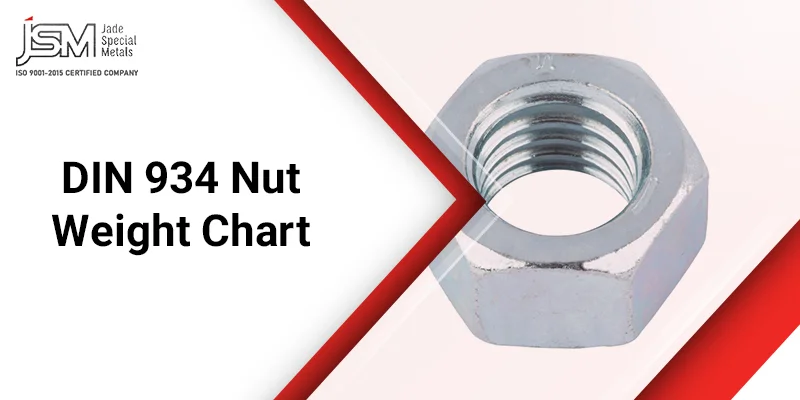
At Jade Alloys, we provide carbon steel DIN 934 and stainless steel DIN 934 hex nuts, and here is the DIN 934 nut weights table that shows the weight of each size in grams per nut, kilograms per hundred, and kilograms per thousand for sizes M1 to M100. The weight of an M12 nut in carbon steel is 17.3 grams while the M20 nut weight is 64.4 grams. The amount of nuts may change according to size, material density and tolerances, please refer to the specified standard on your drawing before ordering. It is possible for a nut of the same nominal size to be different in weight between ISO and DIN. See our DIN 934 standard page for specifications. To see other nut types please refer to our hex nut weight chart.
DIN 934 Hex Nut Weight Chart at a Glance (M6 to M20)
These are the six sizes most often ordered. Weights are nominal, for one nut.
| Size | Weight per piece (g) | Weight per 100 (kg) |
| M6 | 2.5 | 0.25 |
| M8 | 5.2 | 0.52 |
| M10 | 11.6 | 1.16 |
| M12 | 17.3 | 1.73 |
| M16 | 33.3 | 3.33 |
| M20 | 64.4 | 6.44 |
Dimensions Beside the Weights
| Size | Across flats s (mm) | Height m (mm) | Pieces per kg | Note |
| M6 | 10 | 5.0 | 400.0 | Same s as ISO 4032 |
| M8 | 13 | 6.5 | 192.0 | Same s as ISO 4032 |
| M10 | 17 | 8.0 | 86.0 | ISO 4032 s is 16 |
| M12 | 19 | 10.0 | 58.0 | ISO 4032 s is 18 |
| M16 | 24 | 13.0 | 30.0 | Same s as ISO 4032 |
| M20 | 30 | 16.0 | 15.5 | Same s as ISO 4032 |
| M24 | 36 | 19.0 | 9.1 | Same s as ISO 4032 |
| M30 | 46 | 24.0 | 4.4 | Same s as ISO 4032 |
Full DIN 934 Nut Weight Chart, M1 to M100
This table gives the nominal weight of one DIN 934 hex nut in carbon steel for every size from M1 to M100, in three units. Grams per piece and kilograms per 1,000 pieces are the same number, and kilograms per 100 pieces is grams per piece divided by 10. Coarse pitch is assumed throughout.
| Size | Pitch (mm) | Weight per piece (g) | Weight per 100 (kg) | Weight per 1,000 (kg) |
| M1 | 0.25 | 0.030 | 0.0030 | 0.030 |
| M1.2 | 0.25 | 0.053 | 0.0053 | 0.053 |
| M1.4 | 0.3 | 0.061 | 0.0061 | 0.061 |
| M1.6 | 0.35 | 0.074 | 0.0074 | 0.074 |
| M1.8 | 0.35 | 0.129 | 0.0129 | 0.129 |
| M2 | 0.4 | 0.141 | 0.0141 | 0.141 |
| M2.2 | 0.45 | 0.225 | 0.0225 | 0.225 |
| M2.5 | 0.45 | 0.273 | 0.0273 | 0.273 |
| M3 | 0.5 | 0.380 | 0.0380 | 0.380 |
| M3.5 | 0.6 | 0.512 | 0.0512 | 0.512 |
| M4 | 0.7 | 0.807 | 0.0807 | 0.807 |
| M5 | 0.8 | 1.24 | 0.124 | 1.24 |
| M6 | 1 | 2.50 | 0.250 | 2.50 |
| M7 | 1 | 3.14 | 0.314 | 3.14 |
| M8 | 1.25 | 5.20 | 0.520 | 5.20 |
| M10 | 1.5 | 11.6 | 1.16 | 11.6 |
| M12 | 1.75 | 17.3 | 1.73 | 17.3 |
| M14 | 2 | 25.1 | 2.51 | 25.1 |
| M16 | 2 | 33.3 | 3.33 | 33.3 |
| M18 | 2.5 | 49.5 | 4.95 | 49.5 |
| M20 | 2.5 | 64.4 | 6.44 | 64.4 |
| M22 | 2.5 | 79.0 | 7.90 | 79.0 |
| M24 | 3 | 110 | 11.0 | 110 |
| M27 | 3 | 164 | 16.4 | 164 |
| M30 | 3.5 | 229 | 22.9 | 229 |
| M33 | 3.5 | 287 | 28.7 | 287 |
| M36 | 4 | 392 | 39.2 | 392 |
| M39 | 4 | 497 | 49.7 | 497 |
| M42 | 4.5 | 646 | 64.6 | 646 |
| M45 | 4.5 | 791 | 79.1 | 791 |
| M48 | 5 | 966 | 96.6 | 966 |
| M52 | 5 | 1,189 | 119 | 1,189 |
| M56 | 5.5 | 1,424 | 142 | 1,424 |
| M60 | 5.5 | 1,672 | 167 | 1,672 |
| M64 | 6 | 1,964 | 196 | 1,964 |
| M68 | 6 | 2,267 | 227 | 2,267 |
| M72 | 6 | 2,644 | 264 | 2,644 |
| M76 | 6 | 3,009 | 301 | 3,009 |
| M80 | 6 | 3,405 | 340 | 3,405 |
| M85 | 6 | 3,829 | 383 | 3,829 |
| M90 | 6 | 4,866 | 487 | 4,866 |
| M95 | 6 | 5,401 | 540 | 5,401 |
| M100 | 6 | 6,820 | 682 | 6,820 |
All weights are nominal and calculated for carbon steel at 7.85 g per cubic cm, with a chamfer allowance of about 6 percent. Real nuts vary by plus or minus a few percent with chamfer shape, thread tolerance and plating. Weights above M64 are indicative and rounded to the nearest gram.
How to Read the Chart and What Changes the Number
Every weight in the chart is nominal, which means it comes from the standard dimensions rather than from weighing a batch. The size is the metric thread diameter, so M12 is a 12 mm thread, and the pitch column shows the coarse pitch the weight assumes. DIN 934 covers product grades A and B, and the chart applies to both.
Three things move the real weight away from the table value:
- Fine pitch threads. A fine pitch nut has a slightly larger bore, so it weighs a little less than the coarse pitch figure.
- Chamfer and tolerance. Different makers cut different chamfers, which shifts the weight by a few percent.
- Coating. Zinc plating and hot dip galvanising add weight, which is covered in the FAQ below.
If you need a thicker nut for high load work, use our heavy hex nuts range instead, because DIN 934 is the standard hex nut and is not a heavy series.
DIN 934 vs ISO 4032 Nut Weight
An ISO 4032 nut of the same size is usually heavier than a DIN 934 nut, by about 12 percent at M20. The two standards use different heights and, at some sizes, different across flats widths, so the same thread size does not give the same weight.
| Size | DIN 934 Weight (g) | ISO 4032 Weight (g) | Weight Difference (%) | DIN 934 Height (mm) | ISO 4032 Height (mm) |
| M6 | 2.5 | 2.6 | +3.8% | 5.0 | 5.2 |
| M8 | 5.2 | 5.6 | +7.7% | 6.5 | 6.8 |
| M10 | 11.6 | 10.3 | -11.0% | 8.0 | 8.4 |
| M12 | 17.3 | 16.0 | -7.7% | 10.0 | 10.8 |
| M14 | 25.1 | 25.7 | +2.3% | 11.0 | 12.8 |
| M16 | 33.3 | 38.1 | +14.3% | 13.0 | 14.8 |
| M20 | 64.4 | 72.3 | +12.3% | 16.0 | 18.0 |
| M24 | 110 | 124 | +13.2% | 19.0 | 21.5 |
| M30 | 229 | 244 | +6.7% | 24.0 | 25.6 |
| M36 | 392 | 419 | +6.9% | 29.0 | 31.0 |
| M42 | 646 | 646 | 0.0% | 34.0 | 34.0 |
| M48 | 966 | 966 | 0.0% | 38.0 | 38.0 |
| M56 | 1,424 | 1,424 | 0.0% | 45.0 | 45.0 |
| M64 | 1,964 | 1,964 | 0.0% | 51.0 | 51.0 |
The difference is positive when the ISO 4032 nut is heavier. At M10, M12 and M14 the DIN 934 nut has the wider across flats size (17 mm against 16 mm at M10, 19 mm against 18 mm at M12, and 22 mm against 21 mm at M14), so at M10 and M12 it outweighs the shorter ISO 4032 nut. At M42 and above the two standards share the same dimensions, so the weights match.
Weight of DIN 934 Nuts in Stainless Steel and Other Materials
To get the weight in another material, multiply the chart value by the material factor, which is that material’s density divided by 7.85. Stainless steel is only about 1 to 2 percent heavier than carbon steel, so for most quotes the chart value is already close.
| Material | Density (g per cubic cm) | Factor | M12 Nut Weight (g) |
| Carbon steel | 7.85 | 1.00 | 17.3 |
| Stainless steel 304 (A2) | 7.93 | 1.01 | 17.5 |
| Stainless steel 316 (A4) | 7.98 | 1.02 | 17.6 |
| Brass | 8.50 | 1.08 | 18.7 |
| Aluminium | 2.70 | 0.34 | 5.9 |
| Titanium Grade 2 | 4.51 | 0.57 | 9.9 |
Working example, M12 A2 nut. The carbon steel chart value is 17.3 g. Multiply by 7.93 and divide by 7.85, which gives about 17.5 g per nut. For 1,000 nuts that is about 17.5 kg.Our stainless steel fasteners range covers A2 and A4 nuts, and the carbon steel nuts page covers the baseline grades. You can browse all sizes on our hex nuts page.
How to Calculate DIN 934 Nut Weight (Formula and Worked Example)
You can check any size, including sizes not in the chart, with one formula. The nut is a hexagonal prism with a round hole through it, so its weight is the hexagon area minus the hole area, times the height, times the density.
Weight in g = (0.866 x s squared minus 0.7854 x d1 squared) x m x 0.00785 x 0.94
Here s is the across flats width in mm, m is the nut height in mm, d1 is the minor diameter in mm, and the density is 7.85 g per cubic cm for carbon steel (0.00785 g per cubic mm). The factor 0.94 is the chamfer allowance of about 6 percent. For other materials and shapes, use our metal weights calculator.
Worked example for an M20 nut, where s is 30 mm, m is 16 mm and the pitch is 2.5 mm:
- Find the bore diameter. d1 equals d minus 1.0825 times the pitch, so 20 minus 1.0825 times 2.5 gives 17.29 mm.
- Find the volume of steel. The hexagon area is 0.866 times 30 squared, which is 779.4 square mm. The bore area is pi divided by 4 times 17.29 squared, which is 234.9 square mm. The difference is 544.5 square mm, and multiplying by the 16 mm height gives 8,712 cubic mm.
- Convert to weight. 8,712 cubic mm at 0.00785 g per cubic mm is 68.4 g before the chamfer. Applying the 0.94 chamfer allowance gives about 64.3 g, which matches the 64.4 g in the chart.
Weight of Nuts by Quantity (500, 1,000 and 5,000 Pieces)
A box of 1,000 DIN 934 M12 nuts weighs about 17.3 kg before packaging. The table below gives the net weight of DIN 934 nuts in the ten most ordered sizes, including M12, M16 and M20, at three common order quantities, in carbon steel.
| Size | Weight per piece (g) | 500 pieces (kg) | 1,000 pieces (kg) | 5,000 pieces (kg) |
| M6 | 2.5 | 1.25 | 2.5 | 12.5 |
| M8 | 5.2 | 2.6 | 5.2 | 26.0 |
| M10 | 11.6 | 5.8 | 11.6 | 58.0 |
| M12 | 17.3 | 8.7 | 17.3 | 86.5 |
| M16 | 33.3 | 16.7 | 33.3 | 166.5 |
| M20 | 64.4 | 32.2 | 64.4 | 322 |
| M24 | 110 | 55.0 | 110 | 550 |
| M30 | 229 | 114.5 | 229 | 1,145 |
| M36 | 392 | 196 | 392 | 1,960 |
| M48 | 966 | 483 | 966 | 4,830 |
Freight tip: these are net nut weights. Add the weight of cartons, bags and pallets when you book transport, because packaging can add noticeably to small nut shipments. To work out other quantities or materials, use our metal weights calculator.
Frequently Asked Questions
What does a DIN 934 M10 nut weigh?
A DIN 934 M10 nut weighs about 11.6 g in carbon steel, which is 1.16 kg per 100 pieces or 11.6 kg per 1,000 pieces. Stainless steel A2 is about 1 percent heavier, at roughly 11.7 g.
What is the weight of 1,000 M12 nuts?
1,000 DIN 934 M12 nuts weigh about 17.3 kg in carbon steel, or about 17.5 kg in A2 stainless steel. This is the net weight of the nuts only and does not include cartons or pallets.
How heavy is an M20 nut?
A DIN 934 M20 nut weighs about 64.4 g. An ISO 4032 M20 nut is taller, at 18 mm against 16 mm, and weighs about 72 g. Check which standard your drawing names before you use either figure.
Is DIN 934 the same as ISO 4032?
No. They cover the same kind of hex nut, but the heights differ at most sizes and the across flats widths differ at M10, M12 and M14. DIN 934 has been widely replaced by ISO 4032 in new designs, though many buyers still order by the DIN number.
Does plating change nut weight?
Yes, slightly. Zinc plating adds a thin layer and usually changes the weight by well under 1 percent. Hot dip galvanising is thicker and can add more, especially on small nuts, so weigh a sample if the exact figure matters.
Why do two charts show different weights?
Charts differ because of the standard used (DIN 934 or ISO 4032), the chamfer allowance, the density assumed, and rounding. A chart that mixes standards will show a gap of 10 percent or more at some sizes, as with M20.
How do I calculate the weight of a nut not in the chart?
Use the formula in the calculation section above: hexagon area minus bore area, times height, times density, with a 6 percent chamfer allowance. You need the across flats width, the height and the pitch for the size.
Is DIN 934 still valid?
DIN 934 was withdrawn in favour of ISO 4032 and its related standards, but it is still specified on many older drawings and purchase orders, so suppliers still make to it. Confirm with your drawing or customer which standard applies.