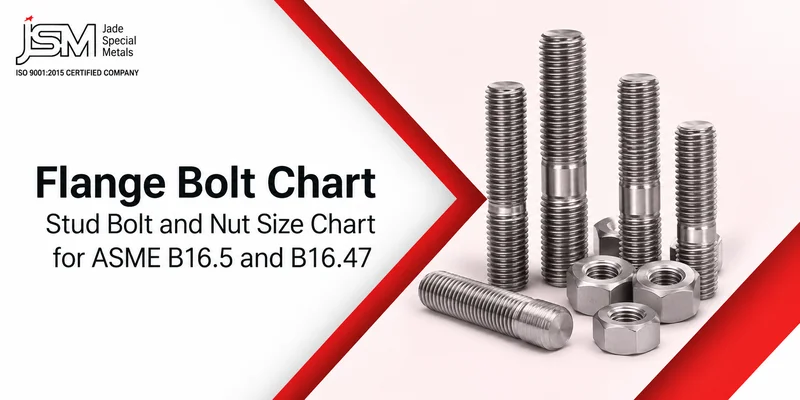
Jade Alloys provides bolts, nuts, and washers for flange connections, with a very popular question being: what bolt to purchase for the given flange? This flange bolt chart gives the answers. It provides the stud, nut, and washer recommendations for ASME B16.5 and B16.47 flanges in different class sizes and in inch and millimeter sizing along with their applicable grades. Whether you are specifying bolts for flanges or any flange connection, refer to the NPS and the class rating and the face style and grade.
How to Read the Chart: NPS, Class and Face Type
Two things identify a flange: its NPS (nominal pipe size) and its pressure class. Together they fix the bolt circle, the number of bolts and the bolt diameter, so you can read most of the flange bolt chart from those two numbers alone.
The third thing is the flange face. When it comes to flange types, a raised face flange and ring type joint flange require different stud lengths due to the addition of ring joint groove height. This height contributes greatly in the total required length along with flange thickness, gasket, nut and thread that show after the nut. Because of the above variables, it is impossible to use one stud length chart for all. Studs and gaskets have their respective charts to account for flange thickness. If required, refer to our stud bolt length and weight chart.
Class 150 Flange Bolt Size Chart, NPS 1/2 to 24
| Nominal Pipe Size NPS (inches) | Diameter of Flange (inches) | No. of Bolts | Diameter of Bolts (inches) | Diameter of BoltCircle (inches) Holes | Bolt Circle(inches) |
| 1/4 | 3-3/8 | 4 | 1/2 | 0.62 | 2-1/4 |
| 1/2 | 3-1/2 | 4 | 1/2 | 0.62 | 2-3/8 |
| 3/4 | 3-7/8 | 4 | 1/2 | 0.62 | 2-3/4 |
| 1 | 4-1/4 | 4 | 1/2 | 0.62 | 3-1/8 |
| 1-1/4 | 4-5/8 | 4 | 1/2 | 0.62 | 3-1/2 |
| 1-1/2 | 5 | 4 | 1/2 | 0.62 | 3-7/8 |
| 2 | 6 | 4 | 5/8 | 0.75 | 4-3/4 |
| 2-1/2 | 7 | 4 | 5/8 | 0.75 | 5-1/2 |
| 3 | 7-1/2 | 4 | 5/8 | 0.75 | 6 |
| 3-1/2 | 8-1/2 | 8 | 5/8 | 0.75 | 7 |
| 4 | 9 | 8 | 5/8 | 0.75 | 7-1/2 |
| 5 | 10 | 8 | 3/4 | 0.88 | 8-1/2 |
| 6 | 11 | 8 | 3/4 | 0.88 | 9-1/2 |
| 8 | 13-1/2 | 8 | 3/4 | 0.88 | 11-3/4 |
| 10 | 16 | 12 | 7/8 | 1 | 14-1/4 |
| 12 | 19 | 12 | 7/8 | 1 | 17 |
| 14 | 21 | 12 | 1 | 1.12 | 18-3/4 |
| 16 | 23-1/2 | 16 | 1 | 1.12 | 21-1/4 |
| 18 | 25 | 16 | 1-1/8 | 1.25 | 22-3/4 |
| 20 | 27-1/2 | 20 | 1-1/8 | 1.25 | 25 |
| 24 | 32 | 20 | 1-1/4 | 1.38 | 29-1/2 |
Class 300 Flange Bolt Size Chart, NPS 1/2 to 24
| Nominal Pipe Size NPS (inches) | Diameter of Flange (inches) | No. of Bolts | Diameter of Bolts(inches) | Diameter ofBolt Holes (inches) | Bolt Circle(inches) |
| 1/4 | 3-3/8 | 4 | 1/2 | 0.62 | 2-1/4 |
| 1/2 | 3-3/4 | 4 | 1/2 | 0.62 | 2-5/8 |
| 3/4 | 4-5/8 | 4 | 5/8 | 0.75 | 3-1/4 |
| 1 | 4-7/8 | 4 | 5/8 | 0.75 | 3-1/2 |
| 1-1/4 | 5-1/4 | 4 | 5/8 | 0.75 | 3-7/8 |
| 1-1/2 | 6-1/8 | 4 | 3/4 | 0.88 | 4-1/2 |
| 2 | 6-1/2 | 8 | 5/8 | 0.75 | 5 |
| 2-1/2 | 7-1/2 | 8 | 3/4 | 0.88 | 5-7/8 |
| 3 | 8-1/4 | 8 | 3/4 | 0.88 | 6-5/8 |
| 3-1/2 | 9 | 8 | 3/4 | 0.88 | 7-1/4 |
| 4 | 10 | 8 | 3/4 | 0.88 | 7-7/8 |
| 5 | 11 | 8 | 3/4 | 0.88 | 9-1/4 |
| 6 | 12-1/2 | 12 | 3/4 | 0.88 | 10-5/8 |
| 8 | 15 | 12 | 7/8 | 1 | 13 |
| 10 | 17-1/2 | 16 | 1 | 1.12 | 15-1/4 |
| 12 | 20-1/2 | 16 | 1-1/8 | 1.25 | 17-3/4 |
| 14 | 23 | 20 | 1-1/8 | 1.25 | 20-1/4 |
| 16 | 25-1/2 | 20 | 1-1/4 | 1.38 | 22-1/2 |
| 18 | 28 | 24 | 1-1/4 | 1.38 | 24-3/4 |
| 20 | 30-1/2 | 24 | 1-1/4 | 1.38 | 27 |
| 24 | 36 | 24 | 1-1/2 | 1.62 | 32 |
Need studs and nuts for your flange job? Tell us the NPS, class and face and we will confirm the stud length.
Class 400 to 2500 Flange Bolting
The same logic carries on up the classes. As the class rises, flanges get thicker, bolts get larger and the bolt count changes, so bolt data for each size comes straight from the bolting table in ASME B16.5. Two points matter when you size studs for the higher classes. Ring type joint flanges are common from Class 900 upward, and the groove height adds to the stud length. And in ASME B16.5, Class 2500 covers sizes only up to NPS 12, so there is no Class 2500 row above that size. For NPS 26 and above, use ASME B16.47, Series A or Series B. For a class or size that neither standard covers, your project specification names the flange standard to follow.
Common Stud Bolt Grades
| Stud Bolt Grade | Material Composition and Condition | Typical Applications | Compatible Nut Grade |
| ASTM A193 B7 | Chromium molybdenum alloy steel, quenched and tempered | High pressure and high temperature bolting applications | ASTM A194 Grade 2H |
| ASTM A193 B16 | Chromium molybdenum vanadium alloy steel | Bolting requirements in elevated temperature environments | ASTM A194 Grade 4 or Grade 7 |
| ASTM A193 B7M | Chromium molybdenum alloy steel with controlled hardness requirements | Sour service applications involving hydrogen sulphide (H₂S) | ASTM A194 Grade 2HM |
| ASTM A193 B8 Class 1 | Type 304 stainless steel | Corrosive environments requiring moderate mechanical strength | ASTM A194 Grade 8 |
| ASTM A193 B8M Class 1 | Type 316 stainless steel | Corrosive applications requiring improved corrosion resistance | ASTM A194 Grade 8M |
| ASTM A193 B8M Class 2 | Type 316 stainless steel in a strain hardened condition | Applications requiring higher mechanical strength from stainless steel bolting | ASTM A194 Grade 8M |
| ASTM A320 L7 | Chromium molybdenum alloy steel, impact tested | Low temperature bolting applications, including services reaching approximately −101°C | ASTM A194 Grade 4 or Grade 7, with impact testing |
The selection of stud bolt grades depends on operating temperature, pressure, corrosion exposure and mechanical strength requirements. Compatible nut grades should also be selected according to the applicable ASTM specifications and service conditions.
Matching Nut and Washer Specification
A stud is only as good as the nut on it, so match the nut to the grade.
- A194 2H nut: the heavy hex nut that goes with B7 studs
- A193 B7 Bolts: the chromium-molybdenum alloy steel bolting used for high pressure services
- A194 Grade 7 nut: the heavy hex nut for L7 studs, and for B16 where the project calls for it
- A563 nut: the nut standard for general and structural bolting, used where the project allows it
- F436 washer: a hardened carbon steel washer, which spreads the load and protects the flange face
Some jobs call for a washer under the nut and some do not, so follow the project specification. For sizes and weights, see our washer weight chart.
Need a complete bolting set? Request a quote for studs, nuts and washers together
Flange Bolt Tightening Procedure and Torque Sequence
Proper flange bolt tightening requires a controlled sequence to distribute the load evenly across the gasket and prevent leakage. The legacy cross-pattern method described in ASME PCC-1 provides a systematic approach to tightening bolted flange connections. Although the standard also covers alternative tightening sequences and grouping techniques, the joint owner is responsible for selecting the appropriate method.
Before starting the tightening process, consider the following requirements:
- Determine the target torque: Establish the required torque based on bolt material, bolt diameter, lubricant or coating conditions (nut factor) and the specified bolt stress. Refer to suitable bolt torque charts for the required values.
- Prepare the bolting components: Apply lubricant to the stud bolt threads and the nut bearing surfaces. Use a new gasket and ensure that the flange faces are clean and free from damage.
- Check flange alignment: Measure the gap between the flange faces at four or more equally spaced locations after every tightening round. Significant differences in measurements may indicate uneven bolt loading or flange misalignment.
- Follow the tightening sequence: Apply torque progressively using the cross-pattern arrangement before completing the final rotational pass.
Stepwise Flange Bolt Tightening Sequence (ASME PCC-1)
| Tightening Stage | Applied Torque | Tightening Sequence and Inspection |
| Initial Installation | Hand tighten, followed by snug tightening to 10–20 ft-lb, not exceeding 20% of the target torque | Follow a cross-pattern sequence and inspect the flange gap to confirm even contact around the circumference. |
| First Pass | 20% to 30% of target torque | Tighten bolts in a cross pattern. Check flange gap uniformity and correct any unevenness before proceeding. |
| Second Pass | 50% to 70% of target torque | Repeat the cross-pattern sequence and inspect the gap between flange faces. |
| Third Pass | 100% of target torque | Tighten each bolt to the full target torque using the cross-pattern arrangement. Check flange gap uniformity. |
| Final Pass | 100% of target torque | Perform a clockwise circular pass, tightening sequentially from one bolt to the next. Repeat the pass until no further nut rotation occurs. |
Common Sizing Mistakes
- Ordering stud length without allowing for the face. A raised face or a ring joint groove changes the length you need.
- Mismatching nut and stud grade. A B7 stud with a weak nut wastes the stud.
- Forgetting the washer. If the job calls for one, a missing washer can fail an inspection.
- Using the B16.5 chart for large flanges. NPS 26 and above follow B16.47.
- Ignoring gasket thickness. A thicker gasket needs a longer stud.
Frequently Asked Questions
What stud bolt length do I need for a flange?
Stud length depends on the flange thickness at both ends, the gasket thickness, the face type and the nut thickness, plus a little thread showing past each nut. Take the length from the ASME B16.5 bolting table for your size, class and face, and add allowance for any gasket or blind flange.
What is the difference between B7 and L7 studs?
B7 is ASTM A193 Grade B7, a chromium molybdenum stud for general high strength and moderate temperature service. L7 is ASTM A320 Grade L7, the low temperature grade, impact tested for cold service. Choose by the design temperature in your project specification.
Do all ASME B16.5 flanges use the same nut grade?
No. The nut grade follows the stud grade. A193 B7 studs take A194 Grade 2H nuts, and A320 L7 studs take A194 Grade 7 nuts. B16 studs take A194 Grade 4 or 7 nuts as the project states. The flange class does not change the nut grade.
What is an F436 washer used for?
An F436 washer is a hardened carbon steel washer. It spreads the bolt load over a larger area, protects the flange face and helps give steadier friction under the nut during tightening. Some jobs specify one under the nut, so follow the project specification.
Does ASME B16.47 use the same bolt chart as B16.5?
No. ASME B16.47 covers large diameter flanges from NPS 26 to 60, in Series A and Series B, and each series has its own bolting. Use the B16.47 data for those sizes, and not the B16.5 chart.
What is the stud bolt size for a 4 inch Class 150 flange?
A 4 inch Class 150 flange takes 8 studs of 5/8 inch diameter, with two heavy hex nuts per stud. Check the stud length column for your face type.
How many bolts does a 6 inch Class 300 flange have?
A 6 inch Class 300 flange takes 12 studs of 3/4 inch diameter, on a bolt circle of 10 5/8 inches.
Closing
Match the stud to the flange by NPS, class and face, match the nut to the stud grade, and check the washer against the project specification. A194 2H goes with B7, and A194 Grade 4 or 7 goes with B16 and L7.
Jade Alloys manufactures studs, nuts and washers. Send us your flange size and class, and we will confirm the complete bolting set.