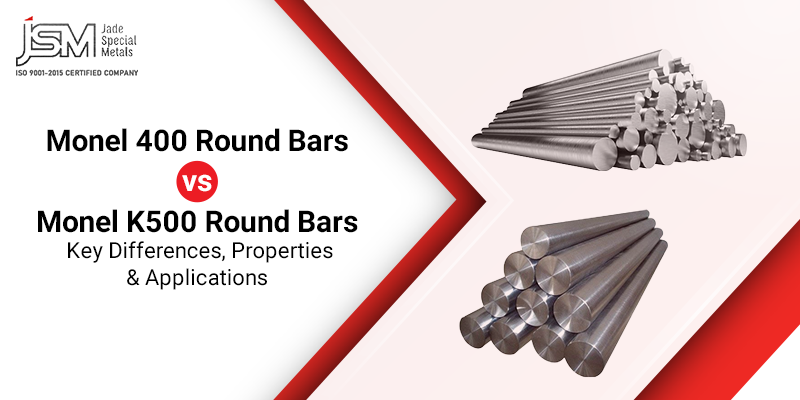
Monel 400 vs Monel K500 is a very close comparison when we have to select the right copper alloy round bar according to industrial demands. Both the material Monel 400 round bar and Monel K500 bar are used in different industries according to their features. However the main difference between them is in their strength, corrosion resistance and fabrication process. Monel 400 has more corrosion resistance and is used in seawater and the chemical industry. On the other hand Monel K500 comes with high strength that makes it suitable for the environment that needs high mechanical strength and hardness. So now comes which alloy you should choose for your application depends on the service conditions and load requirements.
What Are Monel Alloys?
The monel alloy round bar, also known as nickel-copper alloy, is mainly made up of Nickel and copper and contains around 63-70% nickel and 20-30% copper with little addition of iron and manganese. This alloy is primarily made to work easily in harsh and corrosive environments, and corrosive environments like seawater, acid, and high temperature, which makes it suitable for marine, chemical, and oil & gas industries. The two most common grades of alloy round bars are Monel 400 and Monel K500, which are manufactured according to different industrial uses.
What are Monel 400 Round Bars?
Monel 400 round bars consist of solid nickel-copper alloy bars composed of approximately 63-67% nickel and 28-34% copper with small amounts of iron and manganese and are designed to exceptionally work in corrosive environments. The level of resistance against corrosion in acids, alkali and seawater, is extremely high in this alloy, therefore it is highly applicable in the marine and chemical industry as well as possessing a good thermal conductivity and excellent mechanical properties in a wide temperature range. Monel 400 has also been known to be simple to fabricate, machine and weld making it more applicable in the complex industrial system. It is well prepared to conform to standards, such as UNS N04400 and ASTM B164 / ASTM B564. They are usually applied to heat exchangers, marine piping systems, and chemical processing equipment.
What are the Monel K500 Round Bars?
Monel K500 round bar is a precipitation-hardenable, nickel-copper alloy that is based on Monel 400, and other alloys are introduced to permit age-hardening (aluminum (Al) and titanium (Ti)). The strength and hardness of the alloy is highly enhanced by the heat treatment process and this has been one of the key differences made over Monel 400. The ductility of monel K500 is improved by the presence of aluminium and its mechanism performance and fatigue behavior are increased in highly stressful environments. It is produced to conform to the specifications of UNS N05500 and ASTM B865 / ASTM B564 that are consistent in quality in sensitive applications. It is highly used in pump shafts, offshore machinery and in the oil and gas tools where high load bearing capacity and durability are necessary because it is strong and corrosion resistant.
Monel 400 vs Monel K500 Round Bars Detailed Comparison
Chemical Composition
| Element | Monel 400 | Monel K500 |
| Nickel (Ni) | 63–67% | 63–67% |
| Copper (Cu) | 28–34% | 27–33% |
| Aluminum (Al) | — | 2.3–3.15% |
| Titanium (Ti) | — | 0.35–0.85% |
| Iron (Fe) | ≤ 2.5% | ≤ 2.0% |
Note: Monel K500 is essentially a modified version of Monel 400, enhanced with aluminum and titanium to enable age-hardening and significantly improve strength.
Mechanical Properties
| Property | Monel 400 | Monel K500 |
| Tensile Strength | ~480–550 MPa | ~900–1100 MPa |
| Yield Strength | ~170–240 MPa | ~600–790 MPa |
| Hardness | ~110–160 HB | ~200–350 HB |
| Elongation | ~35–45% | ~20–30% |
Note: Monel K500 offers nearly 2x higher strength compared to Monel 400, making it suitable for high-load applications, while Monel 400 provides better ductility.
Corrosion Resistance
The overall corrosion resistance of Monel K500 is equal to that of Monel 400 and better in high velocity seawater and erosion-corrosion service as it is more hard. However, Monel K500 can readily suffer stress corrosion cracking when subjected to a hydrogen-participating environment, and should not be ordered in service where mercury contamination would be less dangerous, in which case Monel 400 would be superior. A specific service environment must always be confirmed and then K500 should be specified to use in the seawater or sour-service.
Strength & Hardness
The hardening of monel K500 is significantly increased with age, making it far more resistant and thus much stronger and harder and this makes it to be used in heavy-duty parts and ones that bear loads. Monel 400 on the other hand is not as hard and more malleable and can be bent and shaped more easily during the fabrication processes.
Weldability & Fabrication
The Monel 400 has been described as possessing a good Weldability, as well as fabrication, therefore, it can be utilized in complex shapes and welded components. The Monel K500 in the age-hardened form is not to be welded but only in the annealed form to avoid cracks formation in the heat-affected area. Once welded, the strength of the alloy must be regained by post-weld heat treatment (re-ageing at 595 o C), thereby increasing the cost and complexity.
Magnetic Properties
In most cases, Monel 400 is non-magnetic and it is a plus to the elements that demand non-magnetic material. Monel K500 on the other hand is slightly magnetic in its behaviour owing to its age-hardening process and composition.
Cost Difference
The more costly Monel K500 exhibits the existence of the extra alloying elements (Al and Ti) and the heat treatment aging process that aggravates the complexity and cost of production.
Applications of Monel 400 vs Monel K500 Round Bars
Monel 400 Applications Usage
Monel 400 round bars are more commonly used where corrosion resistance is the main factor of consideration, particularly where aggressive chemical and marine conditions are the primary needs. They are widely applied in marine devices, such as seawater piping and fittings, because they have an excellent resistance to saltwater corrosion. Monel 400 is a reliable material in thermal and corrosive conditions of heat exchangers. It is also used in wide applications that include chemical processing equipment dealing with acids and alkalis without decay and fuel tanks, where chemical resistance and durability are vital.
Monel K500 Applications Usage
Monel K500 round bars are suitable for applications where high strength and mechanical performance is required and can easily work under high stress conditions. Due to these features, it’s commonly used to make a pump shaft where the resistance is critical. In the oil & gas sector, it is used for oil drilling tools that operate under high pressure and corrosive conditions. The alloy is also ideal for springs and fasteners, thanks to its excellent fatigue resistance, and in offshore components, where both strength and corrosion resistance are necessary for long-term performance in marine environments.
When to Choose Monel 400 vs Monel K500
| Requirement | Recommended Alloy | Key Reason |
| High Corrosion Resistance | Monel 400 | Standard for hydrofluoric acid and seawater. |
| High Strength & Load | Monel K500 | Precipitation-hardened for 3x the yield strength. |
| Easy Fabrication | Monel 400 | Higher ductility; easier to weld and form. |
| High Fatigue Resistance | Monel K500 | Superior resistance to cyclic stress in moving parts. |
| Cost-Sensitive Project | Monel 400 | Lower material cost due to simpler heat treatment. |
Conclusion:
The selection of either Monel 400 round bars or Monel K500 round bars is all dependent on your application needs. In case you are concerned with high-grade corrosion resistance, convenience of manufacture as well as cost-effectiveness, Monel 400 is the best option in the chemical and marine setting. But in case of your application which requires high strength, durability, and resistance to fatigue to heavy loads, then Monel K500 is more appropriate. It must always be judged by service conditions, mechanical stress and lifecycle performance. To ensure the consistency of quality and stability of supply of nickel copper alloy round bars, Jade Alloys makes sure that the material meets the industry standards and application specifications.
Frequently Asked Questions (FAQ)
1. What is the main difference between Monel 400 and Monel K500?
Monel 400 focuses on corrosion resistance and easy fabrication, while Monel K500 is an age-hardened version with much higher strength and hardness.
2.Is Monel K500 stronger than Monel 400?
Yes, Monel K500 is nearly 2 times stronger than Monel 400 due to its age-hardening process.
3.Which alloy is better for seawater applications?
The K500 should not be specified in hydrogen-charged or mercury-contaminated seawater environments where it is susceptible to stress corrosion cracking. Monel 400 is the safer choice in those conditions.
4.Can Monel K500 replace Monel 400?
Yes, but only when higher strength is required otherwise, Monel 400 is more cost-effective and easier to fabricate.
5.Why is Monel K500 more expensive?
It contains additional alloying elements (Al, Ti) and requires heat treatment (age-hardening), increasing production cost.
6.Are Monel alloys suitable for high temperatures?
Yes, both alloys perform well at elevated temperatures, but Monel K500 offers better strength retention under stress.