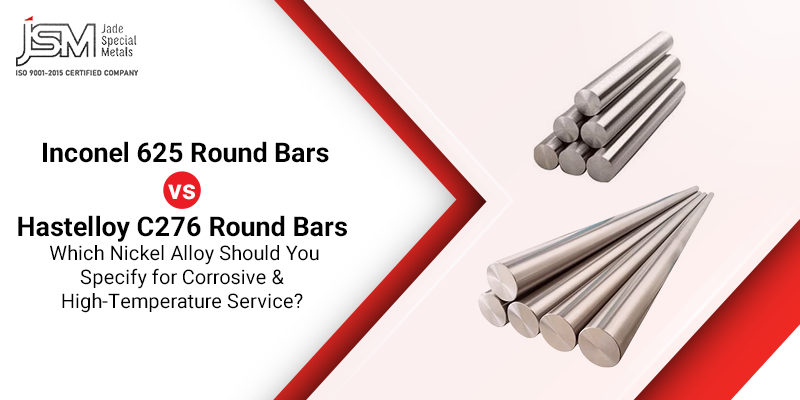
Choosing the incorrect material in sour gas or marine systems can increase the cost and also reduce the life span of the system, which is why the selection of Inconel 625 round bars or other alloys of this kind is a crucial engineering decision. When choosing the materials to be used in corrosive or high-temperature service, Hastelloy C276 round bars are often regarded along with Inconel 625. In particular, the latter is often used in conditions where there is severe chemical exposure or seawater conditions. This guide covers the selection of round bar materials, particularly alloy chemistry, performance characteristics, and suitability of application, but does not include other factors such as the fabrication of pipes or cost variations. An overview of the selection guide and comparison table to make the decision-making process faster and more precise is provided below in a quick-reference format.
What Are Inconel 625 and Hastelloy C276 Round Bars?
Inconel 625 Round Bar
Inconel 625 round bars refer to Nickel-based superalloy round bars, which are recognized as UNS N06625 / AMS 5666 and are hardened by the aid of niobium (Nb) and molybdenum material to offer high-temperature strength and oxidation-resistant properties. They are usually delivered to comply with ASTM B446, which offers standard mechanical service and resistance to corrosion under severe conditions.
Hastelloy C276 Round Bar
Hastelloy C276 round bars are bars made of nickel-molybdenum-chromium alloy that is actually the UNS N10276 / AMS 5796 alloy, but include tungsten (W) to increase resistance to reducing acids and other hostile chemical conditions. These bars are in line with the ASTM B574, and therefore, they can be used in critical applications that are in need of high resistance to pitting and stress-corrosion cracking.
Chemical Composition and What It Means for Corrosion Performance
Inconel 625 Leads at High Temperature
Niobium (Nb) is the strengthening element characteristic of Inconel 625, and it occurs in 3.15-4.15% contents and it is the one that provides the material with its hardening properties at a high temperature. This enables Inconel 625 to sustain mechanical strength, creep resistance and structural stability in the high-temperature service which Hastelloy C276 without niobium cannot compete with. Also, Inconel 625 also has a high chromium (20-23) with a higher percentage than C276 (14.5-16.5%), allowing it to withstand oxidising conditions like nitric acid and high temperatures oxidation better. Consequently, Inconel 625 has a superior application in terms of heat, oxidation and mixed corrosive application.
Hastelloy C276 Leads in Reducing Environments
The element molybdenum (Mo) plays a significant part in increasing the resistance against erosive acids such as hydrochloric acid (HCl) and sulfuric acid (H2SO4). The Mo content ranges 15 to 17 % in Hastelloy C276, which is significantly higher than that of Inconel 625 (8 to 10 %), this aspect specifically leads to the resistance to a hostile chemical environment. C276 also contains tungsten (W) at 3-4.5 %, which further increases the resistance to pitting and localized corrosion in chloride-containing reducing environments- a major benefit in chemical processing and in marine service. An increase in Mo + W combination also helps give C276 a Pitting Resistance Equivalent Number (PREN) of about 70 in comparison to Inconel 625 with a Pitting Resistance Equivalent Number of about 52, causing C276 to be the preferred corrosion-resistant material in reducing environments with high corrosive concentration.
Mechanical Properties Comparison for Round Bar Applications
Tensile and Yield Strength at Room Temperature
In round bar applications, mechanical strength in ambient conditions has a direct effect on the load-bearing capacities and safety margins. Its tensile and yield strengths are greater than that of Hastelloy C276 with tensile being about 690 MPa and yield 283 MPa because Inconel 625 has tensile and yield of approximately 827 MPa and 414 MPa, respectively. Nevertheless, C276 has much better elongation (~ 61 ) compared to 625 (~ 30 ) and is therefore more ductile and easier to bend, form and work bar stock without cracking.
High-Temperature Mechanical Performance
Inconel 625 has the ability to be strengthened through niobium at high temperatures, and therefore Inconel 625 has better mechanical stability and can be used in sustained service at temperatures well over 1000 °C. Hastelloy C276 is capable of functioning under an oxidising environment to a temperature of approximately 1040 °C, but its retention of strength is reduced, especially in a reducing environment. This causes Inconel 625 to be the most preferred in high-temperature structural applications and C276 to be used in corrosion resistance rather than for mechanical strength under heat.
Hardness, Machinability, and Fabrication Considerations
Both alloys have similar hardness and machinability ratings, though their work hardening tendency requires carbide tooling and reduced cutting speeds. As a round bar procurement, it is important to point out that the material Inconel 625 that is supplied in the hot-finished state (ASTM B446) will possess different mechanical properties than cold-drawn material, and therefore the condition of the material should be clearly stated in the purchase order (PO). Moreover, it is recommended that the buyers always demand certified Mill Test Reports (MTRs) to check the actual heat values and to ensure that the mechanical properties specified are met against actual values and not just nominal data.
Corrosion Resistance: Which Alloy Wins in Each Environment?
Eliminating Acidic Conditions
Hastelloy C276 round bars are better used in strong reducing acids because they contain a greater amount of molybdenum and tungsten which increases resistance to chemical attack. Inconel 625 round bars provide only moderate resistance in reducing acids at medium-to-high concentrations and should not be substituted for C276 in these environments.
Oxidising Mixed Acid Service and Environment
The Inconel 625 bars are advantaged in the oxidising environments due to the increase in chromium which resists oxidation. Hastelloy C276 performs adequately in mixed acid environments but is susceptible to attack in fuming nitric acid (HNO3) a condition where Inconel 625’s higher chromium content provides clear protection.
Seawater, Pitting and Stress Corrosion Cracking
Both alloys perform well in seawater. C276 is preferred for static components prone to crevice corrosion; Inconel 625 is preferred for dynamic applications (pump shafts, propeller shafts) where its resistance to stress corrosion cracking under cyclic load is the priority.
Sour Gas Service – H2S and NACE Compliance
Hastelloy C276 round bars would typically be chosen in the sour gas (H 2 S ) environment as they are more resistant to sulfide corrosion. Where oxidation resistance and strength are required, inconel 625 bars are also utilized. Both are required to comply with NACE MR0175 / ISO 15156 requirements.
Environment Selection: Inconel 625 vs. Hastelloy C276
| Environment | Winner | Confidence | Note |
| Reducing Acids (HCl, H_2SO_4) | Hastelloy C276 | High | Mo+W combination is decisive. |
| Oxidizing Acids (HNO3) | Inconel 625 | High | Higher Cr (22%) protects against fuming HNO3. |
| Mixed Acid Service | Hastelloy C276 | Moderate | Depends on acid ratio and temperature. |
| Seawater — Static | Hastelloy C276 | Moderate | Better crevice corrosion resistance. |
| Seawater — Dynamic | Inconel 625 | Moderate | SCC resistance under cyclic load. |
| Sour Gas (H2S + Cl) | Hastelloy C276 | High | Mo+W; both NACE MR0175 compliant. |
Industry Applications: Where Each Alloy Is Actually Specified
Oil & Gas
Downhole tools and pump shafts in H 2 S, CO 2 and chloride-rich wells are made of hastelloy C276 round bars, because their corrosion resistance is high. Inconel 625 round bars are used in wellhead bolting and shafts in cases of high strength of the material. (ASTM B574 for C276, ASTM B446 / AMS 5666 for 625)
Chemical Processing
Agitator shafts and reactor parts of HCl, as well as reducing acids are made of hastelloy C276 round bars. Oxidising support bars and components are made of inconel 625 round bars in oxidising environments such as nitric acid.
Marine and Offshore
Propeller shafts and dynamic components are specified in Inconel 625 round bars for their combination of high tensile strength and resistance to stress corrosion cracking under cyclic load. Hastelloy C276 round bars are found useful in subsea connectors and high-chloride (static bolting).
Aerospace and Defence
Inconel 625 round bars (AMS 5666) are extensively used in engine mounts, fasteners and nacelle parts to provide high temperature strength. Hastelloy C276 has limited application in aerospace.
How to Choose Between Inconel 625 and Hastelloy C276 Round Bar for Your Project
Identify Your Primary Corrosion Threat
Begin with the identification of the environment. In order to reduce acids such as the HCl, H 2 SO 4 or phosphoric acid, select the Hastelloy C276 round bars. Inconel 625 round bars are superior in high-temperature (mixed) oxidising acid (HNO 3 ) or high-temperature conditions.
Check Operating Temperature and Mechanical Load
Inconel 625 round bars are better Inconel 625 round bars are best in an application where the temperature is expected to exceed 500 °C. In case you need high ductility in bending or in forming, Hastelloy C276 round bars are more appropriate.
Relevant Standards and NACE / ASME Requirements
Adhere to standards like when sourcing service (NACE MR0175) and pressure parts (ASME Section IX), aerospace uses (AMS 5666 (625) and AMS 5796 (C276)). Safety and approval cannot be achieved without proper certification.
Cost Against Service Life
The round bars made of Hastelloy C276 cost significantly more than Inconel 625 by 10-20 %. In case you are dealing with mixed environments, take into account materials that will compromise the corrosion resistance and cost, or consider dual-qualified options where they can be.
Cost, Availability, and Lead Time: Procurement Considerations for Round Bar Stock
On the procurement side, Inconel 625 round bars and Hastelloy C 276 round bars will be in a similar premium price range of between 30-60/kg, depending on size, condition and market conditions, with C 276 costing 10-20% higher since it contains more alloying. Inconel 625 round bars are more readily available as standard diameters (around 6 to 200 mm), and thus tend to be easier to get for short-notice applications, whereas C276 larger sizes can take 812 weeks of mill lead time.
When dealing with critical applications, buyers must always demand EN 10204 3.1 Mill Test Reports (MTRs) so that heat traceability and conformity to required standards can be ensured. Also, a portion of Inconel 625 round bars are dual-certified (ASTM B446 / AMS 5666), which simplifies the inventory of projects that are inter-standard. Minimum order quantities (MOQs) are also to be considered, particularly in prototype or small-batch orders, where C276 may not be readily available in large quantities in order to be sourced as compared to 625 readily available stock.
Conclusion:
The choice between Inconel 625 round bars and Hastelloy C276 round bars is determined by your structural needs, temperature, and the type of corrosion. Inconel 625 is the better performing in high-temperature and oxidising environments, whereas Hastelloy C276 is best in aggressive reducing environments. The right choice guarantees increased service life as well as reduced chances of failure. Specifying Inconel 625 or Hastelloy C276 round bar for a critical application? Share your diameter, condition, and MTR requirements with our team. At Jade Alloys we can check our stock of both alloys with full 3.1 certification and can confirm availability against your project timeline. Beyond round bars, we also stock Hastelloy C276 Sheets & Plates in UNS N10276 / ASTM B575.
Frequently Asked Questions (FAQ):
1.What is the main difference between Inconel 625 and Hastelloy C276 round bars?
Inconel 625 round bar offers superior high-temperature strength (up to 1000°C) and performs better in oxidising acids, while Hastelloy C276 round bar provides unmatched resistance in reducing acids (HCl, H2SO4) due to its 15–17% molybdenum content. Choose Inconel 625 for heat-critical applications; choose C276 for aggressive reducing chemical environments.
2.Which nickel alloy round bar is better for sour gas service?
Both Inconel 625 and Hastelloy C276 are NACE MR0175 / ISO 15156 compliant for sour service. In combined H2S and chloride environments, C276 is preferred due to its higher molybdenum and tungsten content. Specify NACE conditions on the purchase order for either alloy.
3.What ASTM standards apply to Inconel 625 and Hastelloy C276 round bars?
Inconel 625 round bar is produced for ASTM B446 (UNS N06625) and AMS 5666 for aerospace. Hastelloy C276 round bar is produced for ASTM B574 (UNS N10276) and AMS 5796. Always specify the applicable standard on the PO and request a 3.1 mill test report per EN 10204.
4.Is Hastelloy C276 more expensive than Inconel 625 round bar?
Yes. Hastelloy C276 typically carries a 10–20% price premium over Inconel 625 per kilogram, driven by its higher molybdenum and tungsten content. C276 also has more limited stock availability in larger diameters, which can extend lead times and add cost on time-sensitive projects.
5.Can Inconel 625 round bar replace Hastelloy C276 in chemical processing?
In oxidising acid service and high-temperature environments, Inconel 625 can replace C276. However, in reducing acids (HCl, H2SO4) at medium to high concentrations, Inconel 625 does not provide equivalent resistance and substitution increases failure risk. Confirm the specific service chemistry before specifying either alloy.