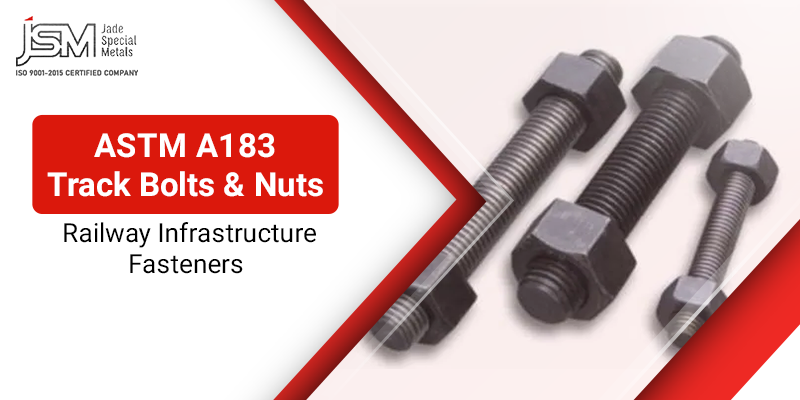
ASTM A183 track bolts are special carbon steel bolts that are used in railways to firmly hold two rails together with the help of joint bars or fish plates. These bolts are very important in ensuring that the track remains on track, structurally stable, and evenly distributed when the train is in motion. They are produced to meet standards of ASTM A183 and provide consistency of mechanical performance, dimensional accuracy and reliability when in arduous railway environments. These fasteners are normally provided with complementary nuts and run in Grade 1 and Grade 2 with each grade having varying strengths depending on the type of rail work they are to be used on, i.e. light duty or heavy load. The fact that they are uniform in design means that they are necessities in contemporary railway infrastructure.
What is ASTM A183 Standard?
ASTM A183 is a common standard that specifies the needs of carbon steel track bolts and nuts to be used in railways. The standard information addresses key areas like material composition, mechanical characteristics, manufacturing processes, and dimensional tolerances to provide consistent performance during heavy loads and dynamic conditions. Such fasteners are mainly used in railroad track systems, where they are used to hold rails in place on a joint bar (fish plates) and keep them straight. With ASTM A183, manufacturers can guarantee that track bolts are strong and durable according to the industry standards. Check out the jade alloys to know more about ASTM standards of industrial fasteners for more information on related specifications.
What Are ASTM A183 Track Bolts Used For?
ASTM A183 track bolts are critical fastening materials that are applied to ensure the rail sections are secured, and that the integrity of railway systems is sound. A common railway track bolt is placed by means of joint bars (fish plates) to connect two rail ends and provides correct alignment, and load distribution across the track. These bolts have found extensive application in the joints of the rail, and are used to ensure that the rails do not move in an unstable manner. Besides joint connections, they are important in track alignment systems, which ensure gauge accuracy and that the rail does not move out of place. ASTM A183 bolts are designed to endure high shear and tensile loads and have a high resistance to vibration due to passing trains. Their strong carbon steel construction is a guarantee of reliability in handling loads and this makes them appropriate in both the normal and heavy-duty railway services.
Types of ASTM A183 Track Bolts (Grade 1 vs Grade 2)
ASTM A183 Grade 1 Grade 2 track bolts are categorized according to their mechanical strength and applicability to various load requirements of the railway. Both grades are produced out of carbon steel and either meet ASTM standards, though have different tensile strength and areas of use in the railway infrastructure.
ASTM A183 Grade 1
ASTM A183 Grade 1 track bolts are comparatively less strong than other types and are commonly applied in light-duty rail sections that have moderate load intensity and frequency of traffic. These bolts are applicable on secondary tracks and industrial rail lines and other less demanding rail settings.
ASTM A183 Grade 2
ASTM A183 Grade 2 track bolts offer greater tensile strength which makes it suitable in heavy-loaded railway tracks like mainlines, freight corridors and high-traffic rail networks. They have increased strength, which guarantees increased resistance to stress, vibration, and dynamic loads.
Chemical and Mechanical Properties of ASTM A183 Track Bolts and Nuts
The carbon steel track bolts manufactured according to ASTM A183 are to be utilized in the railway industry on a reliable basis because of controlled composition and strength characteristics. Carbon content is usually between 0.20 percent and 0.55 percent and is used to balance hardness, strength and durability, with such elements as manganese enhancing toughness. Grade 1 bolts, which are to be used in Grade 1, have a tensile strength of about 60-80 ksi (414-552 Mpa) and a minimum yield strength of 36 ksi (248 Mpa ) where Grade 2 bolts have a tensile strength of about 90-120 ksi (621-827 Mpa ).
Why ASTM A183 Fasteners Are Critical in Railway Infrastructure
ASTM A183 fasteners are necessary to ensure the correct track alignment and this directly affects the train safety and derailment risk. They assist in allocating loads equally over rail joints, reducing the concentration of stress, and increasing the life of the tracks. These are fasteners that are resistant to vibration and fatigue due to the constant movement of the train and therefore can be used in the long run. They are very strong and durable and are commonly applied in the metro, freight railways, and high-speed railways.
ASTM A183 vs. Other Railway Fastener Standards
ASTM A183 bolts and nuts are commonly utilized in carbon steel track bolts and nuts and are available with standardized strength and performance to use in the railroads. ASTM A183 is more globally acceptable as compared to the standards used in North American railway engineering practices, which are known as AREMA. In UK-based systems, BS standards are typical, whereas in European railway infrastructure with rigid dimensional criteria, the DIN standards are applied. ASTM A183 stands out for its balance of strength, cost-effectiveness, and compatibility across various railway systems.
Manufacturing Process of Track Bolts
- Hot forging process is used to shape steel at high temperatures for required strength and form
- Heat treatment is performed to improve hardness and durability
- Thread rolling is applied to create threads with better surface finish and fatigue resistance
- Quality testing is conducted, including hardness checks and ultrasonic testing (UT), to ensure standard compliance
Advantages of ASTM A183 Track Bolts & Nuts
Strong Enough to carry a Heavy Load
ASTM A183 track bolts are strong and therefore, they can withstand heavy loads of trains and continuous pressure of the railway systems such as freight and main line tracks.
Easy Fit Standardized Dimensions
These bolts are of standard sizes and are therefore easy to fit and be used in various railways without compatibility problems.
Easy Maintenance and Replacement
ASTM A183 bolts are designed with uniform designs, hence can be easily substituted in the course of maintenance without any special modification.
Cost-Effective Choice
Compared to alloy fasteners they are cheaper and therefore are a good alternative to large railway projects without performance loss.
Good Resistance to Vibration
These bolts are also capable of constant vibration caused by moving trains and they assist in ensuring that rail joints are tight and stable.
Trustworthy in Various Circumstances
ASTM A183 track bolts are efficient in various weather and working conditions so they can be used in all environments of railways.
Conclusion:
ASTM A183 rail track bolts and nuts are crucial in maintaining the safety, stability and efficiency of rail infrastructure. These carbon steel fasteners are designed to be dependable in challenging environments such as attaching rail joints with fish plates and keeping them aligned during the weight of heavy trains. Grade 1 and Grade 2 versions can be used in light-duty and heavy-duty railway applications with similar mechanical performance, uniform dimensions, and vibration and fatigue resistance. ASTM A183 has a good balance of strength and cost-effectiveness when compared to other standards of fasteners used in railways. To achieve high quality standards-compliant fastening, Jade Alloys provides reliable ASTM A183 track bolts that are accurate and reliable to the engineering needs of the world railway.
Frequently Asked Questions
1.What is ASTM A183 standard for track bolts?
ASTM A183 is a standard that specifies requirements for carbon steel track bolts and nuts used in railway applications.
2.What does ASTM A183 mean in railway fasteners?
It means the fasteners meet ASTM specifications for strength, material quality, and performance in railway systems.
3.Is ASTM A183 used for railway track bolts?
Yes, ASTM A183 is commonly used for railway track bolts and nuts to join rail sections securely.
4.What materials are used in ASTM A183 bolts and nuts?
They are made from carbon steel with controlled chemical composition for strength and durability.
5.Why is ASTM A183 important in railway infrastructure?
It ensures safe, strong, and standardized fasteners that maintain rail alignment and handle heavy train loads.