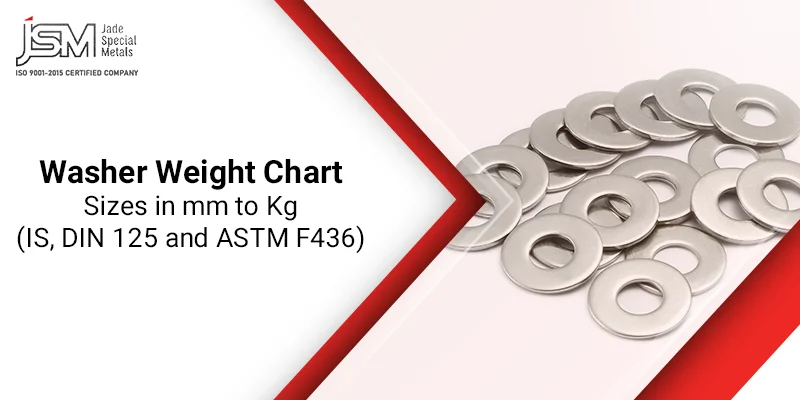
The specific weight of the fastener is an important part of the material estimation, logistics planning and preparing the bill of quantities (BOQ). Procurement departments and engineers can use a trustworthy washer weight chart when calculating loads or structural assembly specifications; this will enable them to accurately convert dimensions to loads. The weight of a washer is greatly influenced by the washer’s specification and not only its nominal bolt size. Different specifications have different O.D., I.D., thickness, hence two washers of same nominal size can have different weights if they have Indian Standards (IS), German Standards (DIN) or American Standards (ASTM).
Knowing about these differences in structure and dimensions helps to avoid unnecessary mistakes in the ordering of materials and project planning. This reference guide categorizes technical data by the applicable standards, such as IS 2016, DIN 125, IS 3063 / DIN 7980 and ASTM F436, so that you can choose and make use of the most appropriate one in your engineering drawing or purchase order. See our full selection of washers available in our main washers product directory.
Why Washer Weight Varies by Standard
It is common to see variations in unit weight when comparing washer weight figures from different international sources. A nominal size designation, such as M12 or 1/2 inch, merely indicates the thread diameter of the bolt the washer is intended to accommodate. It does not dictate a uniform outer profile across all manufacturing specifications.
- Outside Diameter (OD): Standards designed for standard duty distribution (such as DIN 125) utilize different bearing surface areas compared to heavy duty or structural standards (such as ASTM F436). A larger outer diameter increases total volume and weight.
- Inside Diameter (ID) / Clearance: Depending on whether the standard specifies a Form A (without chamfer) or Form B (with chamfer) washer, or calls for tight or loose bolt clearances, the internal cutout dimensions differ subtly.
- Thickness (T): Structural applications demand thicker profiles to withstand severe tightening torques without cupping or yielding. For example, a heavy structural washer can be over twice as thick as a standard commercial plain washer of the same nominal diameter.
How Washer Weight Is Calculated
When working with non standard sizes, custom fabrications, or special alloy grades, you can calculate the estimated weight from first principles using geometric parameters and material density.
A flat plain washer is geometrically an annular cylinder. The mathematical formula to derive the mass of a washer is:
Mass = π/4 × (OD² − ID²) × T × ρ
Where:
- OD = Outside Diameter (in millimetres)
- ID = Inside Diameter (in millimetres)
- T = Thickness (in millimetres)
- ρ (Density) = Material density in grams per cubic centimetre (g/cm³) or kilograms per cubic millimetre (kg/mm³)
Standard Material Densities
- Carbon Steel / Alloy Steel: 7.85 g/cm³ (0.00000785 kg/mm³)
- Austenitic Stainless Steel (304/316): 7.93 g/cm³ (0.00000793 kg/mm³)
- High Nickel Alloys: Varies from 8.19 g/cm³ to 8.89 g/cm³ (Reference ourstainless steel fastener technical documentation for precise grade densities).
To calculate non standard component dimensions instantly, you can also use our online metalweights calculator tool.
Plain (Flat) Washer Weight Chart (IS 2016)
| Nominal Size | Inside Dia (mm) | Outside Dia (mm) | Thickness (mm) | Weight per Piece (g) | Weight per 1,000 Pcs (kg) |
| M3 | 3.2 | 7.0 | 0.5 | 0.12 | 0.12 |
| M4 | 4.3 | 9.0 | 0.8 | 0.31 | 0.31 |
| M5 | 5.3 | 10.0 | 1.0 | 0.44 | 0.44 |
| M6 | 6.6 | 12.5 | 1.6 | 1.12 | 1.12 |
| M8 | 9.0 | 17.0 | 1.6 | 2.05 | 2.05 |
| M10 | 11.0 | 21.0 | 2.0 | 4.14 | 4.14 |
| M12 | 13.5 | 24.0 | 2.5 | 6.05 | 6.05 |
| M14 | 15.5 | 28.0 | 2.5 | 8.39 | 8.39 |
| M16 | 17.5 | 32.0 | 3.0 | 13.20 | 13.20 |
| M18 | 20.0 | 37.0 | 3.0 | 17.90 | 17.90 |
| M20 | 22.0 | 39.0 | 3.0 | 19.10 | 19.10 |
| M22 | 24.0 | 44.0 | 3.0 | 25.10 | 25.10 |
| M24 | 26.0 | 50.0 | 4.0 | 45.00 | 45.00 |
| M27 | 30.0 | 56.0 | 4.0 | 55.10 | 55.10 |
| M30 | 33.0 | 60.0 | 5.0 | 77.20 | 77.20 |
| M33 | 36.0 | 66.0 | 5.0 | 94.20 | 94.20 |
| M36 | 39.0 | 72.0 | 6.0 | 135.00 | 135.00 |
| M42 | 45.0 | 85.0 | 7.0 | 224.00 | 224.00 |
| M48 | 52.0 | 98.0 | 8.0 | 341.00 | 341.00 |
| M56 | 62.0 | 115.0 | 9.0 | 497.00 | 497.00 |
DIN 125 Washer Weight Chart
| Nominal Size | Inside Dia (mm) | Outside Dia (mm) | Thickness (mm) | Weight per Piece (g) | Weight per 1,000 Pcs (kg) |
| M1.6 | 1.7 | 4.0 | 0.3 | 0.02 | 0.02 |
| M2 | 2.2 | 5.0 | 0.3 | 0.04 | 0.04 |
| M2.5 | 2.7 | 6.0 | 0.5 | 0.09 | 0.09 |
| M3 | 3.2 | 7.0 | 0.5 | 0.12 | 0.12 |
| M4 | 4.3 | 9.0 | 0.8 | 0.31 | 0.31 |
| M5 | 5.3 | 10.0 | 1.0 | 0.44 | 0.44 |
| M6 | 6.4 | 12.0 | 1.6 | 1.02 | 1.02 |
| M8 | 8.4 | 16.0 | 1.6 | 1.83 | 1.83 |
| M10 | 10.5 | 20.0 | 2.0 | 3.57 | 3.57 |
| M12 | 13.0 | 24.0 | 2.5 | 6.27 | 6.27 |
| M14 | 15.0 | 28.0 | 2.5 | 8.62 | 8.62 |
| M16 | 17.0 | 30.0 | 3.0 | 11.30 | 11.30 |
| M18 | 19.0 | 34.0 | 3.0 | 14.70 | 14.70 |
| M20 | 21.0 | 37.0 | 3.0 | 17.20 | 17.20 |
| M22 | 23.0 | 39.0 | 3.0 | 18.40 | 18.40 |
| M24 | 25.0 | 44.0 | 4.0 | 32.70 | 32.70 |
| M27 | 28.0 | 50.0 | 4.0 | 42.30 | 42.30 |
| M30 | 31.0 | 56.0 | 4.0 | 53.60 | 53.60 |
| M33 | 34.0 | 60.0 | 5.0 | 75.30 | 75.30 |
| M36 | 37.0 | 66.0 | 5.0 | 91.50 | 91.50 |
| M42 | 43.0 | 78.0 | 7.0 | 182.00 | 182.00 |
| M48 | 50.0 | 92.0 | 8.0 | 294.00 | 294.00 |
| M56 | 58.0 | 105.0 | 9.0 | 425.00 | 425.00 |
| M64 | 66.0 | 115.0 | 9.0 | 510.00 | 510.00 |
| M72 | 74.0 | 125.0 | 10.0 | 670.00 | 670.00 |
| M76 | 78.0 | 135.0 | 10.0 | 780.00 | 780.00 |
Spring Washer Weight Chart
| Nominal Size | Flat Section Weight per 1,000 Pcs (kg) | Square Section Weight per 1,000 Pcs (kg) |
| M4 | 0.16 | 0.18 |
| M5 | 0.36 | 0.40 |
| M6 | 0.80 | 0.90 |
| M8 | 1.60 | 1.80 |
| M10 | 2.80 | 3.10 |
| M12 | 4.40 | 5.00 |
| M14 | 6.60 | 7.20 |
| M16 | 8.90 | 10.20 |
| M18 | 11.50 | 13.00 |
| M20 | 15.20 | 17.50 |
| M22 | 18.50 | 21.00 |
| M24 | 26.00 | 29.50 |
| M27 | 34.00 | 38.00 |
| M30 | 48.00 | 53.00 |
| M36 | 78.00 | 88.00 |
ASTM F436 Structural Washer Weight Chart
| Nominal Size (in) | Inside Dia (in) | Outside Dia (in) | Thickness Range (in) | Weight per Piece (lbs) | Weight per Piece (kg) |
| 1/2 | 0.531 | 1.062 | 0.097 – 0.177 | 0.035 | 0.016 |
| 5/8 | 0.688 | 1.312 | 0.122 – 0.177 | 0.065 | 0.030 |
| 3/4 | 0.812 | 1.468 | 0.122 – 0.177 | 0.088 | 0.040 |
| 7/8 | 0.938 | 1.750 | 0.136 – 0.177 | 0.130 | 0.059 |
| 1 | 1.062 | 2.000 | 0.136 – 0.177 | 0.172 | 0.078 |
| 1 1/8 | 1.188 | 2.250 | 0.136 – 0.177 | 0.223 | 0.101 |
| 1 1/4 | 1.375 | 2.500 | 0.136 – 0.177 | 0.274 | 0.124 |
| 1 3/8 | 1.500 | 2.750 | 0.136 – 0.177 | 0.337 | 0.153 |
| 1 1/2 | 1.625 | 3.000 | 0.136 – 0.177 | 0.407 | 0.185 |
| 1 3/4 | 1.875 | 3.375 | 0.178 – 0.280 | 0.720 | 0.327 |
| 2 | 2.125 | 3.750 | 0.178 – 0.280 | 0.900 | 0.408 |
| 2 1/4 | 2.375 | 4.000 | 0.178 – 0.280 | 1.050 | 0.476 |
| 2 1/2 | 2.625 | 4.500 | 0.178 – 0.280 | 1.380 | 0.626 |
| 3 | 3.125 | 5.500 | 0.178 – 0.280 | 2.150 | 0.975 |
| 3 1/2 | 3.625 | 6.000 | 0.178 – 0.280 | 2.580 | 1.170 |
| 4 | 4.125 | 6.500 | 0.178 – 0.280 | 3.010 | 1.365 |
ASTM F436M Metric Series
| Nominal Size | Inside Dia (mm) | Outside Dia (mm) | Thickness Range (mm) | Weight per Piece (g) | Weight per 1,000 Pcs (kg) |
| M12 | 14.0 | 27.0 | 3.1 – 4.6 | 13.5 | 13.5 |
| M16 | 18.0 | 34.0 | 3.1 – 4.6 | 21.6 | 21.6 |
| M20 | 22.0 | 42.0 | 3.1 – 4.6 | 33.8 | 33.8 |
| M22 | 24.0 | 44.0 | 3.4 – 4.6 | 36.5 | 36.5 |
| M24 | 26.0 | 50.0 | 3.4 – 4.6 | 49.8 | 49.8 |
| M27 | 30.0 | 56.0 | 3.4 – 4.6 | 62.4 | 62.4 |
| M30 | 33.0 | 60.0 | 3.4 – 4.6 | 72.0 | 72.0 |
| M36 | 39.0 | 72.0 | 3.4 – 4.6 | 108.0 | 108.0 |
| M42 | 45.0 | 84.0 | 4.6 – 7.1 | 218.0 | 218.0 |
| M48 | 52.0 | 95.0 | 4.6 – 7.1 | 280.0 | 280.0 |
| M56 | 62.0 | 110.0 | 4.6 – 7.1 | 378.0 | 378.0 |
| M64 | 70.0 | 125.0 | 4.6 – 7.1 | 498.0 | 498.0 |
| M72 | 78.0 | 140.0 | 4.6 – 7.1 | 632.0 | 632.0 |
| M80 | 86.0 | 155.0 | 4.6 – 7.1 | 785.0 | 785.0 |
| M90 | 96.0 | 175.0 | 4.6 – 7.1 | 1010.0 | 1010.0 |
| M100 | 107.0 | 195.0 | 4.6 – 7.1 | 1260.0 | 1260.0 |