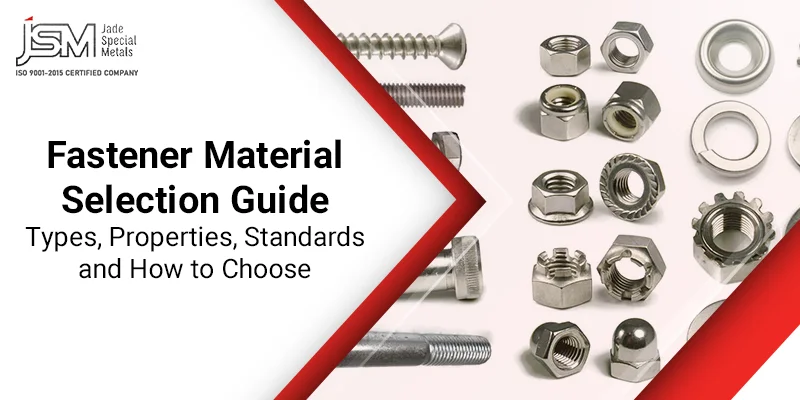
Jade Alloys is asked daily to help specify the right fastener material, since whether a bolt, nut or stud lasts its full service life or fails long before its rated load is reached comes down almost entirely to that one choice. While size and thread pitch are important, the material of which a fastener is composed is the key to its ability to carry load, withstand heat, resist salt water, acids and process chemicals, and endure without the need for replacement.
All the material types are covered, from standard carbon steel to the high performance alloys that are employed in oil & gas, chemical processing, marine and power generation projects, so engineers and procurement teams can quickly navigate to the section of the guide that corresponds with their application, bypassing through the generic hardware advice that ends at basic stainless steel. It begins by comparing side by side the various carbon steel, alloy steel and stainless grades, then progresses to duplex and super duplex steel, the nickel alloy family and ends with the standards that govern each of these materials and a practical approach to selecting between them.
Fastener Material Comparison Table
| Material | Relative Strength | Corrosion Resistance | Max Service Temperature | Typical Use Case |
| Carbon Steel (Grade 2) | Low to Moderate | Low, needs coating | Up to 200°C | General construction, low corrosion indoor assemblies |
| Alloy Steel (ASTM A193 B7) | High | Low, needs coating | Up to 400°C tempered | High pressure piping, valves, flanges |
| Stainless Steel 304 | Moderate | Good | Up to 550°C | Food processing, mild chemical exposure |
| Stainless Steel 316 | Moderate | Very Good, chloride resistant | Up to 550°C | Marine hardware, pharma, chemical processing |
| Duplex 2205 | High | Excellent, chloride stress corrosion resistant | Up to 300°C continuous | Offshore structures, desalination, chemical tanks |
| Super Duplex 2507 | Very High | Superior, highest resistance in the stainless family | Up to 300°C continuous | Subsea equipment, high chloride offshore service |
| Monel 400 | Moderate to High | Excellent in seawater and hydrofluoric acid | Up to 480°C | Marine hardware, chemical processing valves |
| Inconel 625 | High | Outstanding across oxidizing and reducing acids | Up to 980°C | Aerospace, exhaust systems, high temperature process piping |
| Hastelloy C276 | Moderate to High | Outstanding across a wide range of corrosives | Up to 550°C service | Flue gas desulfurization, pollution control equipment |
| Incoloy 825 | Moderate | Excellent against sulfuric and phosphoric acid | Up to 550°C | Acid production, waste treatment plants |
| Titanium Grade 5 | High | Excellent in seawater and oxidizing acids | Up to 400°C | Aerospace, marine, medical equipment |
| Aluminum (6061 / 7075) | Low to Moderate | Good, self passivating | Up to 150°C | Aerospace panels, lightweight low load assemblies |
| Brass and Bronze | Low | Very Good, marine and non-sparking | Up to 200°C | Marine hardware, electrical connectors |
Carbon Steel and Alloy Steel Fasteners
Carbon steel is the starting point for most fastener specifications and the least expensive option by volume. Grade 2 covers general purpose, low strength applications with no head marking required. Grade 5 and Grade 8 are quenched and tempered for higher strength automotive and structural use, identified by three and six radial lines on the bolt head respectively.
Alloy steel raises strength further by adding chromium, molybdenum or nickel to the base steel and heat treating it to a higher hardness. The most common industrial specification is ASTM A193 grade B7, used across high pressure piping, valves and flanged connections, typically paired with A194 grade 2H nuts. Neither carbon steel nor alloy steel offers meaningful corrosion resistance on its own, so both are usually specified with a plating or coating, or reserved for indoor and low corrosion environments. Jade Alloys supplies both families across the full range of carbon steel fasteners and alloy steel fasteners.
Stainless Steel Fasteners: 304, 316, Duplex and Super Duplex
Austenitic stainless steel fasteners such as 304 and 316 are the default choice once corrosion resistance becomes a requirement. 304 covers general indoor and mild outdoor exposure, while 316 adds molybdenum for meaningfully better resistance to chlorides, making it the standard choice for coastal and marine hardware and most chemical processing equipment. Neither grade can be hardened by heat treatment, so their mechanical strength sits below hardened alloy steel even though their corrosion performance is far superior.
Duplex and super duplex stainless steel close that strength gap while pushing corrosion resistance further still. Duplex 2205 fasteners combine a mixed austenitic and ferritic microstructure that resists chloride stress corrosion cracking far better than 316, at roughly double the yield strength. Super duplex 2507 fasteners go further again, and are the standard specification for subsea equipment and the most aggressive high chloride offshore environments where even duplex 2205 is not considered sufficient.
High Performance Nickel Alloy Fasteners
Once an application moves beyond what stainless and duplex steel can reliably handle, whether from extreme temperature, highly aggressive chemicals or a combination of both, the nickel alloy family is where specifications typically move next.
- Inconel 625 fasteners combine high strength with outstanding resistance across both oxidizing and reducing acids, and retain useful mechanical properties at service temperatures up to roughly 980C, making them a common choice for exhaust systems, gas turbines and high temperature process piping.
- Hastelloy C276 fasteners are specified where the corrosive medium is unpredictable or aggressively mixed, since C276 resists a wider range of oxidizing and reducing chemicals, including wet chlorine and chlorinated solvents, than almost any other commercially available alloy. This makes it a standard choice for flue gas desulfurization and pollution control equipment.
- Monel 400 fasteners pair strong mechanical properties with excellent resistance to seawater and hydrofluoric acid specifically, which is why Monel remains the preferred material for marine hardware and certain chemical processing valves even where other nickel alloys are technically available.
- Incoloy 825 fasteners are built around resistance to sulfuric and phosphoric acid in particular, making them a common specification in acid production and waste treatment plants where 316 stainless would corrode too quickly to be economical.
For a deeper look at how these four alloys compare on composition and where each is specified, see the guide to nickel alloys in extreme industrial applications.
Fastener Coatings
Coatings extend the service life of carbon and alloy steel fasteners that would otherwise corrode quickly in outdoor or humid environments. Zinc plating provides basic sacrificial protection at low cost, hot dip galvanizing gives a thicker, more durable coating suited to harsh outdoor and coastal exposure, and chrome plating is used mainly where a polished, decorative finish is required alongside moderate wear resistance. For a full breakdown of when to specify each coating, see the guide to types of fastener coatings.
How to Choose the Right Fastener Material
Five factors decide which material family is appropriate for a given application. Working through them in order narrows the shortlist quickly.
| Factor | What to Check | Material Implication |
| Mechanical load | Tensile, shear and fatigue loads the fastener must carry over its service life | Higher loads point toward alloy steel, duplex or super duplex rather than plain carbon steel or 304 stainless |
| Corrosive exposure | Saltwater, industrial chemicals, acids or process fluids the fastener will contact | Chloride exposure favors 316, duplex or super duplex; strong acids favor Hastelloy or Incoloy |
| Operating temperature | Continuous and peak service temperature, including startup and shutdown extremes | Sustained high heat favors Inconel; sub zero service needs A320 low temperature carbon or alloy steel |
| Galvanic compatibility | Which metals the fastener will directly contact in the assembly | Mismatched metals accelerate corrosion of the less noble material, see the section below |
| Cost and lifecycle | Upfront material cost against expected maintenance, downtime and replacement cost | A higher cost alloy can be cheaper over the asset’s life if it avoids repeat replacement |
Frequently Asked Questions
1. What is the most common fastener material?
2. Which fastener material is best for corrosion resistance?
3. What is the difference between Inconel and Hastelloy fasteners?
4. Can stainless steel and carbon steel fasteners be used together?
5. What fastener material is used for high temperature applications?
6. What is the strongest fastener material?
7. How do I choose between duplex and super duplex fasteners?
7. What thread standards do A2-70 and Grade 8.8 bolts share?