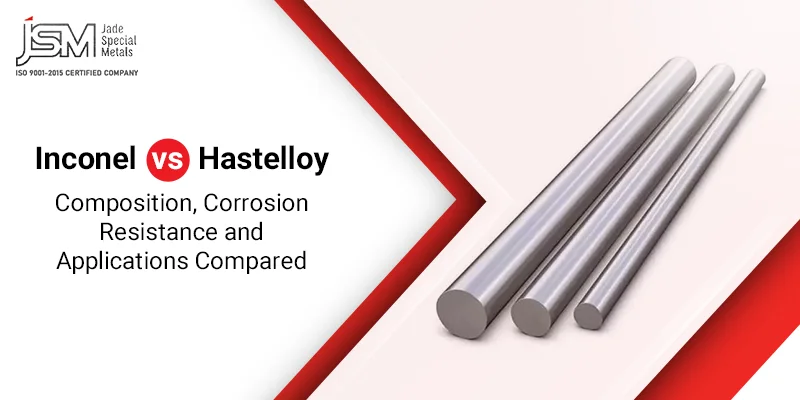
Engineers and purchasing department staff frequently seek assistance from Jade Alloys when it comes to explaining the similarities and differences between the two most popular superalloys, Inconel and Hastelloy. Although both families comprise nickel-based alloys, their actual behavior in real-world conditions may differ. The most important aspect is the differences in the composition. Inconel, which contains higher amounts of chromium, creates a stable layer of oxide that is suitable for use in oxidising conditions and environments containing chlorides, while Hastelloy, which has higher molybdenum content, performs better in acidic and reducing environments. Hence, the knowledge of this single factor makes it possible to initially choose between the two families and then to select the appropriate grade of metal in either family.
What Is Inconel?
Inconel is a commercial name referring to a range of nickel-chromium base alloys invented to withstand high temperatures and oxidation. When it reaches the required temperature, Inconel generates a thick stable layer of oxides that prevents further corrosive influences on the material itself, which allows the Inconel alloys to work successfully in oxidizing environments. Depending on the Inconel brand, its strength will be due to either solid solution strengthening or precipitation hardening – so it ranges from Inconel 600 applied in a variety of purposes to Inconel 718 and Inconel X 750 which provide a high level of strength since they undergo precipitation hardening. Jade Alloys stocks and exports Inconel products in the form of rods, sheets, and tubes.
What Is Hastelloy?
Hastelloy is a registered trade name covering a family of nickel chromium molybdenum alloys developed specifically for resistance to strongly acidic and reducing chemical environments. Where Inconel leans on chromium for its protective oxide layer, Hastelloy leans on molybdenum, which is what gives the family its particular strength in sulphuric acid, hydrochloric acid and other reducing media that would otherwise attack chromium-rich alloys. Hastelloy is strengthened almost entirely through solid solution strengthening rather than precipitation hardening, which gives the family good ductility and reliable weldability even after prolonged exposure to heat. The range includes general corrosion-resistant grades such as Hastelloy C276 and Hastelloy C22, the high molybdenum grade Hastelloy B2 built for reducing acids, and the high-temperature grade Hastelloy X. Jade Alloys supplies Hastelloy in round bars, sheets and plates, and pipes and tubes across the commercially significant grades.
Inconel vs Hastelloy Composition
Composition is where the practical difference between Inconel and Hastelloy actually starts. The tables below set out the chemistry of four commercially significant grades from each family, with chromium, molybdenum, iron, niobium, cobalt and titanium content shown in particular, since these are the elements that drive the behaviour differences covered in the corrosion resistance section below.
| Grade | Nickel | Chromium | Molybdenum | Iron | Niobium | Titanium |
| Inconel 600 | 72.0 min | 14.0 to 17.0 | – | 6.0 to 10.0 | – | – |
| Inconel 625 | 58.0 min | 20.0 to 23.0 | 8.0 to 10.0 | 5.0 max | 3.15 to 4.15 | 0.40 max |
| Inconel 718 | 50.0 to 55.0 | 17.0 to 21.0 | 2.8 to 3.3 | Balance | 4.75 to 5.5 | 0.65 to 1.15 |
| Inconel X 750 | 70.0 min | 14.0 to 17.0 | – | 5.0 to 9.0 | 0.70 to 1.20 | 2.25 to 2.75 |
All figures are weight percent, typical specification ranges.
| Grade | Nickel | Chromium | Molybdenum | Iron | Tungsten | Cobalt |
| Hastelloy C276 | Balance | 14.5 to 16.5 | 15.0 to 17.0 | 4.0 to 7.0 | 3.0 to 4.5 | 2.5 max |
| Hastelloy C22 | Balance | 20.0 to 22.5 | 12.5 to 14.5 | 2.0 to 6.0 | 2.5 to 3.5 | 2.5 max |
| Hastelloy X | Balance | 20.5 to 23.0 | 8.0 to 10.0 | 17.0 to 20.0 | 0.20 to 1.0 | 0.5 to 2.5 |
| Hastelloy B2 | Balance | 1.0 max | 26.0 to 30.0 | 2.0 max | – | 1.0 max |
Hastelloy X carries meaningful iron content, roughly 17 to 20 percent, and only a very small titanium addition, up to about 0.15 percent maximum. These two figures are sometimes shown the wrong way round on composition charts published elsewhere, so it is worth checking this particular row against a current mill certificate before ordering.
High Performance Nickel Alloy Fasteners
Once an application moves beyond what stainless and duplex steel can reliably handle, whether from extreme temperature, highly aggressive chemicals or a combination of both, the nickel alloy family is where specifications typically move next.
- Inconel 625 fasteners combine high strength with outstanding resistance across both oxidizing and reducing acids, and retain useful mechanical properties at service temperatures up to roughly 980C, making them a common choice for exhaust systems, gas turbines and high temperature process piping.
- Hastelloy C276 fasteners are specified where the corrosive medium is unpredictable or aggressively mixed, since C276 resists a wider range of oxidizing and reducing chemicals, including wet chlorine and chlorinated solvents, than almost any other commercially available alloy. This makes it a standard choice for flue gas desulfurization and pollution control equipment.
- Monel 400 fasteners pair strong mechanical properties with excellent resistance to seawater and hydrofluoric acid specifically, which is why Monel remains the preferred material for marine hardware and certain chemical processing valves even where other nickel alloys are technically available.
- Incoloy 825 fasteners are built around resistance to sulfuric and phosphoric acid in particular, making them a common specification in acid production and waste treatment plants where 316 stainless would corrode too quickly to be economical.
For a deeper look at how these four alloys compare on composition and where each is specified, see the guide to nickel alloys in extreme industrial applications.
Hastelloy vs Inconel corrosion resistance
| Aspect | Inconel | Hastelloy |
| Key alloying element | Higher chromium content | Higher molybdenum content |
| Mechanism | Forms a dense, adherent oxide layer that resists attack in oxidising conditions | Molybdenum performs poorly in oxidising conditions but excels in acidic and reducing environments |
| Best suited environment | Oxidising conditions | Acidic and reducing environments |
| Typical applications | Marine and offshore environments; seawater and brine handling equipment; oxidising acid duty; aerospace exhaust systems with hot oxidising gases | Sulphuric acid, hydrochloric acid, phosphoric acid and other reducing duty in chemical processing and pharmaceutical manufacturing; sour gas service (hydrogen sulphide and chlorides) |
| Notable grade | Inconel 625, resistant to pitting, crevice corrosion and chloride stress corrosion cracking | Hastelloy C276, standard choice for reducing acid duty |
| General selection rule | Stronger starting point when environment is primarily oxidising, chloride rich or marine | Stronger starting point when environment is primarily acidic or reducing |
| Need help choosing between Inconel and Hastelloy for your projectJade Alloys’ technical sales team can review your operating environment, temperature and pressure and recommend the right alloy and grade.Contact us for a quotation |
Hastelloy vs Inconel Mechanical Strength Comparison
Strength tells a different part of the story to corrosion resistance, and the two families overlap more here than they diverge. The table below sets out typical minimum tensile strength, yield strength, elongation, density and melting range for the same eight grades, in the solution annealed condition unless noted otherwise. Inconel 718 and Inconel X 750 are shown in the solution treated and aged condition, since that is how they are normally supplied and how their strength is normally quoted.
| Grade | Tensile Strength Min, MPa | Yield Strength Min, MPa | Elongation Min, Percent | Density, g per cc | Melting Range, C |
| Inconel 600 | 550 | 240 | 30 | 8.47 | 1354 to 1413 |
| Inconel 625 | 827 | 414 | 30 | 8.44 | 1290 to 1350 |
| Inconel 718* | 1275 | 1030 | 12 | 8.19 | 1260 to 1336 |
| Inconel X 750* | 1035 | 690 | 20 | 8.28 | 1393 to 1427 |
| Hastelloy C276 | 690 | 283 | 40 | 8.89 | 1325 to 1370 |
| Hastelloy C22 | 690 | 283 | 45 | 8.69 | 1357 to 1399 |
| Hastelloy X | 655 | 240 | 30 | 8.22 | 1260 to 1355 |
| Hastelloy B2 | 760 | 350 | 40 | 9.22 | 1330 to 1380 |
Inconel 718 and Inconel X 750 stand out from the rest of the table by a wide margin because both are precipitation hardened, gaining their strength from a controlled ageing heat treatment rather than from solid solution alone. Among the solid solution strengthened grades, tensile and yield figures across both families sit reasonably close together, which is why corrosion resistance rather than raw strength is usually the deciding factor between Inconel and Hastelloy for a given application.
High Temperature Performance
Both families are genuinely high temperature materials, but the practical temperature limit depends on what the component actually has to do. For pure oxidation resistance in a static or lightly loaded part, Inconel and Hastelloy X can both be used at temperatures approaching 1150 to 1200 degrees Celsius. For load bearing components that must retain meaningful strength under stress, the practical working limit is considerably lower for both families, typically in the region of 700 to 850 degrees Celsius depending on grade and the margin of safety required. Hastelloy X is particularly well regarded for combining good oxidation resistance with dimensional stability at temperature, which is why it remains a common choice for gas turbine combustion cans and furnace components. Inconel 625 and Inconel 718 are more often selected where high strength at moderate to high temperature, rather than the very top of the temperature range, is the priority.
Weldability and Fabrication
Both Inconel and Hastelloy weld readily using standard processes including tungsten inert gas welding, metal inert gas welding and shielded metal arc welding, and both can be cold formed and machined using conventional equipment and tooling. Hastelloy’s solid solution strengthening gives it a slight practical edge in fabrication heavy work, since there is no risk of an ageing response during welding or forming, and the metal remains ductile and forgiving through repeated operations. Inconel’s precipitation hardened grades, particularly Inconel 718 and Inconel X 750, need a defined heat treatment schedule after welding or forming to restore full strength, which adds a process step but is well understood and routinely carried out. Machining both families requires rigid setups, sharp tooling and slower cutting speeds than carbon or stainless steel, since strain hardening during cutting is a known characteristic of both alloy groups.
Inconel vs. Hastelloy applications
The overlap in composition between Inconel and Hastelloy carries through into overlapping, but not identical, use across industry. The table below sets out where each family is more commonly specified.
| Industry | Typical Inconel Use | Typical Hastelloy Use |
| Aerospace | Exhaust systems, engine ducting, fasteners | Combustor cans, afterburners, seals |
| Oil and Gas | Flare stacks, subsea equipment, sour service piping | Downhole tools, sour gas wellheads, valves |
| Marine | Propeller shafts, seawater piping, fasteners | Marine chemical handling equipment |
| Chemical Processing | Oxidising acid duty, chloride handling equipment | Sulphuric and hydrochloric acid piping, reactors |
| Power Generation | Gas turbine components, heat exchangers | Flue gas desulphurisation equipment |
| Pharmaceutical | General process piping | Reactors, buffer tanks, active ingredient handling |
Cost and Availability
Hastelloy generally carries a higher raw material cost than most Inconel grades, largely because of its higher molybdenum content, molybdenum being a more expensive alloying element than chromium on a like-for-like basis. Inconel’s wider grade range, from general purpose grades such as Inconel 600 through to high strength precipitation hardened grades such as Inconel 718, also means there is usually an Inconel option available closer to a project’s exact requirement without over-specifying. That said, the gap in price between the two families is rarely large enough on its own to override a genuine corrosion resistance requirement, and choosing the cheaper alloy for an environment it is not suited to nearly always costs more in the long run through early failure, unplanned shutdowns, and replacement.
Which One Should You Choose
As a starting point for most projects, work through three questions. Is the environment mainly oxidising or mainly reducing? Chloride-rich, oxidising or marine conditions point towards Inconel, while acidic or reducing conditions point towards Hastelloy. Is very high strength at moderate temperature the priority? If so, Inconel 718 or Inconel X 750 are worth a closer look ahead of any Hastelloy grade. Is the component exposed to sour gas or a mixture of acids? Hastelloy C276 or Hastelloy C22 are usually the stronger starting point here. These three questions will not replace a proper materials review for a critical application, but they are enough to narrow the field before specifying a final grade.
| Source Inconel and Hastelloy from a single supplierJade Alloys manufactures and exports Inconel and Hastelloy round bars, sheets, plates, pipes and tubes to ASTM, ASME and equivalent international standards, with full mill test certification on every order.Browse our catalogue or contact our team |
Grade Equivalents, Inconel and Hastelloy
The table below gives the UNS number and Werkstoff number for each grade covered in this guide, useful when cross-checking a specification written to a different standard.
| Grade | UNS Number | Werkstoff Number |
| Inconel 600 | N06600 | 2.4816 |
| Inconel 625 | N06625 | 2.4856 |
| Inconel 718 | N07718 | 2.4668 |
| Inconel X 750 | N07750 | 2.4669 |
| Hastelloy C276 | N10276 | 2.4819 |
| Hastelloy C22 | N06022 | 2.4602 |
| Hastelloy X | N06002 | 2.4665 |
| Hastelloy B2 | N10665 | 2.4617 |
Frequently Asked Questions
1. Is Hastelloy better than Inconel?
2. What is the main difference between Inconel and Hastelloy?
3. Can Inconel and Hastelloy be welded together?
4. Which is more expensive, Inconel or Hastelloy?
5. What is the difference between Inconel 625 and Hastelloy C276?
6. Which alloy is better for sour gas service?
7. Does Hastelloy or Inconel have a higher maximum service temperature?
About Jade Alloys
Jade Alloys is a Mumbai based manufacturer and exporter of industrial fasteners and high performance alloy products, supplying Inconel, Hastelloy, Monel and other nickel based alloys in round bars, sheets, plates, pipes and tubes to customers across the oil and gas, chemical processing, power generation, marine and aerospace sectors worldwide. Every order is supplied with full mill test certification and is manufactured to the relevant ASTM, ASME and equivalent international standards. Contact our technical sales team to discuss your requirements.